

- The History of the Royal-Society of London 1667.
- The natural history of animals 1702
- The natural history of Northampton-Shire.
- The Natural History of Oxford-Shire
- A Philosophical Language by John Wilkins
- The natural history of Stafford-shire 1686
- The natural history of Lancashire
The History of the Royal-Society of London 1667.

946J Thomas Sprat
The History of the Royal-Society of London, For the Improving of Natural Knowledge.
London : printed by T[homas]. R[oycroft]. for J. Martyn at the Bell without Temple-bar, and J. Allestry at the Rose and Crown in Duck-lane, printers to the Royal Society, MDCLXVII. [1667] Price $4,300
Quarto 4to (9 1/4 x 7 in.; 235 x 178).Signatures: [π] A-B⁴ A-Z⁴ Aa-Zz⁴Aaa-Iii⁴. (errata) First issue with “of” repeated on p.85 lines 6/7. This copy has the very rare frontispiece by Hollar Imprimatur leaf A1 with engraved arms of the Royal Society on the verso, engraved allegorical frontispiece by Wencelaus Hollar depicting the crowning of a bust of Charles II flanked by mathematician Lord Viscount William Brouncker and Sir Francis Bacon , missing in many copies. The edition of this work by Jackson I. Cope and Harold Whitemore Jones (1958, p.ix) speaks of large-paper copies, which had a frontispiece by Wenceslaus Hollar showing a bust of Charles II. It is presumed that all copies have the illustration of the Royal Society coat of arms on the half-title verso plus the two diagrammatic plates. The Huntington copy with the Charles II plate is no different in other respects. This copy is bound in original full calf with expert rebacking.

This book is a wonderful read, the experiments and observations are highly expansive, From Weather to Moons of Jupiter, The Clochester-Oyster farms, The recoils of guns .

A foundational charter of the Scientific Revolution.

Thomas Sprat’s History of the Royal-Society (1667) is the first official institutional manifesto of the Royal Society of London, issued only seven years after the Society received its royal charter and at the very moment when the “new science” was defining itself against scholastic and humanist traditions. Commissioned by the Fellows and written by one of its earliest members, it sets out—systematically and programmatically—the Society’s aims, methods, and philosophical commitments: empiricism, experiment, collective observation, plain style, mechanical explanations of nature, and a conscious break with the authority-based learning of the past. Sprat codifies what would soon be known as the “Baconian programme,” presenting the Society as the practical realization of Francis Bacon’s call for a cooperative, experiment-driven natural philosophy.
The book is equally important as a work of self-fashioning. Sprat defends the Society from critics, argues for the moral and political usefulness of experimental knowledge, and articulates its distinctive linguistic ideal—anti-rhetorical, stripped of ornament, trustworthy because transparent—which would shape English scientific prose for generations. The work is also one of the earliest published accounts of the laboratories, instruments, and experimental procedures of the founding Fellows—Boyle, Hooke, Wilkins, Wren, Wallis—making it a primary historical source for the early development of chemistry, microscopy, physiology, and mechanical philosophy.
The rare Wenceslaus Hollar frontispiece, present in this copy, is itself a visual statement of the Society’s identity: a temple of experimental knowledge flanked by scientific instruments and crowned by the Royal arms, asserting the cultural legitimacy and public mission of the new science. Many early copies lack it, making its presence a notable point of completeness.

Sprat’s History stands today as the first systematic exposition of the ethos that would dominate Enlightenment science: cooperative research, methodological skepticism, precise reporting, and the disciplined accumulation of empirical facts. It is, quite literally, the book that taught Europe how to recognize—and trust—the new experimental philosophy.
ESTC R16577; Wing S5032; Norman 1989; Keynes, Evelyn 178; Hooke 28
The Cope & Jones edition (1958)

)(
The natural history of animals 1702

978J. [Académie royale des sciences] Claude Perrault (1613-1688)
The natural history of animals containing the anatomical description of several creatures dissected by the Royal Academy of Sciences at Paris. Wherein The Construction, Fabrick and genuine Use of the Parts, are exactly and finely delineated in Copper Plates, and the whole Enriched with many Curious Physical and no less useful Anatomical Remarks, being one of the most Considerable Productions of that Academy. Done into English by a Fellow of the Royal Society. To which is added an account of the measure of a degree of a great circle of the earth, Published by the Members of the same Academy: English’d by R.W. Srs. With an alphabetical table of the Names of the several Animals mention’d in this Volume. And likewise an Alphabetical Index to make the Work Compleat. Publish’d by an Order of Council of the Royal Society.
London : printed for R. Smith, at the Angel and Bible without Temple Barr, 1702. Price $5,500

Folio 297 x 200 mm Signatures: [π4, a2, b3, A3, B-Z4, Aa-Ii4, Kk-Nn2; [-π]2, B-F4 . Frontispiece and 35 copper engraved plates, an Engraved additional title is in Some copies have and a one sided letterpress title for the second part, these were not and never were added to this copy The text is continuous The Measure of the Earth ,is otherwise all here. The plates each contain a general and several partial views of various animals after their dissection by the Royal Academy of Paris, of which Perrault was a member. – The last third of the work with an extensive contribution by the astronomer John Picard (1620-82) on the measurement of the Earth, illustrated with 5 excellently etched plates. – This is truly a beautiful copy!


Provenance: 1. Library of the Earls of Hopetoun., with their heraldic lithographic bookplate on the front pastedown. 2. Modern printed bookplate with the monogram “DP” and three rodents, also mounted on the front pastedown. The book block partly cracked at the front hinge. Endpapers with glue stains and various short, older handwritten entries, first and last pages slightly browned throughout. Discreetly trimmed, retaining a sufficient white margin. Foxing along the edges, otherwise a well-preserved copy with strong printing and blurred etched plates on mostly pure white paper.


Translated by Alexander Pitfield from the French work by Claude Perrault, first published in 1669 under the title: ‘Description anatomique d’un caméleon’, and later (in 1682) under the title: ‘Description anatomique de divers animaux.’ The ‘Account’ was translated by Richard Waller.

Perrault (1613–1688) was an architect and anatomist, an active contributor to the Académie des Sciences. The second part is by Picard (1620–1682), the first person to measure the size of the Earth with a reasonable degree of accuracy.

Perrault’s philosophy of medicine sprung from Galen, Greek physician of the Roman era, who understood biology in terms of the four humors (i.e., black bile, yellow bile, phlegm, and blood). As the Age of Enlightenment saw the development of animal and plant classification systems, believers in a mechanistic theory of animal function, like Perrault and Buffon resisted. In mechanism, living things are thought to be akin to complicated machines, containing parts that lack any intrinsic relationship to one another. Although Galenism and mechanism kept Perrault from make significant contributions to modern biology, his work maintains its own inherent scientific value, given the parameters of his philosophies, and also serves to document the steps and missteps along the way to a better understanding of biology.


ESTC No.: T113853


Short Link: https://wp.me/p3kzOR-9t0

)-(
The natural history of Northampton-Shire.

971J Morton, John, 1671?-1726.
The natural history of Northampton-Shire; with some account of the antiquities. To which is annex’d a transcript of Doomsday-Book, so far as it relates to that county. By John Morton M. A. Rector of Oxendon in the same County, and Fellow of the Royal Society: Formerly of Emanuel-College in Cambridge.
London : printed for R. Knaplock, and R. Wilkin at the King’s-Head, in St. Paul’s Church-Yard, MDCCXII. [1712] Price $4,500

Folio35 x 22 cm. Signatures: Signatures: A2,(a)2,B-Z2,Aa-Zz2, Aaa-Zzz2, Aaaa-Zaaa2,Aaaaa-Zzzzz2,Aaaaaa-Zzzzzz2, Aaaaaaa2 (a)-(o)2 14plates & map. Bound in contemporary paneled calf and repacked later morocco with decoratively blind-embossed calf boards raised bands gilt decoration and lettering on spine all edges red speckled, bookplate and small stamps for the Law Society armorial bookplate for :

“St. John Percivale Baronet of Burton in the County of Cork in Ireland” on verso of title-page. John Perceval, 1st Earl of Egmont (1683‒1748), represents an early interest among Ireland’s aristocracy in creating better living conditions for people in British prisons. Perceval worked closely with James Oglethorpe on this issue, ultimately helping to establish the American colony of Georgia in 1732 as a haven for English subjects who had been imprisoned for debt. In 1700 he undertook a carefully planned tour of England, and in 1701 he was elected a fellow of the Royal Society.
There is some minor spotting to end-papers slight marginal browning not affecting text, small tear in centre fold of map repaired. This is an extremely rare item in fine condition internally. First edition of Morton’s systematic natural history of Northamptonshire. Compiled over the course of a decade, Morton’s Natural History provides a careful account of the natural history, minerals, fossils, and geography of the county, accompanied by fourteen large copper-engravings. Though he limited his research strictly to Northamptonshire, Morton built on correspondence with Ray, Sloane, Nicolson, and others, subsequently gave nearly one thousand of his specimens to Sloane.
This book also includes a transcript of the Northamptonshire entries from Domesday Book, William the Conqueror’s great survey of England completed in 1086. At the time Morton published his work, Domesday Book remained an archival manuscript known chiefly through limited antiquarian extracts and private transcripts; the first official printed edition would not appear until 1783. Morton therefore provided readers with unusually direct access to one of the foundational documents of English history, extending his account of Northamptonshire from contemporary observation back to the Norman Conquest itself.
Hanson, 1550; ESTC T147393, https://datb.cerl.org/estc/T147393


Short Link:
0-0
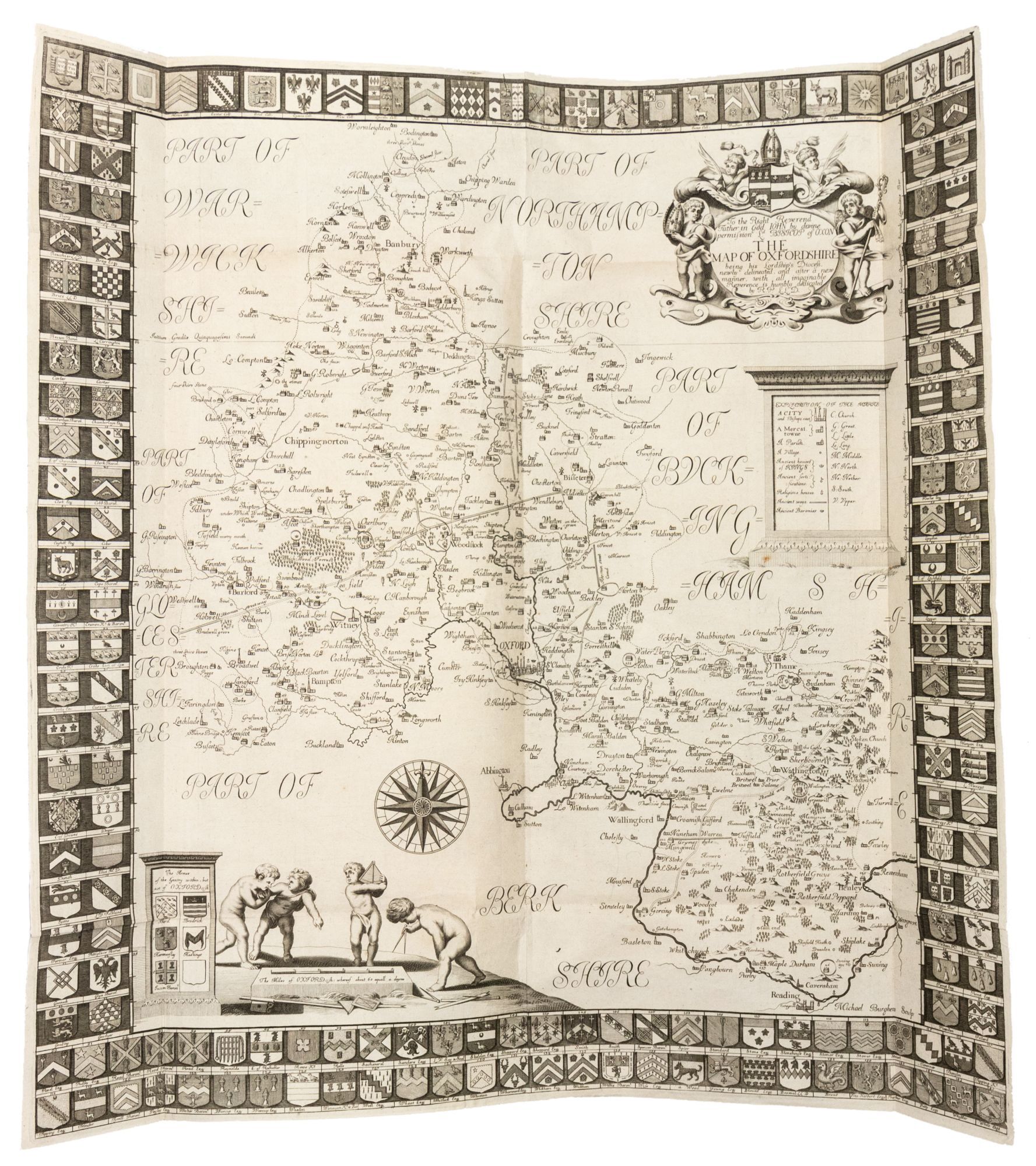
The Natural History of Oxford-Shire


The natural history of Oxford-shire, being an essay toward the natural history of England. By R.P. LL.D.
Printed at the Theater in Oxford : and are to be had there: And in London at Mr. S. Millers, at the Star near the West-end of St. Pauls Church-yard, 1677. Price $6,000
Folio 32 x 20cm. Signatures: [a]² b⁴ A-2Y⁴ 2Z-3A² 3B². (Lacking final blank) 16 plates (including unnumbered map) : NotesR.P. = Robert Plot. At foot of title page: The price in sheets at the press, nine shillings. To subscribers, eight shillings. With an initial imprimatur leaf and a final leaf of errata (on 2Y4r).

FIRST EDITION. Illustrated with a large folding map of Oxfordshire and sixteen full-page engravings—fossils, minerals, plants, the remarkable Enstone waterworks, and other curiosities—engraved by Michael Burghers.
Of all late 17th-century English naturalists, few embody the restless, accumulative curiosity of the Baconian program as fully as Robert Plot. His Natural History of Oxford-shire (1677) is not simply a regional survey, but a working demonstration of how knowledge was to be gathered in the age of Francis Bacon: by collecting, observing, recording—without yet knowing what would prove significant.
Plot’s project begins in 1674 with an itinerary consciously expanding the antiquarian tradition. Where earlier surveyors catalogued manuscripts and monuments, Plot sought “all curiosities both of art and nature.” Within a year he had assembled a cabinet of minerals impressive enough to exhibit before the Royal Society; the book followed in 1677, securing his election as Fellow the same year.
The work proceeds not systematically, but inquisitively: from meteorological anomalies to echoes, mineral waters, soils, erosion (“deterration”), and finally to “formed stones”—fossils. Plot recognized stratification in embryonic form, describing the earth at Shotover Hill as composed of “several folds… including one another,” yet he stopped short of grasping the full geological implications. Like many contemporaries, he explained fossils as mineral crystallizations mimicking organic forms.

And yet—precisely in this mixture of accuracy and error—the book becomes historically decisive.
Among the engraved plates is the first published illustration of what we now recognize as a dinosaur fossil: a large femur from the Stonesfield quarry. Plot identified it cautiously, comparing it to an elephant bone in the Ashmolean collection, though later writers would elevate it to the remains of a giant. Only in the 19th century did Richard Owen, working with Megalosaurus, Iguanodon, and Hylaeosaurus, define the group we call Dinosauria—retrospectively giving Plot’s image its extraordinary significance.

Plot’s natural history is thus not important despite its errors, but because of them. His emphasis on anomalies, exceptions, and the curious—what later critics called a “bizarre” or even “teratological” tendency—reflects a Baconian conviction that knowledge advances most rapidly at the margins of the known.
Equally important is the book’s practical dimension. Scattered throughout are detailed observations on agriculture, mining, and local industry, part of a deliberate effort to disseminate useful knowledge. In this respect, Plot’s work stands alongside the early Philosophical Transactions as an instrument of applied science.
His success as a collector and organizer of such material led directly to his appointment in 1683 as the first keeper of the Ashmolean Museum—arguably the first public museum in England—where the physical accumulation of specimens mirrored the intellectual accumulation represented in this book.

ESTC R7620; Wing P2586; Madan, 3130; Gibson 53. https://datb.cerl.org/estc/R473650


()-()
A philosophical language. By John Wilkins

*980J. John Wilkins (1614-1672)
An essay towards a real character, and a philosophical language. By John Wilkins D.D. Dean of Ripon, and F ellow of the Royal Society
London : printed for Sa: Gellibrand, and for John Martyn printer to the Royal Society, 1668. . Price. $4,900

Folio, 2 parts in one volume, (31 x 19 cm). Signatures: [A]² a-d² B-Z4 Aa-Mm⁴; aaa⁴ ²=Aa-aa-Ttt⁴ (Mmm4 blank). Engraved title vignette, with the armorial device of the Royal Society to title, 4 engraved plates (one folding), 2 large folding tables; license leaf before title. FIRST EDITION (Minor dampstain and wormhole at upper margin of first leaves, small repair to corner of first two leaves, a few other minor stains and edge worming, edge tear on G3 repaired.) Bound in contemporary paneled calf (neatly rebacked, endpapers renewed but original blanks retained, fore-corners repaired. There is a Birkenhead Library mark (rubberstamp on title-page verso); contemporary notes on the work laid in. An excellent copy.

John Wilkins Bishop of Chester was a founder and first Secretary of the Royal Society. He was the author of a number of works including A Discourse Concerning a New Planet in which he used arguments similar to those of Galileo, and Mercury Or, The Secret and Swift Messenger. Philosophical Language, Wilkins s most notable work, was the first comprehensive proposal of a universal language written in English. “Calls for a universal language had increased as a result of the flourishing of vernacular literature and an increasing dissatisfaction with Latin, partly with regard to the difficulty of learning it, but also with regard to its ambiguities and complexities… The vocabulary of this new language was to be built up by systematic modifications of the basic generic terms that were deemed to cover all the major categories of existence. A knowledge of the system would enable the reader, or listener, not just to recognize the signification of a word but also to understand how the referent fitted into the entire scheme of things.” ODNB.

Among of one of the most ambitious intellectual projects of the seventeenth century,Wilkins attempted to construct an entirely new symbolic system in which the structure of language reflected the structure of knowledge itself. Every concept occupied a logical place within an ordered taxonomy of nature, allowing words to express not only meaning but also their relationship to every other object and idea. The engraved tables and dictionary form the practical machinery of this remarkable philosophical language.
Wilkins believed that knowledge could be made universal through systematic classification and unambiguous signs. During the final preparation of the book, the Great Fire of London destroyed his house and many of his papers, yet the work was completed with assistance from fellow natural philosophers including John Ray, Francis Willughby, Samuel Pepys, and Robert Hooke, illustrating the collaborative spirit that characterized the early Royal Society.
Although Wilkins’s universal language was never adopted, the work has acquired a remarkable afterlife. It has become a landmark in the history of linguistics, classification, scientific communication, and information systems, anticipating later discussions of taxonomy, symbolic languages, and semiotics. Modern scholars including Umberto Eco devoted substantial attention to Wilkins as one of the central figures in the centuries-long search for a “perfect language.”
Beyond its importance to the history of linguistics, Wilkins’s Essay stands as one of the earliest attempts to organize all human knowledge into a coherent symbolic system. Its philosophical tables classify the natural world, human society, and abstract concepts into an integrated hierarchy whose symbolic notation was intended to communicate directly across linguistic boundaries. For modern readers the work has become equally significant in the history of classification, bibliography, semiotics, and the organization of information, making it one of the most intellectually influential books produced by the early Royal Society.
Wing W2196, Lowndes 2922., Alston VII 290; ESTC R21115.
-o-
The natural history of Stafford-shire 1686

983J Robert Plot (1640-1696.)
The natural history of Stafford-shire. By Robert Plot. LLD. keeper of the Ashmolean Musæum and professor of chymistry in the University of Oxford·
Oxford : printed at the Theater, anno M.DC.LXXXVI. [1686] Price $2,900


Folio 35×22.5cm. Signatures: π² a⁴ b² A-3M⁴. (Final two leaves (Mmm3-Mm4) contain list of subscribers.) Lacking the folding map, but it has all 37 engraved plates of which 26 are double page or folding, and mostly of the Great Houses of the County, and their Gardens the other plates illustrate curiosities and natural phenomena. Four issues of the first edition are known, with no priority established. In our issue the author’s name is given in full and there is no reference to price on the title page. Bound in blind tooled calf, rebacked with later calf with gilt-lettered morocco spine label.

Although Robert Plot originally envisioned a natural history of all England and Wales, the scale of the undertaking proved impractical, and he ultimately completed only two county surveys: The Natural History of Oxford-shire (1677) and the present Natural History of Stafford-shire (1686). Staffordshire represents the mature expression of his ambitious program, bringing together geology, mineralogy, paleontology, botany, zoology, archaeology, industry, folklore, and local history within a single systematic survey. Conceived in the spirit of the early Royal Society, Plot’s work exemplifies the new empirical approach to observing and recording the natural world.

Among its most celebrated sections are the chapters “Of the Earths,” “Of Stones,” “Of Formed Stones,” and “Of Arts.” These contain some of the earliest detailed English descriptions of geological formations, minerals, and fossils, together with a remarkable account of the pre-industrial pottery manufacture for which Staffordshire would later become famous. Today these chapters continue to be cited by historians of geology, paleontology, ceramics, and early industry, while the volume as a whole stands as one of the foundational works of English county natural history.
The concluding chapter, “Of Antiquities,” reveals Plot’s conviction that the natural and human histories of a county were inseparable. Ancient monuments, coins, inscriptions, and earthworks are examined alongside the county’s physical landscape, reflecting the close relationship between natural history and antiquarian scholarship in the late seventeenth century. Although some of Plot’s archaeological interpretations—such as identifying certain Roman remains as Saxon—have long since been superseded, they illustrate the formative state of English archaeology and the remarkable breadth of his inquiry.
Plot undertook the work at the encouragement of Walter Chetwynd (1633–1691) of Ingestre Hall, antiquary, Member of Parliament, and Fellow of the Royal Society, whose collections and local knowledge provided an important foundation for the book. Richly illustrated with thirty-seven engraved plates, including numerous folding views of Staffordshire’s great houses and gardens together with illustrations of fossils, natural curiosities, and antiquities, the volume remains one of the most handsome and influential scientific county histories of seventeenth-century England.


Wing (CD-ROM, 1996), P2588: ESTC No.R21986. https://datb.cerl.org/estc/R21986
>0<

845J Leigh’s Natural History 1700Leigh, Charles. 1662-1701?
The natural history of Lancashire, Cheshire, and the peak, in Derbyshire: with an account of the British, Phœnician, Armenian, Gr. and Rom. antiquities in those parts. By Charles Leigh, Doctor of Physick.
Oxford: Printed for the Author; and to be had at Mr. George West’s, and Mr. Henry Clement’s, Booksellers there; Mr. Edward Evet’s, at the Green-Dragon, in St. Paul’s Church-yard; and Mr. John Nicholson, at the King’s-Arms, in Little-Britain, London, 1700. . Price $3,500
Folio, 8 3/5 x 13 3/5 in. First edition.Signatures: π2, A2, a2, [a]1, b-c2, π5, ***2, B-Z2, Aa-Tt2, π6, A-Z2, Aa-Bb2, A-S2, [t]-[v]2, T-V2, π2, X-Z2, Aa-Oo2, Aaa-Ddd2. COMPLETE Overall, this is a really lovely copy. It is bound in nineteenth century quarter calf over decorated paper boards recently rebacked. The illustrations in this book are magnificent. They consist of twenty-two full-paged engravings of fossils, caves, and other geological sites; a double-paged map with contemporary coloring; two pages of the arms of the subscribers; and a portrait of the author after Faithorne.
Leigh, remembered primarily as a naturalist and a Fellow of the Royal Society, was a physician by profession. He published several works, “the most important of which is a ‘Natural History of Lancashire, Cheshire, and the Peak of Derbyshire’.” (Thomas)
Leigh’s approach, while empirical in cataloging natural phenomena, often intertwined observation with speculative explanations. For instance, he presented fossils and unusual artifacts as evidence of a global flood, a perspective rooted more in theological interpretation than in the rigorous skepticism Descartes championed.
However, Leigh’s detailed observations of the environment, flora, and fauna reflect an early attempt at systematic classification, akin to the empirical aspects of Cartesian methodology. His work also mirrors the era’s fascination with the “wonders” of nature, blending scientific inquiry with the mystical and the unexplained.
The text of this volume is most intriguing; it is, all in one, a catalogue of antiquities, an archaeological survey, and a freak show. One of the author’s many goals is to demonstrate and prove, by producing artifacts and animals from far flung corners of the world, that a huge flood covered the whole earth and dislodged hippos from the home lands, planting them in the mud of Lancashire. The plates include ‘The devil’s arse,’ a woman with horns, Greek carved tablets, fossils, birds, skulls, and crustaceans. ….twenty-two full-paged engravings of fossils, caves, physical anomalies, artifacts monstrous births, aberrant weather and other difficult to explain occurrences; a double-paged map with contemporary coloring; two pages of the arms of the subscribers; and a portrait of the author after Faithorne.
Leigh, remembered primarily as a naturalist and a Fellow of the Royal Society, was a physician by profession. He published several works, “the most important of which is a ‘Natural History of Lancashire, Cheshire, and the Peak of Derbyshire’.” (Thomas) The text of this volume is most intriguing; it is, all in one, a catalogue of antiquities, an archaeological survey, and a freak show, medical book and classical history book. This book embodies the transitional phase of early modern science, where observation began to challenge traditional narratives, yet was still deeply influenced by them. Leigh’s work serves as a testament to the evolving nature of scientific inquiry during the period.
One of the author’s many goals is to demonstrate and prove, by producing artifacts and animals from far flung corners of the world, that a huge flood covered the whole earth and dislodged hippos from the homelands, planting them in the mud of Lancashire. His investigations begin with a description of the weather and the physical environment (the temperature and pressure of air, the “principles” of mineral waters, soil and coal, minerals and metals) and performs experiments to demonstrate the properties of these various substances and their effects upon humans and animals. He are also describes the flora and fauna, with several long passages on trees and plants, and an entire chapter dedicated to marine biology and “Fossile Plants”. With this evidence, Leigh ‘proves’ the historical reality of the “Universal Deluge” by producing artefacts in Lancashire that were never naturally occurring and therefore must have been swept to England in the Flood.
‘In Book II, Leigh turns to a discussion of Physick, beginning with a description and comparison of variously textured solid substances, including shells, taken from “a man’s leg, a man’s stool, the bladder of a hog” and other surprising places. The rest of the second book concerns various ‘distempers’ including an account of a “The Pestilential Fever raging in Lancashire, in the years 1693, 94, 95, 96”. Leigh discusses the symptoms of each illness, provides case studies, offers medicinal cures, and posits causes, giving the reader a vivid and unadulterated understanding of the state of 17th century Medical arts.
Wing L975.
The Dictionary of National Biography, 1885-1900, Volume 32 tells us, LEIGH, CHARLES (1662-1701 ?), physician and naturalist, son of William Leigh of Singleton-in-the-Fylde, Lancashire, and great-grandson of William Leigh [q.v.], B.D., rector of Standish, was born at Singleton Grange in 1662. On 7 July 1679 he became a commoner of Brasenose College, Oxford, where he graduated B.A. on 24 May 1683. Wood records that he left Oxford in debt and went to Cambridge, to Jesus College, as is believed. He graduated M.A. and M.D. (1689) at Cambridge. He was on 13 May 1685 elected F.R.S. When Wood wrote his ‘Athenæ Oxonienses,’ Leigh was practising in London; but he lived at Manchester at a later date, and had an extensive practice throughout Lancashire.

Some of his papers read before the Royal Society are printed in the ‘Philosophical Transactions,’ and he published the following separate works: 1. ‘Phthisologia Lancastriensis, cui accessit Tentamen Philosophicum de Mineralibus Aquis in eodem comitatu observatis,’ 1694, 8vo; reprinted at Geneva, 1736. 2. ‘Exercitationes quinque, de Aquis Mineralibus; Thermis Calidis; Morbis Acutis; Morbis Intermittentib.; Hydrope,’ 1697, 8vo. 3. ‘The Natural History of Lancashire, Cheshire, and the Peak in Derbyshire; with an account of the British, Phoenic, Armenian, Gr. and Rom. Antiquities found in those parts,’ Oxford, 1700, fol. This contains a good portrait after Faithorne as frontispiece. He also wrote three pamphlets in 1698 in answer to R. Bolton on the ‘Heat of the Blood,’and one in reply to John Colebatch on curing the bite of a viper.
He married Dorothy, daughter of Edward Shuttleworth of Larbrick, Lancashire, with whom he received a moiety of the manor of Larbrick, afterwards surrendered in payment of a debt owing by Leigh to Serjeant Bretland. He left no issue. His widow died before 1717.
He is said to have died in 1701, but there is some doubt on this point, as Hearne, writing on 30 Oct. 1705 (MS. Diary, iv. 222), says : ‘I am told Dr. Leigh, who writ the “Natural History of Lancashire,” has divers things fit for the press, but that he will not let them see the light because his History has not taken well.’
I am doing my best to spread his word which in my humble opinion is worth reading! (JAMES GRAY)
[Wood’s Athenæ Oxon. (Bliss), ii. 643, iv. 609; Fish-wick’s Kirkham (Chetham Soc.), pp. 183, 189; Nicholson’s Engl. Hist. Libr. ed. 1776, p. 13; Earwaker’s Local Gleanings, 4to, i. 68; Ormerod’s Cheshire (Helsby), i. xxxiii; Dugdale’s Visitation of Lancashire (Chetham Soc.), p. 183; Malcolm’s Lives, 1815, 4to; Whitaker’s Whalley, 1818, p. 26; Gough’s Brit. Topogr.; Corresp. of K. Richardson of Bierley, p. 25; Raines’s Fellows of Manchester College (Chetham Soc.), i. 184; Derby Household Books (Chetham
Soc.), p. 119; Thoresby’s Corresp. i. 390; J. E. Bailey’s MSS. in Chetham Library, Bundle No. 7.]


Leave a Reply