


The natural history of Oxford-shire, being an essay toward the natural history of England. By R.P. LL.D.
Printed at the Theater in Oxford : and are to be had there: And in London at Mr. S. Millers, at the Star near the West-end of St. Pauls Church-yard, 1677. Price $6,000
Folio 32 x 20cm. Signatures: [a]² b⁴ A-2Y⁴ 2Z-3A² 3B². (Lacking final blank) 16 plates (including unnumbered map) : NotesR.P. = Robert Plot. At foot of title page: The price in sheets at the press, nine shillings. To subscribers, eight shillings. With an initial imprimatur leaf and a final leaf of errata (on 2Y4r).

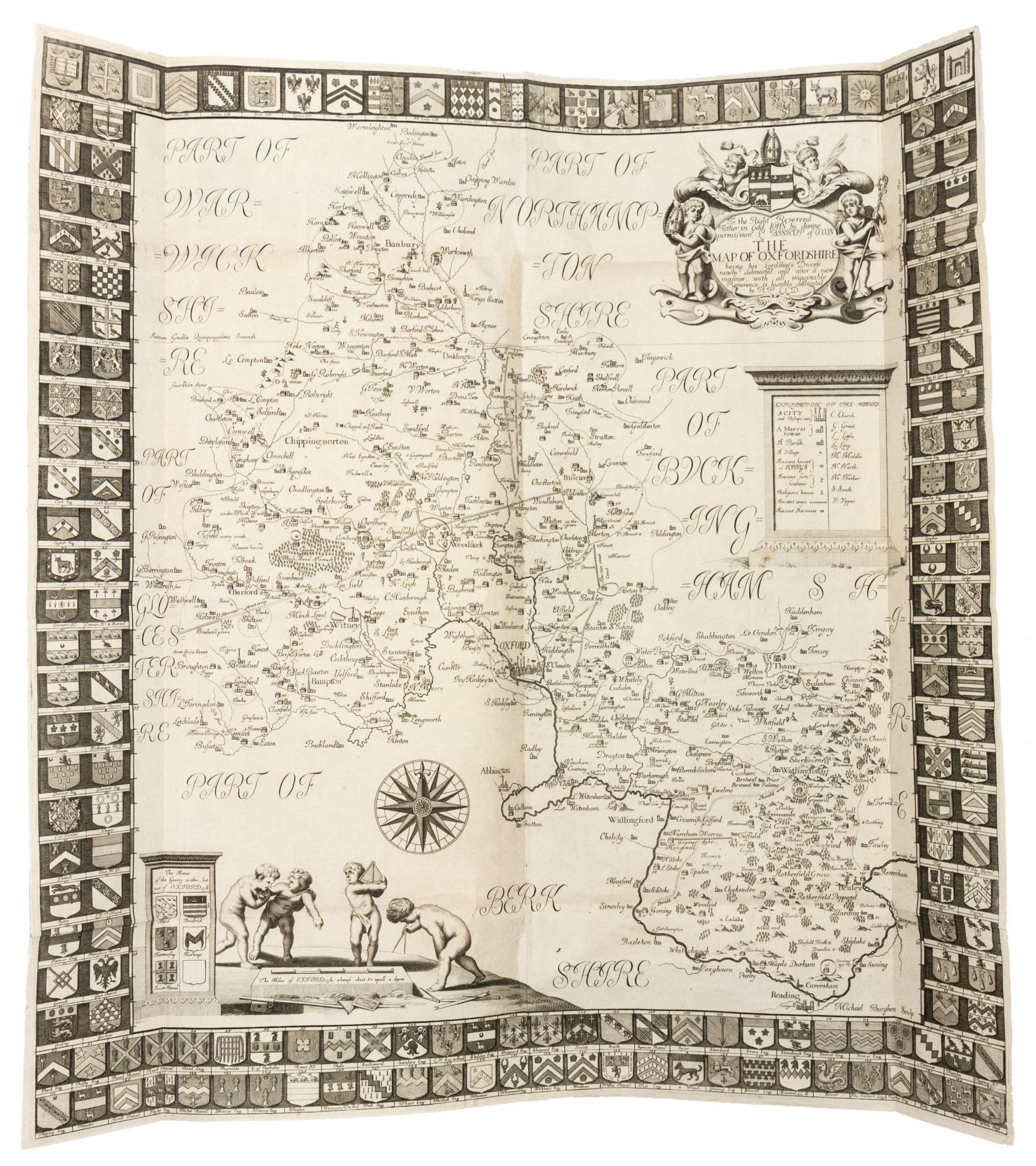
FIRST EDITION. Illustrated with a large folding map of Oxfordshire and sixteen full-page engravings—fossils, minerals, plants, the remarkable Enstone waterworks, and other curiosities—engraved by Michael Burghers.
Of all late 17th-century English naturalists, few embody the restless, accumulative curiosity of the Baconian program as fully as Robert Plot. His Natural History of Oxford-shire (1677) is not simply a regional survey, but a working demonstration of how knowledge was to be gathered in the age of Francis Bacon: by collecting, observing, recording—without yet knowing what would prove significant.
Plot’s project begins in 1674 with an itinerary consciously expanding the antiquarian tradition. Where earlier surveyors catalogued manuscripts and monuments, Plot sought “all curiosities both of art and nature.” Within a year he had assembled a cabinet of minerals impressive enough to exhibit before the Royal Society; the book followed in 1677, securing his election as Fellow the same year.
The work proceeds not systematically, but inquisitively: from meteorological anomalies to echoes, mineral waters, soils, erosion (“deterration”), and finally to “formed stones”—fossils. Plot recognized stratification in embryonic form, describing the earth at Shotover Hill as composed of “several folds… including one another,” yet he stopped short of grasping the full geological implications. Like many contemporaries, he explained fossils as mineral crystallizations mimicking organic forms.

And yet—precisely in this mixture of accuracy and error—the book becomes historically decisive.
Among the engraved plates is the first published illustration of what we now recognize as a dinosaur fossil: a large femur from the Stonesfield quarry. Plot identified it cautiously, comparing it to an elephant bone in the Ashmolean collection, though later writers would elevate it to the remains of a giant. Only in the 19th century did Richard Owen, working with Megalosaurus, Iguanodon, and Hylaeosaurus, define the group we call Dinosauria—retrospectively giving Plot’s image its extraordinary significance.

Plot’s natural history is thus not important despite its errors, but because of them. His emphasis on anomalies, exceptions, and the curious—what later critics called a “bizarre” or even “teratological” tendency—reflects a Baconian conviction that knowledge advances most rapidly at the margins of the known.
Equally important is the book’s practical dimension. Scattered throughout are detailed observations on agriculture, mining, and local industry, part of a deliberate effort to disseminate useful knowledge. In this respect, Plot’s work stands alongside the early Philosophical Transactions as an instrument of applied science.
His success as a collector and organizer of such material led directly to his appointment in 1683 as the first keeper of the Ashmolean Museum—arguably the first public museum in England—where the physical accumulation of specimens mirrored the intellectual accumulation represented in this book.

ESTC R7620; Wing P2586; Madan, 3130; Gibson 53. https://datb.cerl.org/estc/R473650


Jamesgray2@me.com


Leave a Reply