

Part one A-G

1) A small Plantin Æschylus 1580

754J Aeschylus (c. 525/524 – c. 456/455 BC), Willem Canter 1542-1575.
Αισχύλου τραγῳδίαι Ζ =. Æschyli tragœdiæ VII. In quibus præter infinita menda sublata, carminum omnium ratio, hactenus ignorata, nunc primum proditur; opera Gulielmi Canteri. VLTRAIECTINI.
Antuerpiæ : Ex officina Christophori Plantini, architypographi regij, 1580. Price $ 2,500

Duodecimo 12 x 8.5 cm. Signatures: A-Z⁸ (Z7, Z8 blank) Bound in full blind stamped pig skin over boards clasps lacking. a very sweet copy.
This handy copy of the plays from the father of Tragedy. Aeschylus entered many city competitions for the best play of Dionysia of these competitions, and various ancient sources attribute between seventy and ninety plays to him. Only these seven tragedies attributed to him have survived intact: The Persians, Seven Against Thebes, The Suppliants, the trilogy known as The Oresteia (the three tragedies Agamemnon, The Libation Bearers and The Eumenides), and Prometheus Bound (whose authorship is disputed). With the exception of this last play – the success of which is uncertain – all of Aeschylus’s extant tragedies are known to have won first prize at the City Dionysia. This is the first canter edition, Willem Canter was a classical scholar from Utrecht. He edited the Eclogues of Stobaeus and the tragedies of Euripides, Sophocles and Aeschylus.

Adams A-270; Voet, L. Plantin Press, 1555-1589,no. 11; Cockx-Indestege, E. Belgica typographica 38; STCV 12920582; Brunet I, 78. Dibdin, in his Introduction to the Knowledge of Rare and Valuable Editions of the Greek and Latin Classics, calls the 1580 Plantin: “an elegant and correct edition, without the scholia” Sandys notes that in Canter’s Euripides: “the metrical responsions between strophe and antistrophe are clearly marked…”and that the text was corrected through attention to those structures. He then adds that Canter’s editions of Sophocles (1579) and Aeschylus (1580) were published posthumously.


2) 887J: Agnes de Langeac (1602–1634) . ? Hyacinth Cunibert (ƒl1670’s)
Das geistreiches Leben der Wohl-Ehrwürdigen Mutter Agnetis a Iesu, deß H. Prediger-Ordens. Welche Anfangs die Dritte Regel deß H. Vatters Dominici angenommen;… in unsere Teutsche Sprach ubersetzet worden durch Hyacinthum Cunibert.

Köln, P. Steinbüchel 1671.
Price $2,900
Signatures: 12 Bl., 336 Bound in contemporary full calf. First German edition, The first French Vie was indeed published 1635 in Le Puy-en-Velay (where she was born) and then reissued in Lyon and Paris during the 1630s–40s.
Endpaper stamped, title with manuscript ownership, browned and partly brown-spotted partly heavily rubbed and bumped, back cover with worm trails..
The spiritual life of the Most Reverend Mother Agnetis a Iesu, of the Holy Order of Preachers. Agnes of Jesus (Agnès Galand, also called Agnès de Langeac) who was a French Dominican nun and mystic born in Le Puy-en-Velay. She entered the Dominican convent at Langeac in 1623 and became prioress. Agnes is remembered for her mystical visions, intense asceticism, and especially her role as a spiritual adviser to influential churchmen of the Counter-Reformation era. One of her most important connections was to Jean-Jacques Olier, founder of the Sulpicians, who regarded her as a prophetic guide and drew from her counsel in shaping his vision for clerical reform in France. Agnes’s cult was less about local miracles and more about inserting a universal Dominican female mystic into the spiritual arsenal of Catholic renewal in Central Europe.
In 1994 She was beatified by Pope John Paul II, which reflects the enduring impact of her reputation as a model of Dominican piety and mystical spirituality. Her life belongs to a central Catholic project of the seventeenth century: restoring discipline, devotion, and clerical holiness in response to both Protestant reform and internal Catholic laxity.
Translated into German by Hyacinthus Cunibert (Hyazinth Cunibert, O.P.), a Dominican active in the German provinces. His task was to adapt French mystical lives into accessible German, reinforcing Dominican female models for a German-speaking Catholic readership.
Agnes de Langeac, born Agnes Galand in Le Puy-en-Velay on 17 November 1602, entered the Dominican convent of Saint Catherine at Langeac in 1623. Upon professing her vows, she took the name Agnes of Jesus and quickly became known for her humility, strict asceticism, and extraordinary mystical gifts. Her life within the cloister was marked by visions, prophecies, and ecstatic experiences that were carefully recorded by confessors and fellow nuns, and which emphasized obedience, purity of heart, and a deep devotion to Christ crucified. Within a short span of time she was elected prioress, a position she held until her early death.
Although she remained enclosed, her influence reached well beyond the convent walls. She became the spiritual adviser of Jean-Jacques Olier,who later founded the Sulpician order, and through him she left a mark on the wider program of Catholic clerical reform in seventeenth-century France. In this sense, Agnes embodied a paradox common to many female mystics of her age: a life of silence and enclosure that nevertheless exercised a far-reaching spiritual authority.
Agnes died at Langeac on 19 October 1634 at the age of only thirty-two. Her reputation for sanctity led almost immediately to the circulation of devotional biographies. The first French Vie appeared in 1635, only a year after her death, and it quickly established her as a model of Dominican piety. Translations followed, with a German edition printed at Cologne in 1671 by Peter Steinbüchel, translated by the Dominican Hyazinth Cunibert, and later versions in Dutch and Italian. These printed lives carried her reputation across Central Europe and into new Catholic devotional contexts.
Agnes of Jesus was remembered above all as a woman who combined mystical vision with practical counsel, shaping the course of Catholic renewal through the lives of those she guided. Her sanctity was formally recognized much later, when Pope John Paul II declared her blessed on 20 November 1994. Today she remains a figure of Dominican identity and of Catholic reform, remembered not for a body of writings of her own—she left only dictated visions and prayers—but for a spiritual presence that inspired both contemporaries and later generations.
Scarcity.
VD17 ID: 12:117406L. ; OCLC: 718237200
https://www.digitale-sammlungen.de/en/view/bsb10787514?page=,1
First German edition (Cologne: Steinbüchel, 1671).
Verified institutional copies at BnF (4-LN27-8140 (A)) and Toulouse, Couvent Saint-Thomas d’Aquin (012 B AGN. LAN Lan.). Registered in VD17 (12:117406L). OCLC (718237200 Switzerland BIBLIOTHEQUE CANTONALE ET UNIVERSITAIRE. ; OCLC: 1075175021 zerØ copies
3) 977J Anselm, Saint, Archbishop of Canterbury, (1033-1109)
D. Anselmi Archiepiscopi Cantuariensis Theologorum Sui Temporis Facile Principis Operum Omnium Tomus … 4 Continens Diversas Ad Diversos Ab Eodem Exaratas Epistolas Tribus Libris Comprehens, Ac Hactenus Nunquam Editas, Et R. D. Joannis Picardi Bellovaci Ad S. Victoris Parisiensis Augustiniani Canonici Industria Annotationibus Ad Easdem Illustratas.
Agrippinae : Ex officina Cholin. sumptibus Petri Cholini, 1612 Price $2,300

Folio (four parts in one volume) 36 cm. Signatures: v1: π² *⁶ **⁸ (**8 blank) A-N⁶ O⁸; v. 2: Aa-Zz⁶ Aaa-Sss⁶ Ttt⁸; v. 3: *⁸ Aa-Yy⁶ (Yy6 blank); v. 4: π² (π2 blank) A-O⁶ P⁴ (P4 blank) (dagger)]⁸
Bound in a contemporary German blind-stamped pigskin binding over wooden boards, with a central oval panel stamp and multiple decorative roll borders; retaining the original brass catches but lacking clasps.
Earlier printed editions of Anselm’s works, issued from the mid-16th century and often associated with the editorial work of Antoine de Mouchy (1494–1574), circulated widely in Paris and Cologne, frequently without explicit attribution in later reprints. The present 1612 Cologne edition marks a significant development in this tradition, introducing the recension of Jean Picard (d. 1615), who revised the text on the basis of manuscript comparison, incorporated works here stated to be printed for the first time, and furnished the corpus with editorial annotations.
Anselm of Canterbury was born in Aosta around 1033 and entered the Norman abbey of Bec, where he became one of the most admired teachers in Europe. The early Anselm is a monastic intellectual, deeply concerned with meditation, logic, prayer, and the disciplined use of reason in theological reflection. The Monologion and Proslogion emerge from that world—not as public disputations, but as exercises in thinking carefully about what can and cannot be said about God.
After the Norman Conquest, Canterbury became deeply entangled with royal government, and Anselm—almost against his own temperament—was drawn into the machinery of power. When he became Archbishop of Canterbury in 1093, he inherited a church caught between reform ideals and the ambitions of the Norman kings. As one of the great advocates of rational clarity he spent much of his later life navigating situations where reason alone could solve very little. He was exiled more than once, struggled constantly over the limits of royal authority in church affairs, and became a central figure in the Investiture Controversy in England. The famous “ontological argument” matters not because it proves belief mechanically, but because it demonstrates a method: the attempt to follow an idea as far as reason can carry it, while remaining honest about the limits of certainty. In that sense, Anselm’s writings remain less a collection of answers than a discipline of thinking.


4)Humanists and Church Fathers: 295-1536 ad


Richardus de Sancto Victore,; 1110-1173. Ambrogio Traversari 1386-1439. Cristoforo Persona; 1416-1485. Angelo Poliziano; 1454-1494. Nicolas Béraud; 1473-1550. Desiderius Erasmus; 1496-1536.
[bound with]
547Jb. Basilius Caesariensis. 330–379 Jacques Lefèvre D’Etaples. c. 1450–1536.
547Ja. Saint Athanasius, Patriarch of Alexandria, 295-373. Theophylactus de Achrida,; 1055-1126. Richardus de Sancto Victore,; 1110-1173. Ambrogio Traversari 1386-1439. Cristoforo Persona; 1416-1485. Angelo Poliziano; 1454-1494. Nicolas Béraud; 1473-1550. Desiderius Erasmus; 1496-153
[bound with]
547Jb. Basilius Caesariensis. 330–379 Jacques Lefèvre D’Etaples. c. 1450–1536.
Athanasii Episcopi Alexandrini Sanctissima, Eloqventissimaqve Opera Commentarij in epistolas Pauli Contra Gentiles Liber vnus De incarnatio[n]e Verbi … Disputatio contra Arrium. In vim Psalmorum opusculum. Exhortatio ad Monachos. De passione Imaginis domini nostri Libellus. Epistolæ nonnullæ Romanorum Pontificum ad Athanasium, et Atanasij ad eosdem. Que̜ omnia olimia[m] latina facta Christophoro Porsena, Ambrosio Monacho, Angelo Politiano interpretibus, vna cum doctissima Erasmi Roterodani [sic] ad pium lectorem paraclesi.

[bound with]
Basilii Magni Caesariensium in Cappadocia Antistitis sanctissimi opera plane diuina, variis e locis sedulo collecta: & accuratio[n]e ac impe[n]sis Iodici Badii Ascensii recognita & coimpressa, quorum index proxima pandetur charta.

Parisiis: Joanne Paruo [i.e., Jean Petit] , [1519].
[bound with]
Paris: Venundantur eidem Ascensio [i.e., Badius Ascensius, 1520]. Price $6,000
Two Folios bound together; leaf size: 32 x 22 cm.
Signatures: ad. I) a-z8,&8,A-H8,I6,K8, aaa-ggg6,hhh4,iii6(iii6 is blank & present) ad. II)A¹0, a-x⁸, y⁶, z⁴ Both first editions . Bound together in alum-tawed pigskin, tooled in blind with rolls and individual stamps over wooden boards with metal and leather clasps; one clasp perished. Binding with one corner tip broken off; small hole in leather on rear board; dust-soiled. Inside, some early marginalia


Humanists and Church Fathers: 295-1536 ad
Richardus de Sancto Victore,; 1110-1173. Ambrogio Traversari 1386-1439. Cristoforo Persona; 1416-1485. Angelo Poliziano; 1454-1494. Nicolas Béraud; 1473-1550. Desiderius Erasmus; 1496-1536.
[bound with]
547Jb. Basilius Caesariensis. 330–379 Jacques Lefèvre D’Etaples. c. 1450–1536.
547Ja. Saint Athanasius, Patriarch of Alexandria, 295-373. Theophylactus de Achrida,; 1055-1126. Richardus de Sancto Victore,; 1110-1173. Ambrogio Traversari 1386-1439. Cristoforo Persona; 1416-1485. Angelo Poliziano; 1454-1494. Nicolas Béraud; 1473-1550. Desiderius Erasmus; 1496-153
[bound with]
547Jb. Basilius Caesariensis. 330–379 Jacques Lefèvre D’Etaples. c. 1450–1536.
Athanasii Episcopi Alexandrini Sanctissima, Eloqventissimaqve Opera Commentarij in epistolas Pauli Contra Gentiles Liber vnus De incarnatio[n]e Verbi … Disputatio contra Arrium. In vim Psalmorum opusculum. Exhortatio ad Monachos. De passione Imaginis domini nostri Libellus. Epistolæ nonnullæ Romanorum Pontificum ad Athanasium, et Atanasij ad eosdem. Que̜ omnia olimia[m] latina facta Christophoro Porsena, Ambrosio Monacho, Angelo Politiano interpretibus, vna cum doctissima Erasmi Roterodani [sic] ad pium lectorem paraclesi.
[bound with]
Basilii Magni Caesariensium in Cappadocia Antistitis sanctissimi opera plane diuina, variis e locis sedulo collecta: & accuratio[n]e ac impe[n]sis Iodici Badii Ascensii recognita & coimpressa, quorum index proxima pandetur charta.
Parisiis: Joanne Paruo [i.e., Jean Petit] , [1519].
[bound with]
Paris: Venundantur eidem Ascensio [i.e., Badius Ascensius, 1520]. Price $6,000
Two Folios bound together; leaf size: 32 x 22 cm.
Signatures: ad. I) a-z8,&8,A-H8,I6,K8, aaa-ggg6,hhh4,iii6(iii6 is blank & present) ad. II)A¹0, a-x⁸, y⁶, z⁴ Both first editions . Bound together in alum-tawed pigskin, tooled in blind with rolls and individual stamps over wooden boards with metal and leather clasps; one clasp perished. Binding with one corner tip broken off; small hole in leather on rear board; dust-soiled. Inside, some early marginalia
Saint Athanasius, Patriarch of Alexandria, 295-373.
St. Athanasius’s text was translated into Latin by three noted Renaissance scholars, and edited by Nicholas Beraldus, and has the added prestige of apparatus by Erasmus. The title-page is printed within a four-piece woodcut border, with the title in red and black, and the page bears the famous Petit printer’s device. The St. Basil is from Badius Ascensius’s press and he acted as the editor, the translators having been Johannes Argyropoulos, Georgius Trapezuntius, and others(see above and below ). The title-page uses the same four-part woodcut title-page border as found on the St. Athanasius, bound in at the front, which makes much sense given the familial relationship between Ascensius and Petit.
Athanasius was the greatest champion of Catholic belief of Incarnation that the Church has ever known and in his lifetime earned the characteristic title of “Father of Orthodoxy”, by which he has been distinguished ever since. “Athanasius the Apostolic, was the 20th bishop of Alexandria (as Athanasius I). His intermittent episcopacy spanned 45 years (c. 8 June 328 – _2 May 373), of which over encompassed five exiles, when he was replaced on the order of four different Roman emperors. Athanasius was a Christian theologian, a Church Father, the chief defender of Trinitarianism against Arianism, and a noted Coptic Christian (Egyptian) leader of the fourth century. Athanasius’ earliest work, Against the Heathen – _On the Incarnation (written before 319), bears traces of Origenist Alexandrian thought (such as repeatedly quoting Plato and using a definition from Aristotle’s Organon) but in an orthodox way. Athanasius was also familiar with the theories of various philosophical schools, and with the developments of Neo-Platonism. Ultimately, Athanasius would modify the philosophical thought of the School of Alexandria away from the Origenist principles such as the “entirely allegorical interpretation of the text”. Still, in later works, Athanasius quotes Homer more than once (Hist. Ar. 68, Orat. iv. 29). Athanasius was not a speculative theologian. As he stated in his First Letters to Serapion, he held on to “the tradition, teaching, and faith proclaimed by the apostles and guarded by the fathers.” He held that not only was the Son of God consubstantial with the Father, but so was the Holy Spirit, which had a great deal of influence in the development of later doctrines regarding the Trinity.
Athanasius’ “Letter Concerning the Decrees of the Council of Nicaea” (De Decretis), is an important historical as well as theological account of the proceedings of that council, and another letter from 367 is the first known listing of all those books now accepted as the New Testament.
Moreau II Nr. 2242m; P. Renouard, Bibliographie des impres (Paris, I908)s II, I46
Basil the Great is sapientissimus, potentissimus, sanctissimus, piissimus.
This volume includes the following works: the Hexameron, translated by Argyro- pulos for Sixtus IV; Adversus Eunomium, translated by George of Trebizond at the re- quest of Cardinal Bessarion and sent by him to Eugenius IV; Gregory Nazianzen’s funeral oration on Basil the Great in the translation of Raphael Volaterranus; a large selection of Basil’s sermons and several letters, also translated by Volaterranus; and, finally, the De institutis monarchorum, RuEinus’ trans]ation, adaptation, and fusion of Basil’s two monastic rules, the Regulaefusius tractatae and Regulae brevius tractatae. Texts in Migne, P.G. XXIX, XXX, XXXI and F. Boulenger, Gre’goire de NazEanze. Dis- coursfunebres en l’honneur de sonfrere Ce’saire et de Basile de Cesarete (Paris, I908), pp. S8-23I. Argyropulos’ Hexameron was sent to Badius from Rome by Lefevre (fol. Ir and Badius’ preface: ‘Nuper autem divi Basilii vere magni monumenta aeterna cedro dignissima ab urbe Roma ad nos usque perlata, hinc ad negocia sua profecturus, prelo nostro commisit’). It and the translations of Volaterranus had been printed in Rome by Mazochius in September and December 1515 (Panzer, nº, 255, no. 92 and 256 no. 9S); in June 1508 Matthias Schurer printed Basilfi Oratio de invidia, Nic. Perotfo interprete in Strasbourg (Panzer, VI, 42, no. I3I); the letters on reading the pagan classics and on the solitary life were well known; but Badius’ is the first printing of so important a collection of Basil’s works.
Ad1) Moreau II Nr. 2242m; P. Renouard, Bibliographie des impres (Paris, I908)s II, I46
Ad2) BL STC France (16th cent.); Ind Aur III, 311; Wierda, 2006,; p. 210, nr. 40 p. 42; Moreau 1511-1520: 2246; Imprimeurs et libraires parisiens du 16. sie_̀cle … Bade-438/
5) 601J Augustinus (pseudo) Jean de Fécamp


601J Libellus Meditationum
Jean de Fécamp (early 11th century – 22 February 1079)
Pseudo-Augustine;
Saint Augustine 354-430;
Bernard of Claravallensis 1090-1153;
Peter Damian 1007-1072;
Saint Anselm of Canterbury, 1033-1109;
Vincent Ferrer 1350-1419;
Maffeo Vegio 1407-1458;
Pope Pius II,(Enea Silvio Bartolomeo Piccolomini) 1405-1464,

601J
Pseudo-Augustine; Saint Augustine 354-430; Bernard of Claravallensis
1090-1153; Peter Damian 1007-1072; Saint Anselm of Canterbury, 1033-1109; Vincent Ferrer 1350-1419; Maffeo Vegio 1407-1458; Pope Pius II,(Enea Silvio Bartolomeo Piccolomini) 1405-1464,
Medtationes divi Augustini episcopi Hyppoensis Soliloquia eivsden Manuale eidsdem Castigaissime. [a1]
Brescia: Angelus Britannicus de Pallazolo Biblioteca Virtual del Patrimonio Bibliograìfico. 8 Oct. 1498 $5 500
Octavo, 14 ½x10 Cm. Signatures: π4, a-n8, o10 [colophon], l8, m12, p8.[o10,m12, p8are blank and present] Second edition. Bound in later full vellum, a large copy with some deckle edges. Woodcut printer’s device C on leaf o9 verso. For Britannicus’s device C, see BM 15th cent., VII, 972 . Second edition variations in texts though. Bound in later full vellum, a large copy with some deckle edges.
Title and list of contents π1r; Title page,a1r 1)[Pseudo-] Augustinus [Pseudo- Anselmus; Jean de Fécamp]. Meditationes, caption “Invocatio dei omnipotentis ad morum et vite reparationem”, The invocation of the Almighty God for the reparation of character and life.
2) a2r-e5r; [Pseudo-] Augustinus. Meditationes,
3) e5r-i3r; [Pseudo-] Augustinus. Soliloquia,
4) i3r-kkv [i.e. l1v], Manuale including preface, i3r-v; [Pseudo-Bernardus Claravallensis . [i.e. Hugo de Sancto Victore]. Meditationes de cognitione humanae conditionis,
5) l2r-m8v; [Pseudo-] Bernardus Claravallensis. Epistola de perfectione vitae,
6) n1r-n2r; Petrus Damiani. Sermo unicus [i.e Institutio monialis, chapt. 6],( De Institutione monialis, which had the aim of safeguarding Western Christians from the decadent uses of the East. Notable in this work, among other things, Damiani, then Bishop of Ostia, condemned Maria Argyre’s use of a golden fork to eat. ‘Forks were a new invention at the time.)
7) n2v-n3r; Anselmus Cantuariensis. Meditatio de redemptione generis humani,
8) n3v-n7r; Anselmus Cantuariensis. Orationes ad sanctam Mariam virginem,
9) n7r-o7v; Father N. Laudensis [Maphae9us Vegius? Jacobus Arrigoni Laudensis?]. [Verse], incipit “Mens mea q[ui]d cogitas? Quid tantis / ceca procellis / Sponte tuam credis mox peritura ratem?”, “My mind, what are you thinking? Why are you so blind / blind to the storm / Do you automatically believe that your rate will soon perish?”
10-18) o8r :8, elegiac distichs,; Pius II, Pont. Max. In laudem divi Augustini, o8r-v; Maphaeus Vegius. Epigramma in laudem Monicae, o8v-o9v; colophon, ov; printer’s device, o9v; Vincentius Ferrerius. De vita spirituali [also known as De interiori homine formativus],
19) ²l1r-²m11v;
20) p1r-p7v. [Pseudo-] Bernardus Claravallensis. Sermo de passione domini .

Brescia: Angelus Britannicus de Pallazolo Biblioteca Virtual del Patrimonio Bibliograìfico. 8 Oct. 1498 Price $5,500
18 semi mystical texts in this beautiful and excellent little book, maybe eleven Authors, So from the top I will try to discuss the authorship and the texts!

United States of America
Baltimore MD, The Walters Art Museum Library
Chicago IL, The Newberry Library
Collection of the late Phyllis and John Gordan, New York NY
New Haven CT, Yale University, Beinecke Library
Philadelphia PA, Free Library of Philadelphia, Copinger-Widener Collection
San Marino CA, Huntington Library
Stanford CA, Stanford University, Green Library
University Park PA, Pennsylvania State University, Eberly Family Special Collections Library
Goff A1294; HC(Add) 1951; IGI 1013;Sajó-Soltész 406; IBE 126; IBPort 35; Madsen442; SchmittII2828,15; Hubay(Eichstätt)110; Oates2628; Pr6998; BMC VII 980; BSB- Ink L-136; GW 2972 (Pseudo-Augustinus)
https://data.cerl.org/istc/ia01294000


6) 940J Francis Bacon
Of The Advancement And Proficience Of Learning or the Partitions Of Sciences ix Bookes Written in Latin by the Most Eminent Illustrious & Famous Lord Francis Bacon Baron of Verulam Vicont St Alban Counsilour of Estate and Lord Chancellor of England. Interpreted by Gilbert Wats.
Oxford: Printed by Leon: Lichfield, Printer to the University, for Rob: Young, & Ed: Forrest, 1640 [colophon dated 1640] Price $7,500

Small Folio 26 x 17.5 cm. Signatures: ¶4, ¶¶2, ¶¶¶1, A2, B-C4, aa-gg4, hh2, †4, ††2, †1, A-Z4, Aa-Zz4, Aaa-Qqq4, Rrr2. Complete.

This copy has the usual minor rust otherwise the paper is quite crisp and clean, with the original type impression still visible. This is a nice copy, of a very important book. Bound in early full calf rebacked. It is stored in a custom red Morocco box.
“And even the title page it now becomes clear, announces this figure, for the Pillars of Hercules there also represent the temple of the world through which the ship of apocalyptic exploration passes, just as one passes through the twin pillars before Solomon’s Temple. Thus when discussing the Great Instauration’s motto, plus ultra, and Daniel’s prophecy in The Advancement of Learning, Bacon says, ‘For it may be truly affirmed to the honor of these times, and in a virtuous emulation with antiquity, that this great building of the world had never through–lights made in it, till the age of us and our fathers.’ The engraver Thomas Cecill [who engraved the image for the 1620 edition. The engraver here is W. Marshall, after Cecill] saw this great building as Solomon’s Temple.” (quoted from Francis Bacon and Modernity, by Charles Whitney, page 33) An engraved portrait of Bacon is bound before the title. It is dated 1626.
“Partitiones Scientiarum, a survey of the sciences, either such as then existed or such as required to be constructed afresh—in fact, an inventory of all the possessions of the human mind. The famous classification on which this survey proceeds is based upon an analysis of the faculties and objects of human knowledge. This division is represent by the De Augmentis Scientiarum [The Advancement of Learning].”

“Bacon’s grand motive in his attempt to found the sciences anew was the intense conviction that the knowledge man possessed was of little service to him. ‘The knowledge whereof the world is now possessed, especially that of nature, extendeth not to magnitude and certainty of works.’ Man’s sovereignty over nature, which is founded on knowledge alone, had been lost, and instead of the free relation between things and the human mind, there was nothing but vain notions and blind experiments. … Philosophy is not the science of things divine and human; it is not the search after truth. ‘I find that even those that have sought knowledge for itself, and not for benefit or ostentation, or any practical enablement in the course of their life, have nevertheless propounded to themselves a wrong mark, namely, satisfaction (which men call Truth) and not operation.’ ‘Is there any such happiness as for a man’s mind to be raised above the confusion of things, where he may have the prospect of the order of nature and error of man? But is this a view of delight only and not of discovery? of contentment and not of benefit? Shall he not as well discern the riches of nature’s warehouse as the beauty of her shop? Is truth ever barren? Shall he not be able thereby to produce worthy effects, and to endow the life of man with infinite commodities?’ Philosophy is altogether practical; it is of little matter to the fortunes of humanity what abstract notions one may entertain concerning the nature and the principles of things. This truth, however, has never yet been recognized; it has not yet been seen that the true aim of all science is ‘to endow the condition and life of man with new powers or works,’ or ‘to extend more widely the limits of the power and greatness of man.’” (quoted from the Encyclopedia Britannica, eleventh edition, vol. 3, page 145.)
STC 1167, F. FBL. HD. LC. PML. Gibson 141B
7). 694J Francis Bacon 1561-1626
The Essayes or counsels, civill and morall, of Francis Lo. Verulam, Viscount St. Alban.
London: Printed by Iohn Hauiland, and are sold by R. Allot, 1629. Price $3,800

Quarto, Signatures A-2V⁴ 2X² (a)² 2Y-3C⁴. Bound in the original limp vellum,(lacking ties) recently recased and a little rumpled but a very large, clean and unsophisticated copy of an early quarto edition.
“[Bacon’s] Essays, the fruits of his political and social observations, were first published in 1597, enlarged in 1612, and again in 1625. This 1629 edition contains all 58 essays. And is the First edition to contain The colors of good and evil and has divisional title page; register is continuous. Some copies may have been issued without this, but the present copy has it.
“Of Bacon’s literary, as distinct from his philosophical and professional works, far the most popular and important are the Essays [they] are the most original of all Bacon’s works, those which, in detail, he seems to have thought out most completely for himself, apart from books and collections of commonplaces. The last edition [referring to that of 1625, the first to contain all fifty-eight essays] teems indeed with quotations and illustrations, but they are suggested by his own matter and do not suggest it. Though the Essays have the same title as the larger collection of Montaigne, the two works have little in common, except that rare power of exciting interest and the unmistakable mark of genius which is impressed on them both.” (DNB)

His long attempt to reform the intellectual habits of the European mind began with the publication of The Advancement of Learning in 1605, which attacked the unprofitable scholasticism that inhibited the growth of knowledge and the mental prejudices that helped to keep men in ignorance. Above all he deplored the poor and confused state of knowledge about the operations of the natural world. Novum Organum, begun about 1608, published 1620, called for a systematic study of the natural world and of the causes of things, and proposed the inductive method as the most reliable instruments of enquiry. Bacon worked out the principles of the experimental method in this book, and developed them in De Augmentis, 1623. Sylva Sylvarum, a proposal of 1,000 experiments to be undertaken, was published posthumously in 1627, together with New Atlantis, a Utopian fragment written about 1617 that urged the foundation of a college for scientific research. A short book that enjoyed much popularity in his lifetime was De Sapientia Veterum, 1609 (translated as The Wisdom of the Ancients, 1619), which tried to demonstrate that the myths of the Greeks were coded accounts of their knowledge of the physical world.” (Quoted from The Seventeenth Century, by Graham Perry, pages 264-265.)
STC 1149; Gibson 15 Pforzheimer 31.
8) 466J Balthasar de Porta (fl. 1487- 1499)

Expositio Canonis Missae. (Canon sacratissime misse: unacum expositione eiusdem: ubi in primis premittit pulchra contemplatio ante missam habenda de christi pulcritudine. Et quo mo[d]o ipsa in sua passione: ab eo o[mn]ino fuerat ablata. Qualiterque quilibet celebrans debeat esse dispositius incipit foeliciter.)
[Leipzig : Gregorius Böttiger (aka Werman), about 1495. Price: $11,000
Chancery half-sheet Quarto: 18.5 x12.5 cm. Signatures: aa-dd6, 24 of 24 leaves. Editio princeps, text in gothic letter, including a set of large caps, large woodcut initial and display face on title page, long list in a contemporary hand beneath printed title is a contemporary sacristy inventory has been added in a neat late-15th-century German hand, headed Instrumenta bei unserm altar (“Items kept at our altar”).

The list, written in twenty-five lines with “Item” marks in the margin, reads as follows:
Instrumenta bei unserm altar
Item Salz
Item das heilige Wasser
Item ein Kessel
Item Wachs do mit man das Taufwasser macht
Item allen Ornatstücken Hemd oder die Gürtel
Item die Ampullen zum Wein und zum Wasser
Item ein Tüchlein bei der Opferpforte
Item Hostien und Becken dazu
Item Wasser und Wachs
Item neue Pfännlein mit Salz
Item Liechtlin bei dem Altar
Item Öltöpflein, Ampullen, Kellen und Pötte
Item Wein und alte Tücher für den Altar
Item Becken und Fläschlein zum Altar gebrauch
Item Tücher und Decken zum Altar bedecken.
This inventory of liturgical implements—wax, salt, holy water, ampullae for wine and water, vestments, altar cloths, basins, and flasks—records the working contents of a late-medieval parish sacristy, giving the copy notable research value for the study of material religion and Eucharistic practice ca. 1500.
This copy is bound in antique parchment .
Balthasar de Porta’s Canon Missae, also contains the proposal of the Exposition of the Eucharist before the celebration of mass . This commentary on the Mass, has verses taken from the Jesuida of Hieronymus de Vallibus, which are used in the appropriate context to illustrate or emphasize the author’s meaning. We know very few facts about the life of Balthasar de Porta , a Cistercian monk who served as Provisor at the order’s College (Saint Bernard) at Leipzig until about 1499. In the same years, he also published another work about Mass, the Expositio mysteriorum missae (Leipzig: Kacheloven, 1494) and a work on the heretical Bohemian Brethren, Conclusiones contra quorundam Bohemorum errores (Lepzig: Böttiger, about 1494), in which Balthasar refutes specific “errors” of the Hussite beliefs. Balthasar de Porta was Provisor of the Cistercian College of St. Bernhard in Leipzig (fl. 1487-1499).

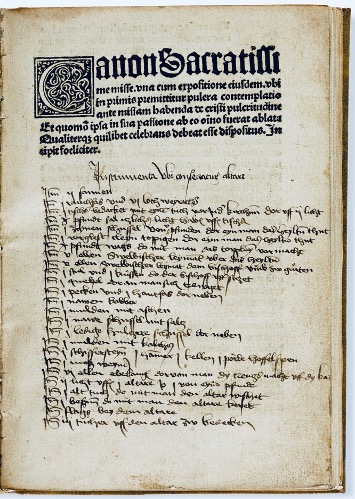
Goff B39; H 2345*; GfT GfT: Gesellschaft für Typenkunde des XV. Jahrhunderts. Veröffentlichungen. 33 parts. Leipzig [etc], 1907-39. 521, 522; Pell 1753; BSB-Ink B-25; GW 3216; ISTC ib00039000. US copies: Huntington Library (2), Southern Methodist Univ, Yale University https://data.cerl.org/istc/ib00039000
Short Link: https://wp.me/p3kzOR-8ty
9) Basilius Magnus De legendis antiquorum libris, Ulm 1478 — Latin translation (Bruni)

939J Basilius Magnus (c. 330-379) Bruni, Leonardo,( 1369-1444), Brenninger, Martinus Uranius,; active 15th century.
De legendis antiquorum libris, sive De liberalibus studiis (Tr: Leonardus Brunus Aretinus). Ed: Martinus Brenningarius [Ad nepotes suos pulchrum de legendis libris secularibus Leonardi Aretini Ad collucium salutatum praefatio in magni Basilii librum incipit foeliciter]
Ulm: [Johann Zainer the Elder, 1478]. Price $9,600

Quarto 18 x 13.5 cmSignatures a-b8 One of the First Latin editions 1470-71, [Almost all pre 1500 editions are undated] translated by Leonardo Bruni. Rubricated, with one 6-line and twenty 5-line wood-cut initials coloured in blue, pink and yellow incorporating figurative ornaments (plants & animals), Bound in later full laced cased Vellum. and a 1955 purchase code from Theodor Ackermann Antiquarit . Enclosed a receipt of Antiquariat Ackermann, Munich, //the sale of the present copy, dated 13 February 1968.(Ackermann celebrated their Jubiläumskatalog in 1966) and an current export license. This is of great rarity, only 2 copies traceable for us at auctions in the last 50 years.

Basil the Great wrote what we call De legendis libris gentilium (Greek: Πρὸς τοὺς νέους, ὅπως ἂν ἐξ Ἑλληνικῶν ὠφελοῖντο λόγων) in the later fourth century, probably in the 360s–370s, when he was already an established bishop and ascetic leader. De legendis libris gentilium addresses a pressing problem faced by Christian families: how to educate youth within a Greco-Roman school system dominated by pagan poetry, rhetoric, and philosophy. Basil himself had received the highest classical training in Athens, and the treatise reflects his effort to reconcile that formation with Christian ascetic and theological commitments. Rather than rejecting classical literature outright, he argues that pagan authors may be read selectively for their moral exempla and rhetorical discipline, provided that their theological errors are avoided. Secular learning, in Basil’s formulation, prepares the soul for virtue but does not supplant divine revelation. The work thus offered an early and authoritative blueprint for integrating classical education into Christian life—precisely the principle that would make it foundational for Renaissance humanists such as Leonardo Bruni.
Leonardo Bruni’s translation of Basil’s De legendis libris gentilium must be understood as a deliberate intervention in the educational and theological culture of the early fifteenth century. Bruni was not merely recovering Greek texts for stylistic pleasure; he was constructing a defensible intellectual program in which the study of classical literature—the poets, historians, and orators of antiquity—could be presented as morally formative and fully compatible with Christian life. At a moment when the revival of pagan authors still provoked suspicion within ecclesiastical and scholastic circles, Bruni sought authoritative precedents from the Church itself. By translating Basil into a polished, Ciceronian Latin and circulating the text among humanist readers, Bruni effectively embedded the studia humanitatis within an orthodox Christian framework, presenting humanist education not as a rival to theology but as its necessary preparation. As James Hankins has noted, Bruni consistently framed classical learning “not as an end in itself, but as a moral and civic preparation for the highest forms of life,” a principle that finds its most authoritative patristic support in Basil’s De legendis libris gentilium.
Basil the Great was uniquely suited to this role. As a Greek Father of the Church and a foundational theological authority, Basil offered an unimpeachable patristic endorsement of selective engagement with pagan literature. In De legendis, Basil argues that classical texts should be read discerningly, not for their false theology but for their ethical exempla and rhetorical discipline, which train the soul for higher truth. Bruni’s choice of this text allowed humanists to claim that the careful reading of pagan authors was not a Renaissance novelty but a practice sanctioned by early Christianity itself—one exemplified by figures such as Moses and Daniel, who first mastered secular wisdom before attaining divine knowledge. In Bruni’s hands, Basil becomes the bridge between classical culture and Christian doctrine, transforming humanism into a project that could flourish within the Catholic Church rather than in tension with it.

Basil’s treatise addresses a recurring tension in the history of the humanities: how to preserve the study of classical literature while subjecting it to moral and intellectual scrutiny. Writing at a time when pagan texts dominated elite education yet conflicted with Christian doctrine, Basil neither rejected nor romanticized the classics, but subordinated them to higher truth. Classical learning, he argues, refines judgment and trains virtue, yet it remains preparatory rather than ultimate. This hierarchy allowed later readers to defend the humanities not as autonomous cultural capital but as formative discipline directed toward ethical ends. It is precisely this argument that would resonate in the Renaissance and continues to illuminate the enduring question of what the humanities are for.
Basil the Great emerges in Luther’s writings as one of the few patristic authorities he consistently and explicitly invokes, yet always in a carefully delimited role. In works such as De votis monasticis (1521), Basil serves as a witness to an earlier, less corrupted form of monastic life, allowing Luther to contrast evangelical freedom with the binding force of later vows. Likewise, in the Assertio omnium articulorum (1520), Basil appears alongside Augustine as part of a patristic chorus that affirms the primacy of Scripture over ecclesiastical tradition. Across sermons and Table Talk, he is treated broadly as a representative of the Greek Fathers, often viewed more favorably than the scholastic theologians who followed. Yet Luther’s use of Basil is always selective and instrumental: he abstracts him into a figure of the “pure early Church,” deploying him as a supporting witness rather than a controlling authority, subordinated—like all Fathers—to the ultimate judgment of Scripture.
This is early printing by the Ulm pioneer printer Johann Zainer the Elder, our copy with large, gorgeously ornamented initials rubricated in several colours.
Provenance: Enclosed a receipt of Antiquariat Ackermann, Munich, mentioning the sale of the present copy, dated 13 February 1966.( Ackermann celebrated their Jubiläumskatalog in 1965) and an export license Of great rarity, only 2 copies traceable for us at auctions in the last 50 years.
Goff B274; HC 2689*; Amelung, Frühdruck I 31; Pell 1997; CIBN B-179; Coq 69; Zehnacker 375; Voull(B) 2615,10; Bod-inc B-130; Sheppard 1813; Pr 2519; BMC II 525; BSB-Ink B-228; GW 3706. https://data.cerl.org/istc/ib00274000
ISTC records one US Copy: University of Michigan Ann Arbor .

10). 979J An annotated Boethius 1513 :|: What can we do with this book?

As many of my readers know, I like to stay as close as possible to the original users of the books I handle. Annotations allow that, bringing us into contact with a reader at work five hundred years ago. Over the past thirty years I have sold more than fifty pre-1700 editions of De Consolatione Philosophiae, but this copy is unusual for the extent and consistency of its marginalia.

This 1513 Florence (Giunta) Boethius, bound with Basil of Caesarea’s De liberalibus studiis et ingenuis moribus 1516,in the Latin translation of Leonardo Bruni, preserves a sustained record of reading. The annotator does not simply mark passages, but extracts terms, arranges them into lists, and at times restates the argument in short propositions, reducing the text to a series of usable forms.
979J Boethius (fl 480-524-5) ed, Nicolas Crescius (fl 1515) bound with Basil of Caesarea, also called Saint Basil the Great (330 – 379) Edited and Translated by Leonard Bruni (1370–9 March 1444)
Severini Boetii de philosophiae consolatione Eiusdem de scholastica disciplina, qui alii quoque autori a nonnullis adscribitur.
Bound with
Sancti Basilii de Liberalibus Studiis et ingenvis moribus liber per Leo Nardvm Ar. Græco in Latinvm conversus
Florentiæ : Sumptibus Philippi de Giunta florentini, 1513 Mense Septembri. . and Impressum Floretiæ opera st Sumptu Philippi Iuntæ, 1516
Price $5,800


Octavo 16 x10.5cm. signatures: ad1) A-K8 | ad 2)a8 b4. Bound in modern glazed boards with the sellers label of William Salloch (Ossining) . The Boethius is annotated throughout (every page) see below.

“Boethius became the connecting link between the logical and metaphysical science of antiquity and the scientific attempts of the Middle Ages. His influence on medieval thought was still greater through his De consolatione philosophiae(written while in prison at Pavia) and the theological writings attributed to him. Whether Boethius was a Christian has been doubted; and it is certain that the Consolatio makes no mention of Christ, and all the comfort it contains it owes to the optimism of the Neoplatonic school and to the stoicism of Seneca. Nevertheless, for a long time the book was read with the greatest reverence by all Christendom, and its author was regarded as a martyr for the true faith” (Schaff-Herzog).
In Giunta’s dedication “studiosis adolescentibus,” he writes: “We publish for your use […] this little work of Boethius, On the Consolation of Philosophy, carefully corrected [by Nicolaus Crescius] and printed with particular diligence. And so that we might further oblige you, we have also joined to it a small book on scholastic discipline, likewise attributed to Boethius, which we believe will be of no less benefit for your studies. But since many learned men are uncertain whether this latter work was truly written by Boethius, and suspect that it may belong to another—whose name is unknown—we grant the reader the freedom to attribute it as he wishes…” The text is edited by Nicolaus Crescius, whose work appears in Boethius editions between 1507 and 1521.
This opening below (as well as 38 other openings in this book) shows how the text was worked by a contemporary reader: the narrative is reduced to names, terms, and a short rule. Evidence of use of this kind extends the book beyond its printed form, preserving a record of how it was read, organized, and understood. For students and researchers, the page becomes not only a witness to the text itself, but to the intellectual activity it generated. In this book there are many markings, eyes, triangles, brackets, manicules, flowers, a pine cone? feathers, making it one of the most beautifully used books I have had.


This is an exemplary leaf of this book. Rather than simply underline memorable passages or mark difficult words, this annotator systematically reorganizes the text into a series of retrievable forms.
Narrative passages are reduced to names, concepts, and propositions: Socrates, Seneca, and Anaxagoras become exemplary authorities; Lady Philosophy’s torn garment becomes a shorthand for the fragmentation of philosophy among rival sects; long arguments are compressed into short moral statements such as sapientia est certamen stultitiae (“wisdom is a contest with folly”) and improbi omnino spernendi (“the wicked are wholly to be despised”). The page reveals a reader actively converting Boethius into a working structure of moral and philosophical thought.
More than evidence that the book was read, but evidence of how it was read. These annotations preserve a process of intellectual extraction associated with late medieval and Renaissance pedagogical habits: authorities are indexed, arguments distilled, and philosophical narratives transformed into reusable propositions suitable for recollection, teaching, or further study. In this way the book extends beyond its printed form, preserving the traces of a reader attempting to order, discipline, and internalize the text


Renouard Annales XXXVII (Giunta) 44 ; Adams B-2287,; EDIT16 CNCE 6544.|
BOUND WITH
The Boethius shows a reader at work; the accompanying Basil, in Bruni’s translation, gives an account of how such work with classical texts are useful and important.
Basil of Caesarea, also called Saint Basil the Great (330 – 379) Edited and Translated by Leonard Bruni (1370–9 March 1444)
Sancti Basilii de Liberalibus Studiis et ingenvis moribus liber per Leo Nardvm Ar. Græco in Latinvm conversus


Impressum Floretiæ opera st Sumptu Philippi Iuntæ, 1516
Basil the Great wrote what we now generally refer to as De legendis libris gentilium (Πρὸς τοὺς νέους, ὅπως ἂν ἐξ Ἑλληνικῶν ὠφελοῖντο λόγων) The Basil text, here titled De liberalibus studiis et ingenuis moribus, is the well-known Ad adolescentes (often printed as De legendis libris gentilium), in the Latin translation of Leonardo Bruni. Basil the later fourth century, probably in the 360s–370s, when he was already an established bishop and ascetic leader. De legendis libris gentilium addresses a pressing problem faced by Christian families: how to educate youth within a Greco-Roman school system dominated by pagan poetry, rhetoric, and philosophy. Basil himself had received the highest classical training in Athens, and the treatise reflects his effort to reconcile that formation with Christian ascetic and theological commitments. Rather than rejecting classical literature outright, he argues that pagan authors may be read selectively for their moral exempla and rhetorical discipline, provided that their theological errors are avoided. Secular learning, in Basil’s formulation, prepares the soul for virtue but does not supplant divine revelation. The work thus offered an early and authoritative blueprint for integrating classical education into Christian life—precisely the principle that would make it foundational for Renaissance humanists such as Leonardo Bruni.
Leonardo Bruni’s translation of Basil’s De legendis libris gentilium must be understood as a deliberate intervention in the educational and theological culture of the early fifteenth century. Bruni was not merely recovering Greek texts for stylistic pleasure; he was constructing a defensible intellectual program in which the study of classical literature—the poets, historians, and orators of antiquity—could be presented as morally formative and fully compatible with Christian life. At a moment when the revival of pagan authors still provoked suspicion within ecclesiastical and scholastic circles, Bruni sought authoritative precedents from the Church itself. By translating Basil into a polished, Ciceronian Latin and circulating the text among humanist readers, Bruni effectively embedded the studia humanitatis within an orthodox Christian framework, presenting humanist education not as a rival to theology but as its necessary preparation. As James Hankins has noted, Bruni consistently framed classical learning “not as an end in itself, but as a moral and civic preparation for the highest forms of life,” a principle that finds its most authoritative patristic support in Basil’s De legendis libris gentilium.

Basil the Great was uniquely suited to this role. As a Greek Father of the Church and a foundational theological authority, Basil offered an unimpeachable patristic endorsement of selective engagement with pagan literature. In De legendis, Basil argues that classical texts should be read discerningly, not for their false theology but for their ethical exempla and rhetorical discipline, which train the soul for higher truth. Bruni’s choice of this text allowed humanists to claim that the careful reading of pagan authors was not a Renaissance novelty but a practice sanctioned by early Christianity itself—one exemplified by figures such as Moses and Daniel, who first mastered secular wisdom before attaining divine knowledge. In Bruni’s hands, Basil becomes the bridge between classical culture and Christian doctrine, transforming humanism into a project that could flourish within the Catholic Church rather than in tension with it.

Basil’s treatise addresses a recurring tension in the history of the humanities: how to preserve the study of classical literature while subjecting it to moral and intellectual scrutiny. Writing at a time when pagan texts dominated elite education yet conflicted with Christian doctrine, Basil neither rejected nor romanticized the classics, but subordinated them to higher truth. Classical learning, he argues, refines judgment and trains virtue, yet it remains preparatory rather than ultimate. This hierarchy allowed later readers to defend the humanities not as autonomous cultural capital but as formative discipline directed toward ethical ends. It is precisely this argument that would resonate in the Renaissance and continues to illuminate the enduring question of what the humanities are for.
Basil the Great emerges in Luther’s writings as one of the few patristic authorities he consistently and explicitly invokes, yet always in a carefully delimited role. In works such as De votis monasticis (1521), Basil serves as a witness to an earlier, less corrupted form of monastic life, allowing Luther to contrast evangelical freedom with the binding force of later vows. Likewise, in the Assertio omnium articulorum (1520), Basil appears alongside Augustine as part of a patristic chorus that affirms the primacy of Scripture over ecclesiastical tradition. Across sermons and Table Talk, he is treated broadly as a representative of the Greek Fathers, often viewed more favorably than the scholastic theologians who followed. Yet Luther’s use of Basil is always selective and instrumental: he abstracts him into a figure of the “pure early Church,” deploying him as a supporting witness rather than a controlling authority, subordinated—like all Fathers—to the ultimate judgment of Scripture.
ad2) Edit 16 CNCE 4582.
11) Johannes Briesmann and the First Generation of Lutheran Print 1523
918J Briesmann, Johannes 1488–1549

Vnderricht vnd ermanung Doct. Johannis Grießsmans, Barfůsser Ordens, an die Christlich gemain zů Cotbus
Wittenberg, 1523. (Augsburg, Steiner,* 1523.) Price $3,500
Quarto. A-B4 Bound in later vellum covered with printed leaf
The Prussian theologian Johannes Briesmann (also Brismann or Briessmann,or as here Grießsmans) was a follower of Luther and an advocate of his teachings. In 1523, on Luther’s advice, he was dismissed from the theological faculty in Wittenberg and appointed to Königsberg to reorganize church affairs. This extremely rare work is directed against Jacob Schwederich, who had slandered Briesmann and Luther in front of the Cottbus congregation
Johannes Briesmann he was serving as lecturer at the University of Wittenberg and pastor at St. Anne’s, directly participating in Luther’s early didactic reform of the arts and theology faculties. The Underricht und Ermanung is, , a catechetical sermon extended into pamphlet form—a teaching exercise aimed at clarifying Luther’s doctrine of faith, confession, and ecclesial authority against slander (Jacob Schwederich).
Briesmann’s tract is organized around disputation and exhortation rather than scholastic quaestio. This hybrid form (half-lecture, half-sermon) was typical of Wittenberg-trained reformers and shows the didactic transposition of university theology into parish pedagogy.
The tract was written in response to attacks made by Jacob Schwederich before the congregation at Cottbus, where Briesmann and Luther had apparently been publicly maligned. Rather than answering through formal scholastic refutation, Briesmann adopts the newer Wittenberg mode of pastoral controversy: exhortation directed to ordinary Christians. The text moves fluidly between instruction, defense, admonition, and preaching, embodying the distinctly Lutheran conviction that doctrinal conflict was not merely an academic matter but something affecting the spiritual health of the entire Christian community.
The work is especially revealing as an example of the pedagogical culture emerging around Luther in the early 1520s. It represents the moment when academic theology was being deliberately translated into parish instruction and civic persuasion through cheap vernacular print. Briesmann’s pamphlet thus stands at the intersection of several transformations at once: the migration of authority from cloister to pulpit, the elevation of German as a language of theology, and the increasing use of the press as an extension of the evangelical classroom.
Luther’s 1520s reforms sought to fuse the “doctrina et vita” model of the medieval studium with evangelical preaching. Briesmann embodies this transition: a university master turned pastor doctor. His tract shows how Luther’s didactic reforms radiated outward from Wittenberg into civic and parish life, using the printed word as an extension of the classroom.
VD16 B 8306. – not in Adams or Panzer. –VD16 B 8306. Not in Adams or Panzer. Extremely rare. Like much ephemeral evangelical printing of the early 1520s, this pamphlet was produced for immediate doctrinal and pastoral use rather than long-term preservation. Surviving examples are now concentrated almost entirely in major institutional collections, including the University of Pennsylvania, Folger Shakespeare Library, Oxford University, the Bayerische Staatsbibliothek, the Herzog August Bibliothek, and the Reformationsgeschichtliche Forschungsbibliothek Wittenberg.
* Actual place of publication and publisher statement from VD 16; in his Letter to the Folger, 11-30-78, J. Benzing gives: Melchior Ramminger, Augsburg as printer.
Short Link: https://wp.me/p3kzOR-9EB
12) 963J. John Browne’s Myographia Nova:


963J John Browne 1642-1700?
Myographia nova: or, a graphical description of all the muscles in the humane body, as they arise in dissection: distributed into six lectures. At the Entrance into which, Are Demonstrated the proper Muscles belonging to each Lecture, now in General Use at the Theatre in Chirurgeons-Hall, London, and illustrated with two and forty copper-plates accurately Engraven after the Life, not only with their Names, but their Uses, fairly delineated on each Plate, as much as can be exprest by Figures; with an Explanation of their Names throughout the whole Discourse: As also their Originations, Insertions, and Uses, at large, in their proper Descriptions, and various useful Annotations, and curious Observations both of the Author’s, and other Modern Anatomists. Together with a Phoilosophical and Mathematical Account of the mechanism of muscular motion, and an Accurate and Concise discourse of the heart and its Use, with the circulation of the blood, etc. and with a compleat Account of the Arteries and Veins, as to their outward Coats, proving them to be made with Circular Fleshy Fibres, by whose Contractions their Trunks become Narrowed, and the Fluid Particles of the Blood are sent forwards into all the Parts of the Body. Digested into this New Method, by the Care and Study of John Browne, Sworn Chirurgeon in Ordinary to the King’s Most Excellent Majesty, and late Senior Chirurgeon of St. Thomas’s Hospital, Southwark.
London: sold by Thomas Shelmerdine, at the Rose-Tree in Little-Britain, 1705. Price $3,300

Folio 31 cm. Signatures [π]5, (a)2 (b)4 t8 (t)2 B-C2, (d)1,D-Z2 Aa-Tt2, Uu1Xx-Zz2 Aaa-Bbb2 (complete [Hh with repair]. In addition to the preceding collation, text complete with 41 (of 41) plates including the portrait frontispiece and 2 un-numbered plates. Includes dedications to William III and Earl of Sunderland, printing privilege, preface, 8 letters and poems of commendation list of subscribers and a Treatise on Muscular Dissection by Dr Bernard Connor at beginning. Richard Lower’s appendix of the heart occupies pp. 177/183. On pp. 171/176 is a tract by John Bernoulli “Mathematical disquisitions concerning muscular motion communicated in the Lypswick transactions” with its own plate” –Third edition.( stated as ‘The second edition, with additions.’) This is in good internal condition throughout with some wear, stained. Modern calf-backed marbled boards by D&D Galeries.

First published in 1681 under title: A compleat treatise of the muscles. The description of the muscles is based on William Molins’ Myskotomia, and the plates partly on Guilio Casserio’s Tabula anatomicae. According to Lowndes, the copies of this work that contain Browne’s portrait are printed on large paper. “Browne was a well-educated man, and likely a good surgeon, as he was certainly a well-trained anatomist according to the standard of the day. […] His treatise on the muscles consists of six lectures, illustrated by elaborate copper-plates, of which the engraving is better than the drawing. It is probably the first of such books in which the names of the muscles are printed on the figures. Browne’s portrait, engraved by R. White, is prefixed in different states to each of his books” (DNB).John Browne, physician to King Charles II, James II and William III, came from Norwich and gained surgical experience in London and in the navy, being wounded in the Anglo-Dutch war of 1665-67. About 1675 he was appointed surgeon-in-ordinary to Charles II and surgeon at St Thomas’s Hospital in 1683. He published other works on medicine, including the first recorded description of cirrhosis of the liver (1685) and the best surviving account of touching for the king’s evil (1684). His most important contribution was one of the clearest early descriptions of cirrhosis of the liver. Browne was subjected to a scathing attack by James Young (1647/1721) in which the present work was shown to be plagiarized from works of Casserio and William Molins. The nearly 40 anatomical plates were, with few exceptions, taken from Lolins’Myekotomia. Browne did not respond to Youngs criticism, but did make extensive changes to his text and issued future editions of the book under the title Myographia nova.”. (Heirs of Hippocrates N° 642 1681 ed.).


13) 1521 Commentariorvm Caesaris Elenchvs in a contemporary binding and two medieval texts.


This is a remarkable survival of Renaissance printing and binding practice, a book that tells its story on several levels—through its text, its images, its binding, and even the waste materials used to construct it.
At its heart lies the 1521 edition of Julius Cæsar’s works, a handsome printing that reflects the early sixteenth century’s renewed fascination with the classical world. The text is accompanied by a suite of woodcuts that illustrate episodes of Cæsar’s campaigns, combining humanist scholarship with vivid visual appeal.

Equally fascinating is the binding, which appears to be either Flemish or Oxford work of the 1520s–1530s. The blind-stamped calf covers are panelled with rolls that carry moral and biblical legends—among them the memorable humanist maxim: “Omnia si perdas, famam servare memento, qua semel amissa nulla revisio erit” (“If you lose everything, remember to keep your honour, for once lost, it cannot be regained”)—and the penitential psalm incipit “De profundis clamavi ad te Domine”. These mottoes, found on both Flemish and Oxford rolls of the early sixteenth century, root the binding firmly in a milieu where moral wisdom, scripture, and the book arts were intertwined.

Opening the volume reveals still more layers of history. The pastedowns are cut from a fourteenth-century Latin manuscript, of two scholastic commentaries (Walter Burley on Aristotle or Peter Lombard’s Sentences), fragments repurposed once the manuscript itself had been rendered obsolete by the press. The fly leaves are written in a dense English secretary hand of the mid-sixteenth century, recording legal formulae—probably a draft of a will or indenture—further evidence that this book travelled through English hands. Thus it unites classical antiquity (Cæsar), scholastic philosophy (the manuscript waste), Reformation-era English legal culture (the flyleaves), and the international trade in bindings (Flemish or Oxford).

This single volume is therefore not only a Renaissance edition of Cæsar but also a palimpsest of the intellectual and material cultures of the later Middle Ages and early modern period. Its pages and covers preserve the voices of antiquity, of medieval scholastics, of early printers and binders, and of English readers—each layer reinforcing the book’s extraordinary historical resonance.

868J. . Gaius Iulius Caesar100? B.C.-44 B.C [Giovanni Giocondo]
Commentariorvm Caesaris Elenchvs : De bello Gallico libri VIII. De bello ciuili Po[m]peiano libri IIII. De bello Alexandrino liber I. De bello Africano liber I. De bello Hispaniensi liber. Pictura totius Galliae, diuisæ in parteis treis secundum C. Cæsaris commantarios. Pictura Pontis in Rheno. Item Auaria. Alexiæ. Vxelloduni. Maßiliæ. Adhæc, totius quoque Hispaniæ. Nomina locorum urbiumq[ue], et populorum Galliae, ut olim diceba[n]tur latine, et nu[n]c dicuntur gallice, secundu[m] ordine[m] alphabeti.
Colophon: Basileae, pridie calendas Ianuarias. Anno M D. XXI. Excudebat Thomas Vuolff.
Price $6,500

Octavo 16×10.5 cm. Signatures: A-B8 a-z8 aa-pp8 qq6. Hors signature, the pastedowns at both ends made from recycled manuscript leaves. The front pastedown in a tiny and highly abbreviated script, probably from the thirteenth century 1250-1320 of Peter Lombard’s Sentences Book I Distinction 8 .

The front free end page is a Litany on both sides written in sixteenth century cursive english secretary hand. Text the first leaf is in two columns, Litany of saints , some of which I list below.

In n(om)i(n)e d(omi)ni a(m)en Ihesus Christus p(ri)ncipiu(m) et fi(n)is Maria Virgo mater eius S(an)c(tu)s Ioseph S(an)c(tu)s Iohannes Baptista S(an)c(tu)s PetrusS(an)c(tu)s Paulus S(an)c(tu)s Andreas S(an)c(tu)s Iacobus S(an)c(tu)s PhilippusS(an)c(tu)s Bartholomeus S(an)c(tu)s Thomas S(an)c(tu)s Matheus S(an)c(tu)s Simon S(an)c(tu)s Mathias S(an)c(tu)s Lucas S(an)c(tu)s Marcus.

At the end of the book there is a free endpaper with in the same hand as the leaf in the front is an English will or a indenture : “praesens scriptum continet…”, “bona et catalla…”, “heredi suo legitimo”, “in cuius rei testimonium sigilla nostra apposuimus”, are absolutely standard in English legal deeds and wills.The word “catalla” = “chattels” is a classic marker of English legal Latin. and there is what appears to be a reference to a name Line 5–6: after “ordinacionem factam p̄dicti dñi …” there seems to be a proper name (compressed, with tall letters).Line 8: “ad usum et commodum p̄dicti.
¶
The rear Pastedown leaf is Walter Burley (1275-1344/5) Expositio Super December Libros Ethicorum Aristotelis , Commentary on Nicomachean Ethics, Book II, lectio 6–7, this leaf is textualis, mid-13th to early 14th c.1380–1420 rubricated Item and Et) it looks like other English university books I have had .

There are eight woodcuts, two are 2 page folding maps, 5 full page military machines and one full page engraving of the printer, VVolf.


This edition with contrabutions by Marlianus, Raimundus <1420-1475> Manuzio, Aldo Pio <1450-1515> Giocondo <Fra, 1433-1515> is the first After Aldus’ edition of 1513 and then the 1518 edition. (Open Library OL7635605A)
Bound in full contemporary panel-stamped calf over thin wooden boards archtypically Flemish (Ghent?). It is decorated in blind with vines roundels inhabited by imaginary birds, framed by Gothic text: “o[mn]ia si perdas / fama[m] seruare memento qua semel amissa nulla reuisio erit” ; ( “If you lose everything, remember to keep your honor, because once lost, it cannot be regained.”) and “De profundis / clamaui ad te domine / domine / exaudi vocem meam.” (“Out of the depths I have cried to you, Lord, Lord, hear my voice”. This is the opening line of Psalm 130 (129 in the Vulgate).

VD16 C 31; (Permalink: https://gateway-bayern.de/VD16+C+31) Panzer XVII, 229, 414; not in Adams, nor in Michiels, Soltesz, Dibdin, Brunet, Graesse.
There are similar multi panel stamped bindings in Fogelmark , Flemish and related panel-stamped bindings BSA 1990) NM.6 and NM.10. Also Goldschmidt, Gothic and Renaissance Bookbindings describes no.’s 117 and 118 which are similarly made up of two end panels and a center panel of Dragons surrounded by text. 190, as “Panels with animals’ which is also similar. This volume has the same parchment endleaves and red and blue paragraphs, which Goldschmidt states are characteristic of Ghent bindings; it had leather lace ties originally, the stubs of which are still visible.
Fogelmark (p. 33) calls panel-stamps with gothic animals in foliage “the Flemish panel stamp par préférence”. We have not found an exact match in the literature. The impressions of the panels are very crisp and clear, especially that on the lower half of the front board.


A large and unsophisticated copy, preserved in its first binding of Flemish panel-stamped calf, of a fine early edition of Cæsar.
14) 926J Madeleine de La Calprenède (1618-1668)
Les Œuvres diverses tant en Vers qu’en Proses; dediees a Madame de Mattignon par Octavie.
A Paris, chez Jacques Le Gras, à l’entrée de la gallerie des Prisonniers. Avec privilege du Roy.1658
Price $3,800 .

Duodecimo: 13x 7.5cm. signatures: ã4, A-E12, F10, G11 (lacking G12) (Bound without a leaf of privilege, apparently as usual (cf Berès). First and only edition. This copy is bound in 18th century calf with gilt spine and label ; some pale damp staining.
First and only edition — and the sole publication of the poet Madeleine de La Calprenède, née de Lyée, a member of the Gascon family that produced the novelist Gautier de La Calprenède. Written under the name Octavie, the volume gathers fifty-nine short poems — sonnets, odes, and a single rondeau — addressed to “Madame de Mattignon,” in whose salon La Calprenède likely moved. Alternating voices of Octavie and Lucidor create a gender-reversed dialogue of love, illness, and devotion. Several pieces dwell on the physical realities of the body: a pair of sonnets describe bloodletting(pp. 133-134), while a striking sequence (pp. 56-59) reflects on her own smallpox, rare among female poets of the Grand Siècle.
The work survives in very few examples. OCLC records only one copy in the United States (Library of Congress) and a small handful in European holdings (BnF, Arsenal, Bodleian). Absent from Cioranescu’s listings of later seventeenth-century women poets and long overlooked in discussions of early modern “préciosité,” it represents one of the earliest independent poetic collections by a French woman outside court patronage.

16) Women of Early Dominican Spirituality: Margaret of Ypres, Margareta de Gerines, and Brigida of Holland

929J Choquet, François-Hyacinthe / Baes, Martin (engr.).
Sancti Belgi Ordinis Praedicatorum.
Douai: Balthasar Bellère, 1618. price $1,900


Octavo 17x 10.5 cm. Signatures:π8,A-R8S3(4 blank and lacking) (16) including engraved, title. With 15 full-page engraved plates in text, signed by Martin Baes (fl. 1604-1637). Bound in handsome late 19th century English calf ruled in gilt, with gilt ornaments and title on spine (bound by W. Pratt). Provenance: 1) Charles Inglis (1824-1900), his intricately cut-out ex-libris; 2) Edward Arnold, Esq., of the Grove, Dorking (his sale in 1929, Sotheby’s, lot #91); 3) Harold E. Matthews (ca. 1950?).
Sole edition of this textual and iconographic treatment of celebrated Dominicans of the Low Countries, including recently-martyred beata and saints. The first 5 chapters describe the early history of the order in Belgium; around half of the 30 or so remaining entries are accorded a full-page portrait including the traditional motifs of the holy man or woman. Chapters are also found on the particular devotion to the rosary (a Dominican innovation) in the Low Countries (pp. 262-268).

Perhaps surprisingly, the single lengthiest entry (62 pages) is given to Margaret of Ypres (1216–1237), a mystic visionary who engaged in self-flagellation. The second lengthiest entry (28 pages) is given to the obscure Bruxelloise poet Margareta de Gerines (ca. 1400-1470).

Among the Dominicans who had enjoyed recent martyrdom during the Wars of Religion we find Antonius Timmerman (pp. 117-127), executed for the attempted assassination of William of Orange in 1582. Blessed Birgitta (Brigida) of Holland. She was a Dominican tertiary (member of the Third Order) who lived in the Netherlands in the 14th century , known as a mystic and a widow, and she is recorded as a stigmatized person, meaning she is believed to have received the wounds of Christ. She died around 1390.
The engraver Martin Baes (fl. 1604-1637) was likely trained in Antwerp and was active in Douai from 1618 until his death. He is most often associated with the English College and its activities there, but we see no obvious Recusant connection to the present work.
Margaret of Ypres (1216–1237)
A young laywoman inspired by the early Dominican preaching in Flanders, Margaret of Ypres became renowned for her precocious holiness, intense affective piety, and ministry of consolation to the poor and sick. Her short life, marked by fasting, tears, and visions, was celebrated by Dominican writers as an ideal of interior devotion that mirrored the earliest friars’ call to reform the heart.
Margareta de Gerines († c. 1275)
A Dominican tertiary connected to the conventual world of northern France and Flanders, Margareta de Gerines is presented by Choquet as a model of hidden sanctity. Her life of penitence, ecstatic prayer, and self-effacing charity exemplifies the contemplative dimension of the Dominican vocation, where the offering of one’s interior life becomes a form of preaching.
Brigida of Holland (late 13th–early 14th c.)
Brigida, a little-known but strikingly devout woman associated with the Dominican milieu in the Low Countries, is remembered for her simple virtues, constancy in prayer, and unwavering service to her community. Choquet includes her as a witness to the broad social reach of Dominican spirituality, showing how the Order inspired sanctity among laywomen as readily as among friars and nuns. Her quiet perseverance and devotion to the Passion place her squarely within the tradition of northern female mysticism.
OCLC shows US copies at the NYPL, Dominican House of Studies, Illinois, Harvard, Providence College, and Wisconsin.
Short Link: https://wp.me/p3kzOR-8wT
17) 755J Annotated Cicero Opera 1538/9

755J Cicero. (106-43 BC)
M.T. Ciceronis opera ex Petri Victorii codicibus maxima ex parte descripta : viri docti et in recensendis authoris huius scriptis cauti & perdilegentis, quem nos industria, quanta potuimus, co[n]sequuti, quasdam orationes redintegratas, tres libros De legibus multo quàm antea meliores, & reliquias de commentariis qui de Republica inscripti erant, magno labore collectas vndique, descriptásque libris, vobis exhibemus : eiusdem Victorii explicationes suarum in Ciceronem castigationum : index rerum et verborum..
[vol. 3]. M. Tullii Ciceronis epistolae — [vol. 4]. M. Tullii Ciceronis philosophica — [vol. 5]. Petri Victorii explicationes suarum in Ciceronem castigationum.
Parisiis : Ex officina Roberti Stephani, 1538-9. Price $ 3,800.

Large folio with wide margins (385 mm x 255 mm). signatures: vol. 3: A-2C⁸; vol. 4: Aa Zz⁸ Aaa-Ddd⁸ Eee¹⁰; vol. 5: A-P⁸ Q¹⁰ (-Q10)./ Includes indexes. Third and Fourth volumes of Cicero’s works. [2], 416–450, 158, Index. With the Fifth volume containing the commentaries by Pietro Vettori. Bound in contemporary calf binding. The binding shows significant wear: corners are bumped, and although the boards remain sturdy, there is splitting along the spine. Ink spotting affects the first 15 leaves. The printer’s line Ex Robert Stephani has been burned away. Each part is separately paginated. Otherwise, a beautiful wide-margined copy, annotated throughout.
Liber I-III of Cicero’s De Officiis is heavily annotated in a contemporary hand. The scholarly value of this particular copy lies in the extensive and dense marginalia in a contemporary hand, found especially on pages 341–420 of the fourth volume. Many passages are underlined in red ink. Most likely, this was the working copy of a Renaissance scholar.
This edition of Cicero’s collected works, produced in four folio volumes between 1538 and 1539, set the standard for the reading.
Adams, C 1640; Bibliothecae ecclesiae Cicestrensis librorum catalogus (1871),; 1309; Brunet, J.-C. Manuel du libraire et de l’amateur de livres (5e éd.),; II, 7; French books III & IV,; 61406; Index Aureliensis,; VIII, page 104; Renouard, A.A. Annales de l’imprimerie des Estienne,; page 48, no. 8; Short-title catalogue of books printed in France and of French books printed in other countries from 1470 to 1600 now in the British Museum,; page 109; Not in Schreiber, F.

Plinius in prologo Naturalis Historiae. Difficulter volumina Ciceronis viri
lectu: non modo in manibus habenda,
quotidie, sed etiam diligenter observanda,
ut quae ad officium pertinent cognoscantur.
Ex his locis legimus, ut philosophia
et etiam ad religionem debeat
fieri; ita de officiis Ciceronis.
Nam apud Platonem et alios disputatur
de virtutibus; similiter apud Ciceronem.
Sed hic magis continetur quod officium
est civile; nam Cicero ad vitam
practicam spectat, non ad solam speculationem.
Ergo ex hoc libro sumenda sunt
praecepta ad vitam dirigendam,
non solum ad disputationem.
Pliny, in the prologue to the Natural History.
The books of Cicero are difficult—
not only to be held in the hands daily,
but to be carefully observed,
so that what pertains to duty may be understood
From these passages we learn that philosophy
must also extend even to religion;
so too in Cicero’s On Duties.
For among Plato and others there is discussion
of the virtues; likewise in Cicero.
But here there is more clearly contained
what concerns civil duty;
for Cicero looks toward practical life,
not merely to speculation.
Therefore from this book are to be drawn
precepts for directing life,
not only for disputation.
Here at the opening of Cicero’s de Officci Libri 1 the annotator reads Cicero comparatively alongside Pliny and Plato, explicitly distinguishing between speculative philosophy and practical ethics, and extracting from the text a set of precepts intended for the conduct of life.


Short Link. https://wp.me/p3kzOR-9pC
18) Bernardus Connor and the Science Behind Gospel Miracles.

945J: Connor, Bernardus . Connor, Bernardus, 1666 ?-1698.
Evangelium Medici: Seu Medicina Mystica, De Suspensis Naturae Legibus, Sive de Miraculis, Reliquisque ἐν τοῖς βιβλίοις Memoratis, quae Medicae indagini subjici possunt : Ubi perpensis prius Corporis Natura, sano & morboso Corporis Humani Statu, nec non Motus Legibus, Rerum Status super naturam, praecipuè qui Corpus Humanum & Animam spectant, juxta Medicinae Principia explicantur / Ubi perpensis prius Corporis Natura, sano & morboso Corporis Humani Statu, nec non Motus Legibus, Rerum Status super naturam, praecipuè qui Corpus Humanum & Animam spectant, juxta Medicinae Principia explicantur.
Amstelædami : apud. Joannem Wolters,1699 Price $1,800

Octavo 17.5 x 10 Signaures: * 8,A-R6. Three other sections with titles: Tentamen suum epistolare de secretione animali “: pages 157-176; ” Novum suum oeconomiae animalis exemplar exhibet”: p. 181-184; “Nova tabula oeconomia animalis “: p. 185-193.are bound in. Title page in red and black. Second edition (Amsterdam, (two editions in the same year), reprinted at London 1699.) Bound in contemporary full calf, gilt spine. Title with handwritten ownership note, only slightly browned and partly slightly stained. From the library of the French neurologist Maurice Villaret(7 September 1877 – 25 January 1946).
Osler characterizes the book as an attempt to explain the Gospel miracles—especially cures—by medical and physiological principles, treating them as phenomena that could be examined within the laws of nature rather than as inexplicable violations of them. He notes that the work created considerable controversy and that Connor’s orthodoxy was questioned, which ultimately led to the book being placed on the Index of Prohibited Books. Connor’s Evangelium medici belongs to the same late-seventeenth-century effort as Ussher’s biblical chronology and Burnet’s Sacred Theory of the Earth: a project to reconcile the miraculous narratives of Scripture with an increasingly law-governed view of nature, not by denying miracle, but by rationalizing its mode of operation. Connor confines his naturalization of miracle almost entirely to the human body, leaving celestial and astronomical prodigies to other contemporaries such as Burnet, Halley, and Newton.
In Evangelium medici Connor repeatedly treats Gospel miracle-cures—especially sudden restorations of motion—as physiologically intelligible events. Paralysis and lameness, he argues, often arise from disordered nervous motion rather than irreversible bodily damage, and may therefore be resolved instantaneously once the proper stimulus restores the circulation of animal spirits. Christ’s cures thus appear not as violations of bodily law, but as its perfect execution—an interpretation that preserves the fact of healing while quietly displacing its traditional mythic explanation.
God is not above the laws but Master of the laws of nature. “non enim naturae leges solvuntur, sed eodem momento recte diriguntur” (the laws of nature are not broken, but rightly directed)
Motus in corpore humano saepe non a laesione partium, sed a perturbatione solius functionis dependet. Unde contingit, ut membra diu immobilia, nulla tamen structurae dissolutione affecta, subito pristinum usum recipiant, ubi causa impedimenti tollitur. Quare mirum non est, si in Evangelio legimus eos, qui diu claudicaverant aut paralysi detenti fuerant, uno verbo ad motum restitutos: non enim naturae leges solvuntur, sed eodem momento recte diriguntur.\
English translation
Movement in the human body often depends not on injury to the parts themselves, but on disturbance of function alone. Hence it comes about that limbs long rendered immobile—though affected by no dissolution of structure—may suddenly recover their former use once the cause of obstruction is removed. For this reason it is not astonishing that we read in the Gospel of those who had long been lame or held by paralysis being restored to motion by a single word: the laws of nature are not broken, but in that same instant rightly directed.
Connor’s Evangelium medici belongs to the same late-seventeenth-century project as Thomas Burnet’s Sacred Theory of the Earth, Robert Boyle’s experimental theology, and Isaac Newton’s law-governed cosmos: an effort not to deny miracle, but to relocate it within an intelligible order of nature. As Connor states explicitly in the Prooemium, God does not merely “set miracles before our eyes,” but also “reveals the manner and rationale by which they are effected” (efficiendi rationem modumque patefaciat). Burnet sought that rationale in the architecture of the Earth itself, explaining the Flood and the Fall as consequences of a divinely pre-designed natural system; Boyle located it in the constancy of natural laws, arguing that regularity magnifies divine wisdom rather than diminishing it; and Newton extended the same principle to the heavens, insisting that celestial motion obeys mathematical law while remaining sustained by providence. Connor applies this shared logic to the human body, proposing that Gospel miracle-cures operate not by suspending nature, but by perfectly directing it. In all four cases, miracle is preserved, yet stripped of arbitrariness: God acts not as a magician interrupting His creation, but as its supreme architect and physician, working through laws that human reason may gradually come to understand.

Connor or O’Connor, Bernard, M.D. (1666?–1698), physician and historian, descended from an ancient Irish family, was born in the county of Kerry about 1666. Being brought up as a catholic he was unable to receive a university education in his native country, but he was thoroughly instructed by private tutors. With the intention of adopting the medical profession he went to France about 1686, and studied at the universities of Montpelier and Paris, but took the degree of M.D. at Rheims on 18 Sept. 1691 (Munk, Coll. of Phys. 2nd edit. i. 514). He became highly distinguished in his profession, and was particularly skilled in anatomy and chemistry. When the two sons of the high chancellor of Poland were on the point of returning to their own country, it was arranged that they should be accompanied by Connor. He first conducted them to Venice, where he cured the Hon. William Legge, afterwards Earl of Dartmouth, of a fever. He then proceeded to Padua, and thence, through the Tyrol, Bavaria, and Austria, to Vienna. After some stay at the court of the Emperor Leopold he passed through Moravia and Silesia to Cracow and Warsaw. He was appointed physician at the court of King John Sobieski in consequence of letters of recommendation addressed to Hieronimo Alberto de Conti, the Venetian minister, whose wife was the Lady Margaret Paston, eldest daughter of Robert and sister to William, earl of Yarmouth. His reputation was increased by the decided opinion he gave, that the king’s only sister, the Duchess of Radzevil, was suffering not from ague as other physicians maintained, but from an abscess in the liver. A post-mortem examination proved the correctness of Connor’s diagnosis. In 1694 he was appointed to attend the king of Poland’s only daughter, the Princess Teresa Cunigunda, who was to travel from Warsaw to Brussels to marry the elector of Bavaria. He set out with the princess on 11 Nov. 1694, and they arrived at Brussels on 12 Jan. 1694–5. Having resigned his charge to Dr. Pistorini, the elector’s physician, he came in February to London and took up his residence in Bow Street, Covent Garden.
Soon afterwards he visited Oxford, where he lectured with great credit upon the discoveries of Malpighi, Bellini, Redi, and other celebrated scientific men whom he had known abroad. In 1695 he published ‘Dissertationes Medico-Physicæ. De Antris Lethiferis. De Montis Vesuvii Incendio. De Stupendo Ossium Coalitu. De Immani Hypogastrii Sarcomate,’ The above treatises, which are printed separately with distinct title-pages, show their author to have been a man of much thought and observation, as well as of great reading and general knowledge. He returned in the summer of 1695 to London, where in the ensuing winter he gave another course of lectures. On 27 Nov. 1695 he was elected a fellow of the Royal Society (Thomson, List of Fellows of the Royal Soc. p. xxix). On 6 April 1696 he was admitted a licentiate of the College of Physicians. In the latter year he lectured at Cambridge.
Hirsch-H. II, 90; Wellcome II, 382; Krivatsy 2642; ; Osleriana 2358
19) A corner stone of Elizabethan education

Cooper’s Thesaurus Lingvae Romanae & Britannicae Was lauded by Queen Elizabeth, used by most of the poets and playwrights of the time. What single book could afford us a better view of how sixteenth century sounds and thought than this fun and informative. Here is the description and some images with excerpts of the copy I offer now.
760J Cooper, Thomas. (1517-1594)
Thesaurus Lingvae Romanae & Britannicae, tam accurate congestus, ut nihil pene in eo desyderari possit, quod vel Latine complectaturamplissimus Stephani Thesaurus, vel Anglice, toties aucta Eliotae Bibliotheca: opera & industria Thomae Cooperi Magdalenesis. Quid fructus ex hoc Thesauro studiosi possint excerpere, & quam rationem secutus author sit in Vocabulorum interpretatione & dispositione, post epistolam demonstratur. Accessit Dictionarium Historicum & poeticum propria vocabula Virorum, Mulierum, Sectarum, Populorum, Orbium, Montium, & caeterorum locorum complectens, & in his iucundissimas & omnium cognitione dignissimas historiae.
London: [publisher not identified] [J. Charlewood?],, 1584
Price $3,800


Folio, 12x 8 inches. Third edition. This edition was preceded by editions in 1565 and 1573. [6], ¶6 A-Y6, 2A-2Y6, 3A-3Y6, 4A-4Y6, 5A-5Y6, 6A-6V6,The first leaf and the last leaf are blank and lacking. Bound in 19th-century three quarter calf over cloth, with gold lettering to spine. Raised bands. Recent rebacking.
Cooper, in addition to his controversial and historical works, (he completed Lanquet’s Chronicle and became embroiled in two of the greatest controversies of ecclesiastical polity of the sixteenth century in England: the Jewel/Harding exchanges and the “Martin Marprelate” controversy) his expanded and corrected edition of Eliot’s dictionary appeared in 1552 and 1559. He then went to work on what the DNB calls “his greatest literary work” the present “Thesaurus Lingvae Romanae & Britannicae” According to the DNB this work “delighted Queen Elizabeth so much that she expressed her determination to promote the author as far as lay in her power.” Originally published in 1565, Thomas Cooper’s famous Latin English dictionary was of the greatest importance in shaping Elizabethan education.

It owes its name in part to Estienne’s “Thesaurus linguae Latinae” of 1532, and is indebted as well to Sir Thomas Elyot’s dictionary of 1532 (Cooper later edited the “Bibliotheca Eliotae”), as well as to the literary humanist tradition of Northern Europe, notably Erasmus and Bude.

The book contains several epistles—one a dedication to Robert Dudley and the others notes to the reader on the use of the book—and several poems for the author by other academics in both Latin and Greek. Only one of the epistles uses English, and this one describes the use and organization of the volume and how words are organized into “primitives” and “derivatives”.

The Thesaurus was a standard reference during the formative years of Edmund Spencer, Christopher Marlowe, William Shakespeare* and Ben Jonson; and for scholars today it remains one of the most important books for the study of the English idiom of the Elizabethan period. “M Cooper was made dean of Christ Church, Oxford, in 1567, dean of Gloucester in 1569, bishop of Lincoln in 1571, and bishop of Winchester in 1584.

STC 5689; ESTC (RLIN),; S121950; Vancil, p. 59; Zaunmuller, col. 120; Starnes, Renaissance Dictionaries, chapt. VIII. Green.I. Humanism and Protestantism in early modern English education].


Short Link: https://wp.me/p3kzOR-9pC
20) Crashaw, Richard (1612-1649) Steps To The Temple


Crashaw, Richard (1612-1649)
Steps To The Temple, The Delights Of The Muses, And Carmen Deo Nostro. By Ric. Crashaw, sometimes Fellow of Pembroke Hall, and late Fellow of St Peters Colledge in Cambridge.
Bound With
Richardi Crashawi Poemata et epigrammata, quæ scripsit Latina & Græca, dum Aulæ Pemb. alumnus fuit, et Collegii Petrensis socius.
[London]: In the Savoy, Printed by T.N. for Henry Herringman at the Blew Anchor in the Lower Walk of the New Exchange, 1670
[ bound with ]
Cantabrigiae: Ex officina Joan Hayes, celeberrimæ academiæ typographi: 1670. Price: $7,500

Octavo 16.5 x 10.5 cm. Signatures A-O8: A-F8 . This is the third edition (not the second, as the title states) of his “Steps to the Temple” (first 1646). The third edition of “The Delights of the Muses” (first edition 1648) The second edition of the posthumous “Carmen Deo Nostro…Sacred Poems” (first edition 1652). BOUND With The First edition of the “ Poemata et Epigrammata” (in this volume there are ten Latin poems reprinted from the 1646 & 1648 editions of the “Steps to the Temple”

This copy is beautifully complete, including the engraved frontispiece, and the final blank, O8. This is a lovely copy in very good contemporary condition. The original dark brown sheepskin has been expertly rebacked. The leaves are strikingly clean and white throughout. With the bookplate of Graham Pollard. `


Steps to the Temple is generally recognized as one of the most important collections of metaphysical verse produced in the Restoration period. Crashaw’s “Hymm to St. Teresa” provided the inspiration for Coleridge’s “Christabel.” Crashaw shows his admiration for Herbert, throughout his poems, there are also many echoes of Donne.
“Compared with one another, Crashaw represents more of Donne’s ecstasy, and Herbert more of his reason.” (The Donne Tradition, George Williamson)
This volume contains Crashaw’s best known poems: “The Weeper,” “The Divine Epigrams,” “In memory of the Vertuous and Learned Lady Madre de Teresa,” and the much anthologized “Wishes To His (Supposed) Mistresse.”
Wither to Prior #234; Wing C-6838.
and
Wither to Prior #236; Wing C6834; Allison, A.F. Four metaphysical poets,; Crashaw [2]; Martin, L.C., Poems … of Crashaw,
21) Annotated Dunns Scotus 1477 Pars IV

753J Dunns Scotus, (c.1265-1308)
Quaestiones in quattuor libros Sententiarum Petri Lombardi. Ed: Thomas Penketh and Bartholomaeus Bellatus. (part 4). [sAmaritanus ille piissim9~poliatu vides homine·atrociter sauciat
Venice : Johannes de Colonia and Johannes Manthen (1476? before 3 Oct. 1477) Price: $16,000

Folio, 28 x 20 cm. Signatures: a-g10 h-i8 k-o10 p-q8 r-z10 98. 240 leaves. Bound in later yet old vellum recentlyre-backed, the first few leaves are dusty and slightly stained, but the remaining 235 leaves are very clean, this is a large margined copy with about 30 pages with scattered tiny annotations in two hands (further investigation pending on these) This book is a Dunns Scotus’s commentary on book of the book four of Lombards sentences, the Sententiarum libri quattuor (usually referred to as the Sentences). Scotus’s commentary was written in the Thirteenth Century and survives in many medieval manuscript copies. Its popularity resulted in it also being produced in numerous printed editions in the latter half of the Fifteenth Century, including this one. This book is only part four of the work. The other three parts of this edition were produced separately.

John Duns Scotus , was a Franciscan friar. He was born in Duns, in the Scottish borders, and studied and taught at the Universities of Oxford, Cambridge and Paris. He was famed for his lectures on Peter Lombard’s Sentences.
The Italian theologian Peter Lombard (c.1100-c.1160-64) wrote his book of ‘sentences’ in about 1150. Arranged in four parts, it discusses all aspects of theological doctrine systematically in a long series of questions. His text was later divided into chapters, referred to as distinctiones. It became an important text of scholastic* theology,incessantly studied and read throughout the later Middle Ages: discussion (or ‘disputation’) of the Sentences was an integral part of the medieval theological University curriculum.
In Lombards Book four, The Doctrine of Signs, the sacraments are the main subject of Book 4, taking up forty-two of its fifty Distinctions: Baptism is treated in Distinctions 2–6, confirmation in 7, the Eucharist in 8–13, penance in 14–22, extreme unction in 23, sacred orders in 24 and 25, and marriage in 26–42 In particular, penance and marriage (with regard to which the Lombard’s consensual theory was to prove extremelyinfluential) receive extensive discussion. The Book concludes with eight Distinctions on the last things – the resurrection of the body, purgation, hell, the last judgement, and eternity.

“The first question raised in the Prologue to John Duns Scotus’s Commentary on the Sentences of Peter Lombard is “Whether it is Necessary for Man in His Present State To Be Supernaturally inspired with some doctrine.” Scotus’s answer is “Yes,” but onlyafter a lenthy discussion ofseveral impor- tant epistemological issues connected to understanding and faith.” [Mann, William E.(1992) “Duns Scotus, Demonstration, and Doctrine,” Faith and Philosophy: Journal of the Society of Christian Philosophers: Vol. 9: Iss. 4 , Article 2.]
Duns Scotus’s commentary was based upon his University lectures; but there is controversity around this because no manuscripts exist at Oxford, which has manuscript evidence for lectures on the other three books.

Goff D379; HC 6416*; C 2124 (I); Pell 4451; CIBN D-256; Hillard 753; Girard 174; Lefèvre 163; Parguez 392; Péligry 314; Richard 199; Castan(Besançon) 401; Polain(B) 1353 (II,III); IDL 1638; IBE 2197; IGI 3598; IBP 1993; SI 1398; Sajó-Soltész 1211; IBPort 619; Martín Abad D-76; Mendes 442, 443, 444, 445, 446, 447; Madsen 1459 (IV); Lőkkös(Cat BPU) 175; Voull(Trier) 1862 (II); Voull(B) 3747 (III), 3751 (I), 3752 (II); Ohly-Sack 1052; Sack(Freiburg) 1300; Walsh 1693, 1694; Oates 1721 (IV)
22) Erasmus: De CONTEMPTU MUNDI

777J Desiderius Erasmus 1466/7-1536
Desiderii Erasmi Roterodami
De CONTEMPTU MUNDI.
Lugduni Batavorum, ex officina Ioannis Maire, 1641 Price $900
Duodecimo 13 x 7 cm. Signatures: A-D12 E6(E6 blank), Bound in a vellum antiphonal leaf wrapper, with release mark from MNtCA by MH-AH 1991 with the bookplate of the Andover Harvard Theological Library.

“His misgivings found expression in one of his first works, De Contemptu Mundi (On disdaining the World, written in the 1490s, published 1521). Ostensibly a praise of monastic life, it began by recommending seclusion and withdrawal from the world but ended in a lament about the decline of monasticism and a warning to postulants not to take the vows rashly. Erasmus himself discovered that he was constitutionally and psychologically unsuited to the monastic life. He would have preferred to go to university. In 1495 he saw a chance to realize this goal when Bishop Hendrik of Bergen sent him to the Collège de Montaigu in Paris and promised him financial support. It is uncertain how much, if any, theological training Erasmus received during his brief stay at the college. In any case, he did not find the Parisian brand of theology to his liking, declaring that scholasticism “repelled him” (CWE 4: 408). When the promised financial support did not materialize, Erasmus left the college, then renowned for its strict discipline and harsh living conditions, and supported himself by tutoring well-to-do young men.”
(Rummel, Erika and Eric MacPhail, “Desiderius Erasmus”, The Stanford Encyclopedia of Philosophy (Winter 2021 Edition), Edward N. Zalta (ed.), UR<https://plato.stanford.edu/archives/win2021/entries/erasmus/>.
Van der Haeghen, Bibl. Erasmiana,; 1, 65;Short title catalogue Netherlands,; 840238592’.
23) Eusebius: Ecclesiasticall Histories 1607

592J. Eusebius of Cæsarea (275-339)
The Avncient Ecclesiasticall Histories of the First Six Hvndred Yeares After Christ, written in the Greeke tongue by three learned Historiographers, Eusebius, Socrates, and Euagrius. Evsebivs Pamphilvs Bishop of Cæsarea in Palæstina uurote 10. bookes. Socrates Scholasticvs of Constantinople uurote 7. bookes. Evagrivs Scholasticvs of Antioch uurote 6. bookes. VVhereunto is annexed Dorothevs Bishop of Tyrus, of the liues and endes of the Prophetes, Apostles and 70. disciples. All which authors are faithfully translated out of the Greeke tongue and now perused and corrected by Meredith Hanmer, Doctor of Diuintie. Last of all herein is contained a briefe Chronographie collected by the said Translator, with a copius Index of the Principall matters throughout all the Histories.
London : Printed by Richard Field, dwelling in the Blackfriers, 1607. Price $2,400

Folio 27 x 18 cm. Signatures: ¶⁶ A-2I⁶ 2K-2M⁴ 2N-3E⁶ 3F⁴. Bound in age-appropriate modern full calf with spine label.
“In his Church History, Eusebius attempted according to his own declaration to present the history of the Church from the apostles to his own time, with special regard to the following points: (1) the successions of bishops in the principal sees; (2) the history of Christian teachers; (3) the history of heresies; (4) the history of the Jews; (5) the relations to the heathen; (6) the martyrdoms. He grouped his material according to the reigns of the emperors, presenting it a she found it in his sources. The contents are as follows: After a detailed introduction, which treats of Jesus Christ, comes the history of the apostolic time to Trajan; books iv. and v. treat of the second century; book vi. of the time from Severus to Decius; book vii. extends to the outbreak of the persecution under Diocletian; book viii. treats of this persecution; book ix. brings the history to the victory over Maxentius in the West and over Maximinus in the East; book x. relates the re-establishment of the churches and the rebellion and conquest of Licinius. In its present form the work was brought to a conclusion before the death of Crispus (July, 326), and, since book x. is dedicated to Paulinus of Tyre who died before 325, at the end of 323 or 324.

This work required the most comprehensive preparatory studies, and it must have occupied him for years. His collection of martyrdoms of the older period may have been one of these preparatory studies. The authenticity of Eusebius’ Church History is beyond dispute. Every new discovery shows anew the conscientious, careful and intelligent use of the libraries of Caesarea and Jerusalem.” (Schaff-Herzog)
STC (2nd ed.), 10574


____________________https://datb.cerl.org/estc/S121379
24) Eusebius: (La vita el transito) 1487

Two North American copies.
658J. Eusebius -(275-339)
(La vita el transito) Eusebius Cremonensis: Epistola de morte Hieronymi; Aurelius Augustinus, S: Epistola de magnificentiis Hieronymi; Cyrillus: De Miraculis Hieronymi).

[Venice, Hannibal Foxius, 1 June 1487]. $7,000

Octavo 16.7x12cm. Signatures: a–i8. 72 leaves, 36 lines, Roman letter, rubricated with capital letters in red ink. Several annotations in ink and marginal notes, first leaf mounted, 5 leaves, small wormholes touching the letters on the front edge of 4 leaves, 2 intermediate margins reinforced with old paper strips, small worming marks on 4 leaves. – Bound in twentieth century quarter Morocco, with a spine label “Transito di San Gerolamo, Venetia, 1487”

This collection of pseudonymous works are now considered to have been composed anonymously in the thirteenth or fourteenth century by Dominicans in Rome. These Epistles here attributed to threefamous Bishops who were contemporaries of St Jerome Eusebius of Cremona 347-420, Augustine ofHippo 354- 430 and Cyril of Jerusalem 313-386.,
ISTC ih00257000; Goff H257; H8645*;
GW 9466].
United States:
Walters Library & Huntington Library. ONLY


ntritter, and is believed to have been printed using funds provided by Santritter, as was Paulus Pergulensis’s Compendium logicae printed by E. Ratdolt in 1481. It includes the two-color printing and table-style printing at which Ratdolt excelled. Santritter himself was a printer, and there are five known titles of incunabula that he printed.
Goff H257; H 8645*; IGI 3743; Hunt 2881; Bod-inc E-060; Sheppard 4095; Pr 5014; BSB-Ink E-126; GW 9466
https://data.cerl.org/istc/ih00257000
Short Link: https://wp.me/p3kzOR-7Ha
25) Royal mandate of Ferdinand I, Archduke of Austria and later Holy Roman Emperor, addressing all Lords and Estates of Upper and Lower Silesia regarding matters of faith and the handling of Reformation literature.
953J Ferdinand I. Heiliges Römisches Reich, Kaiser Österreich. 1503-1564 Verfasserin (Author)
Ein New Mandat Koniglicher Maiestat zu Hungarn vñ Behem an alle Herrn vñ Stende Ober vnd Nider Schlesien vnd bayder Laußnitz die sachen des glaubens betreffendt.; neues beider Lausitz; Ein neu Mandat an alle Herrn und Stände Ober- und Niederschlesien … die Sachen des Glaubens betreffend; Ein New Mandat Koniglicher Maiestat zu Hungarn vñ Behem an alle Herrn vñ Stende Ober vnd Nider Schlesien vnd bayder Laußnitz die sachen des glaubens betreffendt.
Dresden: Stöckel, Wolfgang. 1529 Price $3,600

Quarto cm Signatures; A-B4 Modern half parchment. Slight, even browning; minor foxing; a tiny wormtrack. Bound in modern half leather boards.
A very rare royal mandate issued by Ferdinand I, Archduke of Austria and later Holy Roman Emperor, addressing all Lords and Estates of Upper and Lower Silesia and both Lusatias regarding matters of faith and the handling of Reformation literature. Printed at Dresden by Wolfgang Stöckel in 1529, this decree was given at Wenceslas’ Castle in our royal palace in Prague, the first day of August” 1528.
“Because through the printing of Lutheran, Karlstadtian, Zwinglian, Oecolampadian, and other heretical books of the new sects, many contradictory and almost as many different beliefs as there are people have been introduced, it is our earnest will and intention that henceforth these or similar books and tracts, which have hitherto been the beginning and cause of unheard-of evils, shall not be printed, bought, sold, given away, read, or kept in any place, but shall be burned immediately without further delay, under penalty of our severe punishment and displeasure.” –
This text belongs to the earliest phase of Habsburg attempts to contain Lutheran teaching in the eastern territories of the Empire. These edicts are among the first documents to reveal the monarchy’s anxiety about the rapid spread of evangelical preachers and illicit pamphlets in Silesia, Görlitz, Bautzen, and the Lusatian towns.
The mandate orders local authorities to suppress unlicensed preachers, to report and confiscate Lutheran books, and to enforce obedience to Catholic rites pending further royal instruction. Its tone reflects the period before Ferdinand adopted more pragmatic toleration; here, the Habsburg state still believes rigorous policing of print and preaching might reverse the evangelical tide.
VD16 ZV 16104 ; urn:nbn:de:bvb:12-bsb10999223-4; https://www.digitale-sammlungen.de/en/view/bsb10999223?page=2,
26) A sammelband of Renaissance humanist defense of faith.

935J Petrus Reginaldetus fl/15thc. and Ficino 1433-1499
Speculu[m] finalis retributio[n]is magistri Petri Reginaldeti ordi[ni] mi[n]oru[m].
bound with
Marsilii ficini florentini: doctoris in omni disciplinarum genere profundissimi: de christiana religione : aureum opusculum: post omnes impressiones ubiq[ue] locoru[m] excussas: a bene docto theologo adamussim recognitum: cunctisq[ue] mendis expurgatum.
Impressum Uenetijs : [Per] Iacobinu[m] de Pentijs de Leucho impe[n]sis vero Lazari de Soardis,1489
and
[Venice] : summa diligentia per Caesarem arrivabenum venetum, 1518 Price $9,400

Octavo 15 x 12cm. Signatures: ad1: π⁸ a⁴ b-p⁸ | ad2 :A-M⁸ (M8 blank) Bound in a contemporary Venetian blind-stamped calf over paste-paper boards, circa 1518. With a woodcut title page showing a Franciscan preacher addressing an attentive audience from a pulpit within a simple architectural interior. The scene underscores the book’s function as a sermon-based manual of moral and eschatological instruction, typical of late-medieval devotional printing. Covers decorated with a deeply impressed rectangular panel design, framed by multiple fillets and filled with dense late-Gothic vine and floral tools, a style still current in Venetian workshops in the early sixteenth century. Spine with raised bands and later gilt lettering. The binding is structurally sound, with expected surface wear and darkening from early use. Housed in a modern custom clamshell box, with a glazed window allowing the decorated upper cover to remain visible while fully protected. For Provenance see below.*

The volume brings together two works that stand at a pivotal moment in the transition from late-medieval pastoral theology to early Renaissance Christian humanism. Petrus Reginaldetus’s Speculum finalis retributionis is a classic product of mendicant moral culture: a sermon-oriented compendium focused on the Four Last Things—death, judgment, heaven, and hell. Structured for preaching and exhortation, the text deploys scriptural authorities, atristic citations, and vivid exempla to shape conscience through fear, hope, and moral urgency. Its wide circulation in the late fifteenth century reflects its effectiveness as a practical tool for confessors and preachers tasked with guiding Christian conduct in an age deeply concerned with salvation and final accountability.

Bound with it is Marsilio Ficino’s De christiana religione, a work that addresses a different but complementary problem: not how Christians should live in view of judgment, but why Christianity itself is intellectually true and defensible. Written by the leading Florentine Platonist, the treatise offers a learned apology for Christianity, harmonizing Christian doctrine with Platonic philosophy and responding to pagan, skeptical, and heterodox challenges. Ficino’s approach is rational, humanist, and synthetic, presenting Christianity as the fulfillment rather than the negation of classical wisdom.
Taken together, the two texts form a coherent and revealing pairing. Reginaldetus represents the late-medieval pastoral tradition, oriented toward discipline, repentance, and preparation for the afterlife; Ficino represents the Renaissance humanist defense of faith, concerned with reason, harmony, and intellectual persuasion. Their union in a single contemporary volume reflects the lived reality of the late fifteenth and early sixteenth centuries, when older mendicant modes of moral instruction coexisted with—and were increasingly reframed by—humanist theology. The book thus stands as a material witness to a moment when Christian belief was simultaneously preached from the pulpit and argued in the language of classical philosophy.

Ad1). Goff R890; ISTC,; ir00089000; BMC 15th cent.,; V, p. 565;HC 13766. 13771. Sander 6393. Ce³ R-89. IBE 4887. IBP 4691. IGI 8312. CRF VI 1722. BSB-Ink R-56. Pr 5580. Collijn: Uppsala 1292. Madsen 3467. Oates 2197. Scardilli-Venezia 247.
U.S. copies: | Austin TX, (Incun 1498 R263s), The Newberry Library, Princeton Univ, Huntington Library.
Ad2). LC: BT1100; Dewey: 230.01. U.S. copies:| STANFORD,EMORY,INDIANA U, MIDDLEBURY COL.


Provenance
This book has had a handful of proud owners.
From the library of the Carthusian Charterhouse of Scala Coeli (Vallis Caeli), near Évora, [Established between 1587 and 1598, it was home to Carthusian monks until the 19th-century expulsions, later becoming an agricultural school before restoration.]donated in the early 16th century by its founder Teotónio de Braganza, Archbishop of Évora, as recorded in a contemporary Latin inscription. After the suppression and dispersal of monastic libraries, the volume entered the celebrated collection of José de Salamanca y Mayol, Marquis of Salamanca, and was sold with that library in Guipúzcoa in the spring of 1885. It was then acquired by Cardinal Manuel María de la Barrera y Parra, associated with the Biblioteca Nacional, Madrid, who subsequently presented the book to José María de Valdenebro y Cisneros, librarian and Spanish bibliophile. Preserved with Valdenebro’s engraved ex-libris (motto Quo trahor), and later presentation inscription dated 1 January 1901, marking its transmission as a humanistic and bibliographical gift at the opening of the 20th century.


This precious book belonged to the Charterhouse of Scala Coeli, by donation of its founder, the Archbishop of Évora, Don Teotónio of Braganza, as is shown by the note written in the 16th century on the verso of the title page.
Three hundred years later it came to form part of the extremely rich library of the banker Don José Salamanca, which, some years after his death, in the spring of the year 1885, was put up for sale in the province of Guipúzcoa, remaining his property.
There I purchased it together with many others — Cardinal Manuel María de la Barrera y Parra, then in charge of the Prints Section of the National Library — who held it in very high esteem.
Madrid, 23 April 1885.
(Later note)
Which he offers on the first day of the 20th century to his good friend José María de Valdenebro y Cisneros, librarian…


27) Annotated; Letters of Marsilio Ficino 1497

The Letters of Marsilio Ficino represent an essential core of his thought and influence as a chief architect of the Platonic and Hermetic revival, the philosophical and revelatory center of the new learning that was revamping religious vision and humanistic enquiry Italian Renaissance.
Marsilio Ficino (1433–1499), the great Florentine translator of Plato and a central figure of Renaissance humanism, left behind not only his philosophical works but also a vast correspondence. His Epistolae (Letters), first published in 1495, circulated widely and gave voice to the intellectual, spiritual, and cultural concerns of the fifteenth century
525J Marsilio Ficino 1433-1499
Epistolae Marsilii Ficini Florentini.
[Nuremberg] : Per Antonium Koberger impræsse, 1497

Price $25,000
Imprint from colophon.

Chancery quarto 15 x 10cm. . Signatures: π¹⁰,A-Z⁸ a-g⁸ h⁴(lacking blank leaf h4); Errors in folation: D2 signed C2; G2 unsigned, G4 and G5 signed G3and G4. Final leaf blank and wanting. Colophon reads: Marsilii Ficini Florentini eloquentissimi viri epistolae familiares per Antonium Koberger impraesse anno incarnate deitatis Mccccxcviixxiiii Februarii finiunt foeliciter./ Place of publication suggested by ISTC.
This copy is bound in seventh century, full vellum. With filled initial spaces, printed guide letters, foliation, without catchwords, The first initial letter is Illuminiated with colours on gilt background with tendrils and an arabesque on margin, red and blue initial letters. There is quite a bit of contemporary marginalia and underlining. Probably by Symb(olum) And(reae) Vasc(i / us / quez). “The motto of Andreas Vascus” (or Vascos, Vasquez, Vascensis
There is also an ownership note from the XVI century handwritten on title and crossed through. Ex libris Thoma [Cantuar?] Universit[atis] [Sigmunt?] 13. 6. Maij and finally a seventeenth century : Ex libris Matth[iae] ?? Lipsky 1647. That is a lot of names but Through all my searching I find nothing?
Restoration on foot of spine, some damp staining. This copy is better than most of the copies that I have seen in person or online.
Here is my take on the title page.

I.D.C. = In Domino Christo (“In the Lord Christ”). N.E.C. = Non Est Confusio (“There is no shame / confusion”). D.I.V.M. = Deo In Vita Mea (“To God in my life”).
Christe, triumphales tua sunt mihi signa tropaea = “O Christ, your triumphal standards are my trophies.”
Tua fides cordis nenia voces divinas = “Your faith is the song of my heart, raising divine voices.”
Paul Oskar Kristeller makes clear below that the Letters of Marsilio Ficino represent an essential core of his thought and influence as a chief architect of the Platonic and Hermetic revival, the philosophical and revelatory center of the new learning that was revamping religious vision and humanistic enquiry Italian Renaissance.

Excerpt from Paul Oskar Kristeller Preface to volume 1 of the Letters of Ficino:
“The Letters occupy in fact a very important place in Ficino’s work. As historical documents, they give us a vivid picture of his personal relations with his friends and pupils, and of his own literary and scholarly activities. As pieces of literature, edited and collected by himself, the letters take their place among other correspondences of the time and are a monument of humanistic scholarship and literature. Finally, the letters are conscious vehicles of moral and philosophical teaching and often reach the dimensions of a short treatise.

Ficino began to collect his letters in the 1470’s, gradually arranged them in twelve books, had them circulated in numerous manuscript copies, and finally had them printed in 1495. The first book contains letters written between 1457 and 1476, and its manuscript tradition is especially rich and complicated. These letters derive great interest from the time of their composition, for they were written at the same time as some of the commentaries on Plato and as the Platonic Theology, Ficino’s chief philosophical work. The correspondents include many persons of great significance: Cosimo and Lorenzo de’ Medici, and members of other prominent Florentine families, allied or hostile to the Medici at different times: Albizzi and Pazzi, Soderini and Rucellai, Salviati and Bandini, Del Nero, Benci and Canigiani, Niccolini, Martelli and Minerbetti. There are two cardinals, Francesco Piccolomini, the later Pius III, a famous patron and bibliophile, and Bessarion, the great defender of Platonism. There is Bernardo Bembo, Venetian patrician and ambassador, Giovanni Antonio Campano, bishop and humanist. Francesco Marescalchi in Ferrara, and Giovanni Aurelio Augurelli from Rimini. There are the friends of Ficino’s youth, Michele Mercati and Antonio Morali called Serafico, and his favourite friend, Giovanni Cavalcanti. There are philosophers and physicians, and there are numerous scholars, of different generations, who occupy a more or less prominent place in the annals of literature: Matteo Palmieri and Donato Acciaiuoli, Benedetto Accolti, Bartolomeo Scala and Niccolò Michelozzi, all connected with the chancery, Cristoforo Landino, Bartolomeo della Fonte and Angelo Poliziano, Francesco da Castiglione, perhaps Ficino’s teacher of Greek, and Antonio degli Agli, bishop of Fiesole and Volterra, Jacopo Bracciolini the son of Poggio, and Carlo Marsuppini, the son of the humanist chancellor of the same name, Benedetto Colucci and Lorenzo Lippi, Domenico Galletti and Francesco Tedaldi, Antonio Calderini and Andrea Cambini, Cherubino Quarquagli and Baccio Ugolini, known for their vernacular verse, and a number of Latin poets: Peregrino Agli, Alessandro Braccesi, Amerigo Corsini, Naldo Naldi and Antonio Pelotti.

ISTC,; if00155000; GW; 9874; Goff; F-155; IGI,; 3864; BM 15th cent.,; II, 443; BSB-Ink,; F-120 Walsh

28) 969J Fontenelle, Le Bovuer DeBeranard (1657-1757); Aphra Behn (1640-1689), tr. Antonius van Dale (1638-1708).
The History of Oracles, and the CHEATS of the pagan priests. In two parts. Made English.
London : printed in the year, 1688. and sold by most Booksellers. Price $4,500

Octavo X A8 a2 B-P8 Q4; $4 (-a2, Q2,Q3,Q4. First edition. Bound in contemporary speckled calf, corners rubbed, occasional light foxing, title stabilised with tissue, repairs to front and rear gutters, light pencil annotations and manicules.
This text is a translation of Bernard Le Bouvier de Fontenelle’s Histoire De Oracles(1687) by Aphra Behn. This work on debunking the Oracles of Ancient Greece and Rome as frauds of the priests used to manipulate the masses, rather than under Demonic influence as suggested by the Church. This is an abridged version of Antonius van Dale’s’ Latin work De Oraculis Ethnicorum (1683). Van Dales argument against the supernatural and the role of the Devil in the pagan oracular tradition was highly influential but was not popularized until Fontelle s adapted version two decades later. Appearing a generation after Margaret Cavendish’s Blazing World (1666), Behn’s translation of Fontenelle participates in the same reconfiguration of authority—no longer imagining new worlds of knowledge but actively dismantling inherited systems of belief.” Aphra Behn was one of the first English women to earn her living by her writing. She broke cultural barriers and opened public space for women writers. She was employed by Charles II to work as a spy in Antwerp. During the turbulent political times of the Exclusion Crisis, she wrote an epilogue and prologue that brought her into legal trouble; she thereafter devoted most of her writing to prose genres and translations. Issued in 1688, Behn’s translation of Fontenelle stands at the intersection of Restoration literary culture and the emerging skepticism of the Royal Society—here transforming classical oracles from sites of divine speech into instruments of human deception. The History of Oracles… was the penultimate work to be published before her death in 1689. The dedication by Behn is to Lord Jeffreys, known as the “hanging judge”. He became notable during the reign of King James II, rising to the position of Lord Chancellor. His conduct as a judge was to enforce royal policy, resulting in a historical reputation for severity and bias. Jeffreys historical notoriety comes from his actions in 1685, after Monmouth s Rebellion, where he was responsible for a high number of executions. Estimates of the numbers executed for treason have been given as high as 700. Behn’s dedication has been criticised as a “triumph of sycophancy”. Her name does not appear in the work, but the dedication is signed A.B. This dedication was removed from later editions.
Behn’s decision to translate the book and her translation shed light on her philosophical, religious, and political views. The controversial nature of the book is perhaps reflected in Behn s decision to sign the translation only as “A. B.” See Mary Todd’s discussion of the book, below, for Behn s translation, her alignment with Hobbes, Lucretius, and Fontenelle, etc. Fontenelle s Oracles: Bernard Le Bovier de Fontenelle s The History of Oracles (1687) is a rationalist critique of ancient pagan oracles, challenging the belief that they were supernatural communications from demons. The work is structured into two dissertations: Demons and Possession: Fontenelle argues that oracles were not delivered by demons but were fabrications by pagan priests to manipulate the populace. He critiques the Christian tradition that attributes oracular messages to demonic forces, suggesting instead that these were human deceptions. He emphasizes the importance of verifying facts before attributing unexplained phenomena to supernatural causes. The oracles did not suddenly fall silent when Christ was born; they sputtered on for centuries until paganism itself died out. Fontenelle frames “The History of Oracles” as two long “discourses.” In the first he tackles a question that had exercised both pagan philosophers and early Christian apologists: were the famous responses of Delphi, Dodona, and the rest of the ancient oracles really spoken by demons? Fontenelle’s reply is an unequivocal No. He points out that Scripture never states that demons managed pagan shrines and therefore leaves Christians free to judge the matter on rational grounds. Because the Bible is silent, Fontenelle argues, it would be rash to fill the gap with tales of invisible spirits; in fact, the very silence obliges us to take the contrary position and assume no such license was ever granted to malevolent beings. He notes, too, that the Fathers of the Church had relied on impressive stories rather than evidence, and that respect for their authority has allowed the notion to stagger on long after its foundations had crumbled. Having dismissed the demon-hypothesis, Fontenelle attributes the workings of oracles to priestly fraud. He shows how oracular colleges-controlled access to the god, gathered private intelligence from travelers, opened sealed letters by night, and manufactured ambiguous verses to fit every possible outcome. The Pythian shrine at Delphi is his favorite example. There, the lone figure visible to the worshippers was a woman perched on a tripod; her writhing, shrieks and contorted gestures served as a public display of “possession,” while the real authors of the oracle male priests remained hidden. The same pattern recurs elsewhere: at Trophonius in Boeotia crowds were first stupefied with perfumes, drug-laced waters and frightening noises before being lowered through a shaft and brought up half-dazed, ready for any interpretation the priests cared to impose. Fontenelle is alert to the fact that women figure prominently in this theatre yet wield little authority.
O’Donnell BA6; Wing (CD-ROM, 1996), F1413; ESTC: R13813; T.C. 2:230
29) A philosophical treatise … writ in America 1687

“–Franck’s book is now regarded as the first work of philosophy written in North America, though it is a confusing, unfocused text complicated by grossly ornamental language—”
Approaching this book, like any other will certainly lead to confusion , as a Connoisseur of Chaos, I thought I would be ready a voyage into American euphuistic literature. Or at least Euphuistic literature written in America.
So as I often say here we begin “”A sharp sore hath a short cure” (Euphues)”” Lets see if I can find something like that in this book. “thus Paul by Faith fought with beasts at Ephesus and Philanthropus with monsters in the desarts of America (page 34)
But to the book!

637J. Richard Franck , (1624-1708)
A philosophical treatise of the original and production of things writ in America in a time of solitudes by R. Franck.
London: Printed by John Gain and are to be sold by S. Tidmarsh at the King’s Head in Cornhill: and S. Smith at the Prince’s Arms in St. Paul’s Church-Yard, 1687. Price $4,700
(But arguments have been made—most lucidly by Worthington Ford that it might be Boston. or Cambridge)
Octavo 16.5 x 10.5 cm. Signatures: A-M⁸ N². This copy is bound in modern quarter calf. As for the imprint. Arguments have been made—most lucidly by Worthington Ford—that the book might have been printed in Boston, by none other than Benjamin Harris, who, having been recently liberated from gaol, may have “borrowed” John Gain’s identity as a safe, obscure, respectable unbrella under which to resume publishing. Ford, writing in The Boston Book Market 1679-1700, examines the history of the publication of The New England Primer, and not incidentally considers Franck’s book:
“Who was this “Master John Gaine” who thus holds the first claim to the title New England Primer? He must have been a member of the Stationers’ Company, for he is styled “master,” and presumably was a bookseller but without a known place of business. His name does not appear in the Term Catalogues, and it occurs in the Stationers’ Registers so infrequently as to suggest an unenterprising publisher. […] In 1687 he issued R. Franck’s Phylosophical Treatise of the originall and Produccon of things. Writ in America in a Time of Solitude. On the titlepage of that work [Gain] is a printer. With this second venture pertaining to America [Gain] disappears. […] In 1683 Benjamin Harris had been out of prison a year or more, and his situation would lead him to print over his own name as an advertisement of his reentry into the field. […] Later, when safe in New England, it may be imagined that Harris may have seen the possibilities attached to such a title, and deliberately made Gaine’s still-born proposition his own—an early instance of a pirate publisher on American soil.”
During the late 1680s colonial printers often closely mirrored London imprints, and visual evidence suggests that A Philosophical Treatise could indeed be a Boston printing, especially the layout of the title page. But more rigorous typographic examination must be performed to support this assertion. Richard Franck, for his part, probably returned to England in the early 1690s, but at some point, may have journeyed back to America. Cotton Mather, in his diaries, remarks:
“There is an old Man in the Town, who was a Souldier in the Army of my admirable Cromwel, and actually present in the Battel of Dunbar; he is now come to eighty-eight; an honest Man, and in great Penury. I must releeve him and look after him.” The circumstances of this “old Man” are consonant with Richard Franck’s life. Could he have lived out his days in Boston, in the care and society of Cotton Mather? In any case, a most unusual Americanum, well worth renewed study and consideration as a possible colonial imprint.
As for the text of Franck, Franck, was a captain in Cromwell’s army during the Battle of Dunbar and other Scots campaigns, lived for a few years in America in the 1680s, during which time he composed his Philosophical Treatise, a strange, euphuistic meditation on God, Mosaic Creation, and the wonders of nature—especially fish and fishing. “Franck’s book is now regarded as the first work of philosophy written in North America, though it is a confusing, unfocused text complicated by grossly ornamental language—”the vaporings of a disordered mind,” Charles E. Goodspeed said in his 1943 monograph on Franck. Goodspeed regards Franck as an enigma, and though he researched him deeply, Goodspeed was unable to pinpoint the exact years Franck was in the Colonies, or even where he lived. The most compelling passage relating to America occurs on p. 75, where the Franck asserts:
“The Americans can tell you that Trees grew naturally where the Native Indians never had a being; and were it not for Europes agriculture, and industry; her florid Fields, and flourishing Pasture, would soon feel the fatal stroke of disorder; so become Forrests, and barren Desarts, fit only for bestial and savage inhabitants.”
On p. 34 Franck implies that he actually battled with Native Americans. And on page 112, Franck, an avocational angler (who is better known for his piscatory Northern Memoirs, published at London in 1694), refers to a fish called the American snite, a term on which the OED seems to have missed.
It is also quite rare, this is the only copy I have seen The last copy I have traced, aside from this one, in an American auction since a copy brought $260 in 1921, though a handful have appeared in England.
Wing F2065; ESTC R20723; Sabin 25467; Alden-Landis 687/65; Barrett, Wendell, ed., Cotton Mather, the Puritan Priest, New York: Dodd; Mead, 1891, p. 244; Ford, Worthington Chauncey, The Boston Book Market, 1679-1700, Boston: Club of Odd Volumes, 1917, pp. 29-33; Goodspeed, Charles E., “Richard Franck,” Bookmen’s Holiday: Notes and Studies Written and Gathered in Tribute to Harry Miller Lydenberg, New York: NYPL, pp. 151-187.
30) Gutenberg, Columbus and a few other important 15th century guys…

A note on Gutenberg, with the comment “a divine invention, and one quite apt for displaying human stupidity” (trans.)
557j. Baptistae Fulgosi. 1453-1504
De Dictis Factisq[ue] Memorabilibus collectanæ Camillo Gilino latina facta.
Milan, Giacomo Ferrari, 22 Juin 1509. Price $3,500

Imprint from colophon; which reads: Iacobus Ferrarius Mediolani. x k[a]l[endas] Iulias a redemptione Christiana anno M.D. VIIII. impressit.
Folio 31×21,5 cm. Signatures: A⁶ a-x⁸ y⁶ z⁸ aa-ff⁸ gg⁶ hh⁸ ii⁶ kk⁸ ll-mm⁶ nn-rr⁸ ss⁶ tt⁸ uu⁶. Editio princeps, a Latin translation of the Italian manuscript original, which was never printed. This copy is bound in full contemporary vellum.

There are comments on Francisco Pico dela Mirandola; Ludovico Sforza, Savonarola, Petrus Sermone-tus and Cardinal Riario among others. There is also a note on Gutenberg, (in the 12th chapter of book VIII signature LLii. Page 294) the comment:
“a divine invention, and one quite apt for displaying human stupidity” (trans.)

This is also one of the early books, recording the discovery of America.

On sig. LL2 the discovery by Columbus of a way to the Indies, shorter than any known before, is recorded, Fulgosi states that this new way was much easier, shorter, and better than the long and dangerous voyage round the Cape and through the Indian Ocean, by which, Vasco de Gama had sought the same regions. This, constitutes an interesting and very early notice of the two most important voyages in the annals of geographical discovery.

EDIT 16 CNCE 19894 JCB Lib. cat., pre-1675,; 1:49; Alden, J.E. European Americana,; 509/6; BM STC Italian, 1465-1600,; 281Thacher,; II, p. 100 (Miscellanea); Adams,; F1148; Isaac,; 13634; BM STC Italian, 1465-1600,; p. 281; NUC pre-1956Sabin; 26140; JCB; I, 49; Harrisse Additions; no. 34. Libreria Otto Lange. Catalogue No. 48. CATALOGUE OF BOOKS DEALING WITH NORTH AMERICA. Books published before 1551. (1925)
31) 907J Gassendi, Pierre (1592-1655); Galilei, Galileo (1564-1642); Kepler, Johannes (1571-1630
Petri Gassendi Institutio Astronomica: Juxta Hypotheseis tam Veterum quàm Recentiorum. Cui accesserunt Galilei Galilei Nuncius Sidereus; et Johannis Kepleri Dioptrice. Tertia editio prioribus Correctior.
London: Jacob Flesher for William Morden, 1653. $12,000

Octavo: 18.3 x 11.8 cm. 3 parts in one volume: [16], 199, [1]; 173, [1] p., 4 leaves of plates. Signatures: A-N8, O4; A-L8(including the final blank leaf). SECOND EDITION THUS, Fourth edition overall of Gassendi. . Bound in 17th century English calf boards with an expert rebacking back fly leaf with contemporary notes; sewing renewed, with spine label. The internal text is very generally clean and crisp with only slight aging. The first title page is printed in red and black. Galileo’s “Sidereus Nuncius” and Kepler’s “Dioptrice” are introduced by separate title pages. There are several 17th century inscriptions of members of the Holden family on title page regarding ownership of the book, including John and Obadiah; This copy is Ex libris Professor, Astronomer, Historian & Bibliophile Owen Gingerich.
The text is illustrated with astronomical woodcuts including images of the moon, showing its uneven, mountainous surface as discerned by Galileo through the telescope and four full-paged woodcut illustrations of stars (the Pleiades, Orion’s belt, the Praesepe and Orion Nebulas.)

Gassendi’s “Institutio Astronomica,” has been called the first modern astronomy textbook. It is divided into three sections: the first details the so-called theory of the spheres, the second describes astronomical theory, and the third discusses the conflicting ideas of Brahe and Copernicus.
Theis edition is important for the inclusion of two seminal works of telescopic astronomy: Galileo’s “Sidereus Nuncius” (first ed. Venice, 1610), in which announces his discovery of Jupiter’s moons, and Kepler’s “Dioptrice” (first ed. Augsburg, 1611), Kepler’s brilliant explanation of how the telescope works.Galileo’s Discoveries with the Telescope:”Galileo’s ‘Starry Messenger’ contains some of the most important discoveries in scientific literature. Learning in the summer of 1609 that a device for making distant objects seem close and magnified had been brought to Venice from Holland, Galileo soon constructed a spy-glass of his own which he demonstrated to the notables of the Venetian Republic, thus earning a large increase in his salary as professor of mathematics at Padua. Within a few months he had a good telescope, magnifying to 30 diameters, and was in full flood of astronomical observation.

”Through his telescope Galileo saw the moon as a spherical, solid, mountainous body very like the earth- quite different from the crystalline sphere of conventional philosophy. He saw numberless stars hidden from the naked eye in the constellations and the Milky Way.
Above all, he discovered four new ‘planets’, the satellites of Jupiter that he called (in honor of his patrons at Florence) the Medicean stars. Thus Galileo initiated modern observational astronomy and announced himself as a Copernican. (Printing and the Mind of Man)


Kepler’s Explanation of the Telescope: ”In order that the enormous possibilities harbored in the telescope could develop, it was necessary to clear up the theoretical laws by which it worked. And this achievement was reserved solely for Kepler. With the energy peculiar to him, inside of a few weeks, in the months of August and September of the same year, 1610, he composed a book tracing basically once and for all the laws governing the passage of light through lenses and systems of lenses. It is called ‘Dioptrice’, a word that Kepler himself coined and introduced into optics. […]”In problem 86 in which he shows ‘how with the help of two convex lenses visible objects can be made larger and distinct but inverted’ he develops the principle on which the astronomical telescope is based, the discovery of which is thus tied up with his name for all time. Further on follows the research into the double concave lens and the Galilean telescope in which a converging lens is used as objective and a diverging lens as eyepiece. By this suitable combination Kepler discovers the principle of today’s telescopic lens. Even this scanty account sows the epoch-making significance of the work. It is not an overstatement to call Kepler the father of modern optics because of it. (Max Caspar, “Kepler”, pp. 198-199) Kepler’s work is also the first to announce Galileo’s discovery that Venus has phases like the moon.
Wing G293; Cinti 155; Sotheran, I p. 75 (1476); cf. PMM 113 and Dibner, Heralds of Science, #7 (the 1610 edition)

32) Gaurico, Luca (1476-1558). Annotated by Paul Haintzel (1527–1581
Tractatus astrologiae judiciariae de nativitatibus virorum & mulierum, compositus per D. Lucam Gauricum Neapolitanum, ex Ptolemaeo & alijs autoribus dignissimis, cum multis aphorismis expertis & comprobatis ab eodem. Addito in fine libello Antonii de Montulmo de eadem re, cum annotationibus Ioannis de Regiomonte, hactenus nusque impresso.
Nuremberg: Apud Johan. Petreium, 1540. Price SOLD

Quarto 20.5 x 15 cm. Signatures: a-e4 f6 (LACKING PART TWO ‘Addito in fine libello Antonii de Montulmo de eadem re, cum annotationibus Ioannis de Regiomonte, hactenus nusque impresso. A-N4 ) With contemporary annotations of astronomer and friend of Tycho Brahe, Paul Haintzel (1527-1581) throughout. This copy was the Harrison D. Horblit copy, with a description from H.P. Kraus, inserted. This is bound in modern half calf with boards covered in faux parchment. First Latin edition, preceded by an Italian version published at Rome in 1539. part one of two Only. With the exlibris of Owen Gengerich.

Paul Hainzel’s annotated table of contents: organizing Gaurico as a working astrological text. His annotations begin before the text itself and show him organizing and interrogating the book.
Gaurico’s Tractatus first appeared in Italian in 1539, followed by this first Latin edition in 1540, at a time of renewed interest in genethliacal astrology—the interpretation of a person’s life and character from the configuration of the heavens at birth. Such judgments depended upon the accuracy of the geniture, or natal horoscope, but also upon the astrologer’s ability to interpret it, and consequently invited comparison between prediction and the subsequent facts of an individual life. Only three years after the present work, Johann Petreius published at Nuremberg Girolamo Cardano’s Libelli duo (1543), containing sixty-seven genitures of emperors, popes, scholars, reformers, artists, and other celebrated figures. Cardano used such individual cases not merely as illustrations but as evidence with which astrological judgments could be examined and corrected.
The resulting dispute between Cardano and Gaurico was both methodological and personal. Cardano repeatedly attacked Gaurico’s calculations and interpretations, most famously his horoscope of Martin Luther. Gaurico assigned Luther’s birth to 1484, the year of a significant conjunction of Saturn and Jupiter, and interpreted that configuration in accordance with Luther’s disruptive religious career; Cardano insisted upon 1483 and rejected both Gaurico’s dating and his judgment. The disagreement became part of a wider culture in which astrologers compared competing genitures with the known lives of their subjects. Gaurico eventually answered Cardano in his Tractatus astrologicus of 1552, identifying in turn errors in Cardano’s horoscopes and predictions that events had subsequently proved wrong. Astrological authority was thus not simply received: calculations, interpretations, and predictions were repeatedly confronted with other authorities and with the evidence of individual lives.

Above, Hainzel enters planetary symbols into Gaurico’s printed astrological diagrams, using the book’s schematic figures as working instruments for the application of its rules.
It is within this culture of comparison, correction, and testing that Paul Hainzel’s densely worked annotations should be understood: he is himself a participant in it. Hainzel repeatedly supplements Gaurico’s aphorisms with other authorities, calculations, planetary configurations, and apparently individual cases; in places he seems to compare the printed predictions with personal or familial experience.

Hainzel testing Gaurico’s rules against particular configurations: alongside the printed judgments for Mercury and for the twelve signs in the ascendant, he records planetary symbols and numerical notations, while fuller manuscript comments supply qualifications and comparisons. The page shows astrology being worked through case by case
This copy thus preserves material evidence of critical astrological practice in the sixteenth century: printed rules confronted with cases, experience, calculation, and competing authorities.
Hainzel’s subsequent association with Tycho Brahe places this working copy at an especially suggestive point in the changing relationship between astrological prediction and astronomical observation. In Augsburg in 1569, Hainzel and his brother Johann Baptist assisted Tycho in the construction of an enormous quadrant, some nineteen feet in radius, erected on Hainzel’s estate for the precise measurement of stellar positions; Tycho also supplied Hainzel with a portable sextant. Hainzel later made observations with the great quadrant and independently checked astronomical parallax for Tycho.

Densely annotated throughout by Paul Haintzel (1527–1581), Augsburg patrician, mayor, and astronomer, a correspondent of Tycho Brahe who participated in observational work including parallax measurements and the construction of large astronomical instruments. The annotations—frequent, structured, and often computational in character—transform the present copy into a working document, illustrating the practical use of astrological texts by a figure actively engaged in the emerging culture of precision observation in the later sixteenth century.

In the above Image Paul Hainzel includes himself and his family among the individual cases used to test and supplement Gaurico’s astrological aphorisms.
(see William B. Ashworth Jr.’s March 12, 2024 “Scientist of the Day” essay, published by the Linda Hall Library: https://www.lindahall.org/about/news/scientist-of-the-day/luca-gaurico/). See also Anthony Grafton’s Cardano’s Cosmos: The Worlds and Works of a Renaissance Astrologer (1999).
VD 16, G-558; Adams, G-291; BM STC German, 1455-1600, p.333
33) 899J Geistliche Schöpfung (Menrad Molther; August von Lantzcron)
Geistliche Schöpffung und Reise dess wahren Israels auss Egypten, durch die Wüste in das gelobte Land :darinnen viele biszanhero unter Mosis-Decke gelegene Wörter und Namen der heiligen Schrift erklärt … werden, damit der egyptische Welt-Mensch … zur Aufferstehung in Christo geführet werde : dazu uns beydes das Alte und Neue Testament gegeben ist. Testament und Abschrifft der zwölf Patriarchen, der Söhnen Jacobs, wie ein jeder vor seinem End seine Kinder gelehret, zur Forcht Gottes und gottseligem Leben vermahnet hat
Franckfurt a. M : In Verlegung Christoff Le Blon, 1664/5. Price $3,500

Quarto 21cm Signatures: [A]4, B–Z4, Aa–Mm4 ([6], 200, 64 pp. (64-page appendix is sometimes separately titled Geistlicher Anhang). With engraved allegorical title by Adam and 50 copperplate illustrations by C. Meyer. Bound in full contemporary vellum.

This anonymous or pseudonymous book—sometimes attributed to Johann Georg Gichtel (1638–1710) or one of his circle and it belongs to the wave of German mystical and spiritual-allegorical literature inspired by Jacob Böhme, Valentin Weigel, and Johann Arndt.

The first part (Geistliche Schöpfung) reinterprets the Creation narrative as an inner cosmology: the rebirth of the soul as a microcosmic Genesis.
The second part (Reise des wahren Israels aus Egypten durch die Wüste in das gelobte Land) allegorizes the Exodus as the Christian’s mystical journey toward regeneration and divine union, turning the stages of Israel’s journey into steps of purification, illumination, and perfection. Each section combines Scriptural glosses, mystical commentary, and alchemical–psychological allegory—Egypt = material bondage; the wilderness = inner trial; Canaan = divine unity. It reflects the pervasive 17th-century habit of reading the Bible esoterically, decoding “words and names of Scripture lying under the veil of Moses.”
The Engraved title-page by “Adam”, often identified as Michael Adam (active in Frankfurt ca. 1650–1670), showing the six days of creation as an inner drama within the soul. 50 copperplates by C. Meyer (Conrad or Christoph Meyer, 1621–1689), a Frankfurt engraver and draftsman known for emblematic and devotional cycles.


Each image corresponds to a stage of the Exodus and its spiritual meaning—paralleling the plates in Johann Arndt’s Paradies-Gärtlein or the Emblemata Sacra of Boetius à Bolswert.
Together, text and image create a “spiritual emblem book” of exceptional richness and typographic sophistication. Many plates are signed “C. Meyer sc.” and have lengthy engraved captions blending Scripture and meditative verse.
The Geistliche Schöpfung represents the transition from Lutheran devotional orthodoxy to theosophical inwardness, anticipating the Radical Pietist and Philadelphian currents of the later 17th century. Its heavy use of biblical allegory, cosmic correspondences, and “inner Exodus” imagery reflects Böhme’s “Wiedergeburt im Geiste” and Arndt’s “Wahre Christenthum.”
VD17 12:637460N (variant issues recorded with slightly different collation).
Landwehr, Emblem and Fable Books, no. 318. Praz, Studies in Seventeenth-Century Imagery, p. 459.
Löwe, Theologie und Theosophie in Deutschland, § 243. Hollstein (Meyer) nos. 201–250 for the plate series. Faber du Faur, Deutsche Illustrierte Barockliteratur, II 312
34) 937J Gergory I as used by Luther.


937J Gregory I pope (540-604)
Secundus dyalogorum liber de vita ac miraculis beatissimi Benedicti. Eiusdem Almi patris nostri Benedicti regula. Speculum Bernardi Abbatis casinensis de his ad que in professio nec obligatur monachus. [Bonum notabile super regulam Sancti Benedicti quod spectat et servit abbatibus et prioribus ad recte judicandum.]. (Dialogorum Papae; De vita ac miraculis beatissimi Benedicti)
Venetijs : Impressum … per nobilem virum . Luca[n]tonium de giunta florentinum felicibus diui martyris Georgij auspicij 1505 Price $ 5,500

Sextusdecimuo 10.5x.7cm (tiny) Signatures: A⁸ a-z⁸ &⁸ (e7 blank).plus 44 blank leaves. Somewhat water-stained, slightly stained or browned in places, title reinforced at the edges, the outer borders cut with loss of image and partly slightly rubbed. Title and some text passages printed in red and black.
The first full-page woodcut depicts the enthroned Pope Gregory I This scene illustrates the traditional preface to Book II (the life and miracles of St Benedict), where Peter requests Gregory to recount the stories of the holy men of Italy. Gregory responds with reluctance, then dictates.,

The second wood cut is of St. Benedict with Placidus and Maurus, St. Benedict teaching the The Story (Gregory, Dialogues II.7–8), Placidus, a young monk in Benedict’s care, goes down to the lake to draw water. As he leans forward, he falls into the lake, is swept away by the current, and begins to drown. Benedict, sitting in his cell, immediately perceives this supernaturally—though no one has told him. He turns to his disciple Maurus, saying: “Brother Maurus, run—the boy Placidus has fallen into the lake.” Maurus rushes to the water, and—without realizing it—walks on the surface of the lake, running across the water as if on dry land. He reaches Placidus, seizes him by the hair, and pulls him safely to shore. When they return, Maurus attributes the miracle to Benedict’s holiness. Benedict attributes it to Maurus’s obedience and faith. Placidus then clarifies: “When I was being drawn from the water,
I saw the Abbot’s cloak over me—it was you, Father Benedict, who saved me.”

The third large wood cut is is the opening woodcut for the Speculum of Bernard of Cassino (Bernardus Casinensis) — and the woodcut depicts Bernard himself teaching his monks, exactly matching the text on the facing page. The forth large woodcut is of St. George slaying the dragon. St. George functioned as a:
protector against spiritual evil, adefender against temptation and the model of struggle with the devil (“dragon” as allegory of vice).
Bound with 44 blank leaves.

During the incunable and early Cinquecento period, printers regularly published only Book II— because it was the most “usable” text: concise, edifying, visually rich, and ideal for small-format devotional printing. Gregory’s Book II contains: healings, visions, prophecy, demonic encounters, etc. the Life of Benedict, the miracles of Placidus & Maurus, the poisoned cup, the Goth Totila episode where Benedict confronts Totila (Baduila), the Ostrogothic king, reigned 541–552 and prophesied his success and downfall. The books gives other examples of healings, visions, prophecy, demonic encounters, etc.


Luther often invoked Gregory I as a true witness to Christian tradition, especially in contrast to scholastic accretions or papal corruption.
- Indulgences: In the 95 Theses (1517), Thesis 40 directly cites Gregory: “True contrition seeks and loves penalties, but the abundance of indulgences weakens contrition and causes men to hate penalties.” Luther presents Gregory as an authority against indulgence traffic.
- Papal humility: Luther frequently quoted Gregory’s rejection of the title universal bishop (e.g., Decretals, Book IX), using Gregory’s own words to argue against papal supremacy. In De captivitate Babylonica(1520), he underscores Gregory’s warning that whoever claimed universal jurisdiction was a forerunner of Antichrist.
- Preaching and pastoral care: Luther admired Gregory’s Homilies on the Gospels, drawing on them for his own early preaching. Gregory’s emphasis on moral exhortation and pastoral responsibility chimed with Luther’s reform of the sermon as the central act of worship.
- Erasmus’s Novum Instrumentum (1516) and the Lyon Gregory corpus (1516) exemplify the return to textual sources. Reformers read Gregory not as medieval gloss but as an early Father to be recovered and measured against Scripture. These editions became munitions bibliographiques: Reformers mined them to prove that their reforms were not innovations but recoveries of ancient Christian truth. Gregory’s allegorical exegesis (e.g., Song of Songs) and penitential emphasis could be rejected as “medieval” or “monkish,” while his criticisms of power, humility in office, and emphasis on pastoral preaching were elevated as reform precedents.
Against the Title “Universal Bishop” (Gregory I, Epistles)
- Gregory’s words: “Quisquis se universalem sacerdotem vocat, vel vocari desiderat, in elatione sua Antichristum praecurrit.”
(“Whoever calls himself, or desires to be called, universal priest, is in his pride a forerunner of Antichrist.”) - Luther’s use: At the Leipzig Disputation (1519) against Johann Eck, Luther cites this line to argue that papal supremacy is a late invention.
- Reference: WA 2, 246–249. See also WA 2, 318–321 for Luther’s summary.
Gregory’s teaching (from the Homilies on the Gospels and Registrum Epistolarum): true satisfaction for sin is humility, prayer, and works of mercy — not financial payments.
- Luther’s use: In the 95 Theses (1517) and the subsequent Resolutiones (1518), Luther contrasts Gregory’s pastoral model with the indulgence traffic of his own day.
- Reference: WA 1, 233–236 (Theses); WA 1, 527–531 (Resolutiones). Gregory is invoked as precedent for limiting indulgences to pastoral acts of mercy.
Gregory emphasized the Eucharist as a sacrifice of praise and intercession but did not elaborate the scholastic doctrine of transubstantiation. In De captivitate Babylonica ecclesiae (The Babylonian Captivity of the Church, 1520), Luther cites Gregory’s simplicity to argue against later ceremonial and doctrinal accretions. Gregory’s example is a weapon against “papal additions.”


35) A Proto reformation sammelband of Gregory I

880J Gregory the Great Sammelband of six works. (Lyon: Bevilacqua, 1516). price $3,500


880J Pope Gregory I (Latin: Gregorius I; Gregorio I; c. 540 – 12 March 604)
Octavo, 14 x 10cm. For signatures see below, Bound in full roll stamped pigskin over wooden boards with intact clasps. On the first title is a hand written gift note and a stamp.

The contents of this sammelband:
I) Homiliae divi Gregorii super Ezechielem. Lyon, Bevilacqua,1516. aa-qq8 CXXI, [7] ff
II) Homiliae quadraginta beati Gregorii Papae de diversis lectionibus Evangelii, nunc primum diligenter castigatae. Lyon, 1516. a-o8 p4 CX, [6] ff.
III) Expositio beati Gregorii Papae super Canticum canticorum: octo comprehendens capita. Lyon, 1516. AA-II8 KK4 XXXI, [1] ff
IV) Pastoralis cure liber diui Gregorij pape in quatuor tantum libros divisus Lyon, 1516. Aa-Ee8Ff10 V) Dialogus … de vita & miraculis patrum Italicorum et de aeternitate animarum. Lyon, 1516. AA-II8 KK4, LXX, [6] ff
VI) In septem psalmos paenitentiales explanatio admodum utilis cum tabula materiarum. Lyon, 1516. A-G8, G8 LIII, [2] ff.
urn:nbn:de:bvb:12-bsb11108806-2

| Transcription | Translation |
|---|---|
| Divinitatem facit qui bene curam habet… Pietas ad omnia… | “Divinity is shown by the one who takes good care… Piety is useful for all things…” (faint devotional motto in the upper margin) |
| BIBLIOTHECA DOMUS PROFESSOR. S. J. VIENNENSIS | Library of the Jesuit Professors’ House in Vienna. |
| Nicolaus Pretorius pastor ps. me possidet. 1596. | Nicolaus Pretorius, pastor, owns me. 1596. |
| Ex dono et liberalitate honesti ac ornati viri Dñi Jacobi Neuman, Organistæ ad S. Germanum & Mauritium Spiræ expertissimi, Fr. Joann… hic dono accepi. Ao 80. | By the gift and generosity of the honorable and distinguished Master Jacob Neuman, organist at Saints Germanus and Mauritius in Speyer, most skilled in his art, I, Brother Johann…, received this as a gift in the year ’80 (1580). |
| Ex Regali R. D. Jos. Kunicla, Pastoris in Galbas… domus Angel… 1666. | From the royal gift/library of Rev. Joseph Kunicla, pastor in Galbas [unidentified locality], of the House of the Angels. 1666. |
| Canisius-Haus S. J., Wien IX. | Canisius House of the Society of Jesus, Vienna, 9th District. |

All Six books: Impressum Lugduni : Per magistrum Simonem beuelaqua(IS), Lyon : Bevilaqua, Simon. March thru May 1516 Price $ 3,600.
Binding: Blind‑stamped pigskin over wooden boards of the period, with two brass clasps. Numerous woodcut initials.
A sammelband of Lyon 1516 works by Gregory the Great’s works, uniformly printed by Bevilacqua and bound as a contemporary sammelband. Bound in a contemporary pigskin over wooden boards with working clasps. T
I)Baudrier VII, 17; Adams G 1186 II). Baudrier VII, 15; Adams G 1197 III). Baudrier VII, 16; Adams G 1183 (IV). Baudrier VII, 16; Adams G 1202 (V). Baudrier VII, 17; Adams G 1192 VI). Baudrier VII, 16; Adams G 1180
1. A Complete Program of Gregory’s Pastoral and Exegetical Thought
Together, these five volumes represent almost the full sweep of Gregory’s influence in medieval and early-modern Christian thought:
- Homilies on Ezekiel – apocalyptic, prophetic, heavily mined by reformers and polemicists alike.
- Forty Homilies on the Gospels – his most widely read preaching material, foundational to medieval sermon traditions.
- Exposition on the Song of Songs – allegorical exegesis on mystical union, deeply tied to monastic spirituality.
- Dialogues – lives of Italian saints and the key treatise on the soul’s immortality, enormously popular and formative for hagiography.
- Commentary on the Seven Penitential Psalms – a manual of penitential theology, crucial in the sacramental life that Luther would soon challenge.
Owning these together is like a “Gregory corpus” on the cusp of the Reformation—precisely the material that reformers were soon to critique for allegorical method, penitential emphasis, and hagiographic miracle narratives.

“Nunc primum diligenter castigatae”
The Gospel homilies (II) advertises itself as nunc primum diligenter castigatae (“now for the first time carefully corrected”). Erasmus was preparing the Novum Instrumentum in 1516; Gregory’s homilies are being “corrected” the same year, in the same climate of returning ad fontes.
Gregory was revered as Doctor Ecclesiae but also criticized for allegorical methods and penitential emphases. The seven penitential psalms commentary (VI) embodies the penitential theology that Luther would directly attack in the 95 Theses. The juxtaposition is remarkable: the same year these editions were rolling off Lyon presses, indulgence-preachers were using Gregory’s penitential framework in ways that triggered reform.

Other examples.
- Against abuses, not the Fathers: In the 1510s and 1520s Luther often invoked Gregory I as a true witness to Christian tradition, especially in contrast to scholastic accretions or papal corruption.
- Indulgences: In the 95 Theses (1517), Thesis 40 directly cites Gregory: “True contrition seeks and loves penalties, but the abundance of indulgences weakens contrition and causes men to hate penalties.” Luther presents Gregory as an authority against indulgence traffic.
- Papal humility: Luther frequently quoted Gregory’s rejection of the title universal bishop (e.g., Decretals, Book IX), using Gregory’s own words to argue against papal supremacy. In De captivitate Babylonica(1520), he underscores Gregory’s warning that whoever claimed universal jurisdiction was a forerunner of Antichrist.
- Preaching and pastoral care: Luther admired Gregory’s Homilies on the Gospels, drawing on them for his own early preaching. Gregory’s emphasis on moral exhortation and pastoral responsibility chimed with Luther’s reform of the sermon as the central act of worship.
- Erasmus’s Novum Instrumentum (1516) and the Lyon Gregory corpus (1516) exemplify the return to textual sources. Reformers read Gregory not as medieval gloss but as an early Father to be recovered and measured against Scripture. These editions became munitions bibliographiques: Reformers mined them to prove that their reforms were not innovations but recoveries of ancient Christian truth. Gregory’s allegorical exegesis (e.g., Song of Songs) and penitential emphasis could be rejected as “medieval” or “monkish,” while his criticisms of power, humility in office, and emphasis on pastoral preaching were elevated as reform precedents.
Against the Title “Universal Bishop” (Gregory I, Epistles)
- Gregory’s words: “Quisquis se universalem sacerdotem vocat, vel vocari desiderat, in elatione sua Antichristum praecurrit.”
(“Whoever calls himself, or desires to be called, universal priest, is in his pride a forerunner of Antichrist.”) - Luther’s use: At the Leipzig Disputation (1519) against Johann Eck, Luther cites this line to argue that papal supremacy is a late invention.
- Reference: WA 2, 246–249. See also WA 2, 318–321 for Luther’s summary.
Gregory’s teaching (from the Homilies on the Gospels and Registrum Epistolarum): true satisfaction for sin is humility, prayer, and works of mercy — not financial payments.
- Luther’s use: In the 95 Theses (1517) and the subsequent Resolutiones (1518), Luther contrasts Gregory’s pastoral model with the indulgence traffic of his own day.
- Reference: WA 1, 233–236 (Theses); WA 1, 527–531 (Resolutiones). Gregory is invoked as precedent for limiting indulgences to pastoral acts of mercy.
Gregory emphasized the Eucharist as a sacrifice of praise and intercession but did not elaborate the scholastic doctrine of transubstantiation. In De captivitate Babylonica ecclesiae (The Babylonian Captivity of the Church, 1520), Luther cites Gregory’s simplicity to argue against later ceremonial and doctrinal accretions. Gregory’s example is a weapon against “papal additions.”
36) Two Incunabula bound together. One Very Rare, printed at Vienne by Eberhard Frommolt.

Both rubricated at the same time and both signed by the Rubricator!


https://data.cerl.org/istc/_search?query=+ig00654800&from=0
https://data.cerl.org/istc/it00553000

f.1 VITAM BONAM ET EXITUM Beatum | Ego Frater Guilhermus sacre Theologie Profes | sor minimus parisius educat[um]. Sacroru[m] euangelio|rum ac epistolariu[m] de te[m]pore dieb[us] dominicus et sa[n] | ctis. Etiam super cômune Apostolo[rum] Martirum. confossorum. | virginum. Et pro defunctis Exposiciones in vnu[m] colligere v | olume mius expertis clericis.


f 180v: [Et ego reſuſci—||tabo eum in nouiſſimo die] quo ad coꝛpus vt ſimul gaudeat|| in coꝛpore et in anima.
Poſtilla ſuper epiſtolis et euangelijs dominicalibus feſt||uitatibus ac de ſanctis per anni ciꝛculum ſecūdum ſenſum||litteralem collecta feliciter Explicit.

[Vienne: Eberhard Frommolt. not before 1480] ( Date and assignment to printer by GW)
Chanclery Folio. 26.8 x 18 cm. signatures: [a–x⁸ y-z⁶]. 179 of 180 leaves 40 lines Lacking the initial blank. Three-to six-line capital spaces, with guide letters. Six-line opening text initial supplied in red, capital strokes. In this edition the comentaries are pinted within the text controled by brackets. Many initials supplied in red.

“More than one hundred editions of the Postilla super epistolas et evangelia by Guillermus Parisiensis were printed during the fifteenth century. Surely this esteemed compilation must be regarded as one of the earliest ‘best sellers’, for how else can one explain why the text was not only frequently reprinted but was reissued time and time again by the same printer. The introduction to the Postilla, his only published work, tells us that he was a Dominican and a professor of sacred theology at Paris. This compilation of the Postilla was written down in 1437 expressly for members of the clergy and for those desirous of understanding the excerpts from the Epistles and the Evangelists, more commonly called lessons, which are read at appropriate services throughout the church year. It obviously filled a most pressing need” (Goff, “The Postilla of Guillermus Parisiensis,” Gutenberg-Jahrbuch 1959, p. 73).
Thirteen titles are assigned to Frommolt. Of the present edition, only four copies are known with Only one in the US at Brown University which came from the Southwark Diocesan Archives, London.
GW 11926.; ISTC ig00654800. ;Pellechet 5641. ; Copinger 2861.
- World wide Holdings:
- France: Beaune BM, Besançon BM, Colmar BM
- United States Brown Univ. ONLY
- Number of holding institutions 4
- Of printings by Frommolt there only 11 copies of any of his titles, representing 6 Titles and only 8 Institutions.
https://data.cerl.org/istc/_search?query=+ig00654800u0026amp;from=0
BOUND WITH
Johannes de Turrecremata, (1388-1468) NICOLAUS DE BYARD(fl. c.1300).
Quaestiones Evangeliorum de tempore et de sanctis. & [Dictionarius pauperum:] Flos theologiae sive Summa de abstinentia. ; 2 parts in 1 volume.
Incipit materia aurea enucleata ex originalib[us] virtutu[m] et vitioru[m], Flos theologi[a]e nu[n]cupata, [secundu]m ordine[m] alphabeti pro sermonib[us] applicabilis tam de tempore q[uam] de sanctis totius anni.


[Basel: Johann Amerbach, [ A copy at Frankfurt am Main has rubricator’s date 28 Sept. 1481]
Price $29,000
Chanclery Folio. 26.8 x 18 cm. [350].f ; 110 28 310 48 58 A10/8-L10 M12 (Flos) π8, a10/8-v8 x6
ISTC it00553000; Goff T553 ; BMC III 747; GW M48236 ; HC 15714* ; Pell Ms 11270; Polain(B) 3869 ; IDL 4519 ; IBE 5680 ; IGI 9889 ; Sheppard 2414 ; Pr 7566 ; BSB T-568
Bound in later full calf over wooden boards.
https://data.cerl.org/istc/it00553000

- US Holdings
- Collection of the late Phyllis and John Gordan, New York NY (BMawrCL?)
- Columbia University,
- Cornell Univ.
- Free Library of Philadelphia,
- Library of Congress,
- Huntington Library
- Southern Methodist
- Stanford Univ. Library
- Univ. of Illinois Urbana-Champaign
- Washington Univ.
- Yale


37) Annotated on almost Every Page!


448J. Jacobus de Gruytrode
Lavacrum conciencie [sic] omnibus sacerdotibus perutile
Lyptzck [Leipzig] : Gregor Böttiger, 1495. Price $9,900

Quarto 12 x 9 cm. Signatures: a8 b-p6 q8.[Errors in foliation: lxxxviiii-xcviii foliated xc-xcviiii, with xc as cxi, xciiii as cxv] Blank initial spaces. Bound in half leather of the 19th century, with quite a bit contemporary marginalia.

This “Soap of the Conscience” is filled with morally instructive stories intended to keep priests faithful to their vows and safe from worldly temptations, lest they suffer the “harshest punishments” of hell. In this work he tries in numerous moral and instructive stories to prove the nullity of worldly joys.

Born in Gruitrode ca. 1400-10, Jacobus van Eertwach was a Carthusian monk who served as an abbot of the prior of the Liege from 1440 until his death in 1475, during which time he produced numerous works of spiritual guidance for both clergy and laypersons. This treatise against immorality, especially the priests, which was first published in Nuremberg around 1488 and was attributed to Charterhouse, who died in 1482, with short stories and some German proverbs (e.g. on page XIIIv On women and on “wein mag nyemant frolich gesein “


Although today the work is generally attributed to the Carthusian monk of German origin, Jacob von Gruytrode. According to Theodor Petreius, Bibliotheca Cartusiana (Cologne, 1609), the actual author is Johannes Meskirchius (Messkirch, d. 1511), a monk at the charterhouse of Güterstein near Stuttgart (for Messkirch see R. Deigendesch, ‘Bücher und ihre Schenker – Die Bücherlisten der Kartause Güterstein in Württemberg’, in S. Lorenz, ed., Bücher, Bibliotheken und Schriftkultur der Kartäuser. Festgabe zum 65. Geburtstag von Edward Potkowski, Stuttgart 2002, pp. 93-115. BMC assigns authorship to Jacobus de Gruytrode
ISTC il00099000 Goff L99; IBP 3382; Madsen 2157; Voull(B) 1383; Günt(L) 1205; Hubay(Würzburg) 1187; Pad-Ink 375; Wilhelmi 387; BSB-Ink L-71.050; GW 1388;
Not in Hain, BMC, STC et c.
Two US Copies :
Library of Congress
and U Cal Law library. https://data.cerl.org/istc/il00099000
THE END OF PART I
For university and special collections purchases, I am accustomed to working within committee timelines and budget cycles. Titles may be placed on hold during review, and flexible invoicing arrangements can be discussed where appropriate. I welcome inquiries at jamesgray2@me.

Short Link to catalogue CCIV : https://wp.me/p3kzOR-ac6

James E. Gray Booksellers 46 Hobbs Road Princeton Ma 01541
617-678-4517
jamesgray2@me.com
I am always happy to arrange a brief Zoom or FaceTime appointment to view this or any other of my books.


Leave a Reply