

This week’s blog is descriptions of a few more incunabula not represented in NYC libraries
#1
Two Incunabula bound together. One Very Rare, printed at Vienne by Eberhard Frommolt.

Both rubricated at the same time and both signed by the Rubricator!


https://data.cerl.org/istc/_search?query=+ig00654800&from=0
https://data.cerl.org/istc/it00553000

f.1 VITAM BONAM ET EXITUM Beatum | Ego Frater Guilhermus sacre Theologie Profes | sor minimus parisius educat[um]. Sacroru[m] euangelio|rum ac epistolariu[m] de te[m]pore dieb[us] dominicus et sa[n] | ctis. Etiam super cômune Apostolo[rum] Martirum. confossorum. | virginum. Et pro defunctis Exposiciones in vnu[m] colligere v | olume mius expertis clericis.


f 180v: [Et ego reſuſci—||tabo eum in nouiſſimo die] quo ad coꝛpus vt ſimul gaudeat|| in coꝛpore et in anima.
Poſtilla ſuper epiſtolis et euangelijs dominicalibus feſt||uitatibus ac de ſanctis per anni ciꝛculum ſecūdum ſenſum||litteralem collecta feliciter Explicit.

[Vienne: Eberhard Frommolt. not before 1480] ( Date and assignment to printer by GW)
Chanclery Folio. 26.8 x 18 cm. signatures: [a–x⁸ y-z⁶]. 179 of 180 leaves 40 lines Lacking the initial blank. Three-to six-line capital spaces, with guide letters. Six-line opening text initial supplied in red, capital strokes. In this edition the comentaries are pinted within the text controled by brackets. Many initials supplied in red.

“More than one hundred editions of the Postilla super epistolas et evangelia by Guillermus Parisiensis were printed during the fifteenth century. Surely this esteemed compilation must be regarded as one of the earliest ‘best sellers’, for how else can one explain why the text was not only frequently reprinted but was reissued time and time again by the same printer. The introduction to the Postilla, his only published work, tells us that he was a Dominican and a professor of sacred theology at Paris. This compilation of the Postilla was written down in 1437 expressly for members of the clergy and for those desirous of understanding the excerpts from the Epistles and the Evangelists, more commonly called lessons, which are read at appropriate services throughout the church year. It obviously filled a most pressing need” (Goff, “The Postilla of Guillermus Parisiensis,” Gutenberg-Jahrbuch 1959, p. 73).
Thirteen titles are assigned to Frommolt. Of the present edition, only four copies are known with Only one in the US at Brown University which came from the Southwark Diocesan Archives, London.
GW 11926.; ISTC ig00654800. ;Pellechet 5641. ; Copinger 2861.
- World wide Holdings:
- France: Beaune BM, Besançon BM, Colmar BM
- United States Brown Univ. ONLY
- Number of holding institutions 4
- OF PRINTINGS BY FROMMOLT THERE ONLY 11 COPIES OF ANY OF HIS TITLES, REPRESENTING 6 TITLES AND ONLY 8 INSTITUTIONS.
https://data.cerl.org/istc/_search?query=+ig00654800u0026amp;from=0
BOUND WITH
Johannes de Turrecremata, (1388-1468) NICOLAUS DE BYARD(fl. c.1300).
Quaestiones Evangeliorum de tempore et de sanctis. & [Dictionarius pauperum:] Flos theologiae sive Summa de abstinentia. ; 2 parts in 1 volume.
Incipit materia aurea enucleata ex originalib[us] virtutu[m] et vitioru[m], Flos theologi[a]e nu[n]cupata, [secundu]m ordine[m] alphabeti pro sermonib[us] applicabilis tam de tempore q[uam] de sanctis totius anni.


[Basel: Johann Amerbach, [ A copy at Frankfurt am Main has rubricator’s date 28 Sept. 1481]
Price $25,000
Chanclery Folio. 26.8 x 18 cm. [350].f ; 110 28 310 48 58 A10/8-L10 M12 (Flos) π8, a10/8-v8 x6
ISTC it00553000; Goff T553 ; BMC III 747; GW M48236 ; HC 15714* ; Pell Ms 11270; Polain(B) 3869 ; IDL 4519 ; IBE 5680 ; IGI 9889 ; Sheppard 2414 ; Pr 7566 ; BSB T-568
Bound in later full calf over wooden boards.
https://data.cerl.org/istc/it00553000

- US Holdings
- Collection of the late Phyllis and John Gordan, New York NY (BMawrCL?)
- Columbia University,
- Cornell Univ.
- Free Library of Philadelphia,
- Library of Congress,
- Huntington Library
- Southern Methodist
- Stanford Univ. Library
- Univ. of Illinois Urbana-Champaign
- Washington Univ.
- Yale


#2
SUSO Horologium aeternae sapientiae Köln 1501


573J Henricus Suso. (1295-1366)
Horologium aeternae sapientiae.

Cologne: Johann Landen, December 1500/1501. Price $15,000

Octavo, 13.4 x 10cm. Signatures A-Q8. In this copy there are lombard initials in red and blue, one with dog-head decoration, red capital strokes, paragraph marks, and underlining.
A Woodcut appears three times, on title, title verso, and verso of final leaf (margin of f. 2 slightly extended, occasional damp stains at gutter and edges, a few leaves in gathering O stained and one with short closed tear). Bound in modern vellum with manuscript antiphonal leaf reused as pastedowns.

No copies of this edition are recorded at auction by ABPC or RBH.
ISTC is00876500; GfT 424; Voull(K) 1113; GW M44600; VD16 S 6103; Goldschmidt p. 135. See Ford BPH 177 (first edition) and 178 (fourth edition). [APA citation. McMahon, A. (1910). Blessed Henry Suso. In The Catholic Encyclopedia. New York: Robert Appleton Company. Retrieved April 27, 2022 from New Advent: http://www.newadvent.org/cathen/07238c.htm%5D
https://data.cerl.org/istc/is00876500
Germany. Augsburg, Staats- und Stadtbibliothek Koblenz, Stiftung Staatliches Görres-Gymnasium Koblenz, Historische Bibliothek Köln, Universitäts- und Stadtbibliothek München, Bayerische Staatsbibliothek (3)
Wuppertal, Stadtbibliothek Wuppertal, Zentralbibliothek Elberfeld
Russia. Moscow, Russian State Library (Berlin copy)
Number of holding institutions 6
Last Edit2025-02-19 12:01:11

The German Mystics of the fourteenth century, Meister Eckhart, Johannes Tauler and Heinrich Suso, seemed to be constantly Willing the ability of Unwillingness. Perhaps Eckhart is the most profoundly speculatively blunt so much so that he was accused of heresy and brought up before the local Franciscan-led Inquisition, and tried as a heretic but died before a verdict. Tauler intern provides neo-platonic richness and logic to this position. Suso’s is to explore the territory through emotion. Suso’s first books , Büchlein der Wahrheit (Little Book of Truth) and Das Büchlein der ewigen Weisheit (The Little Book of Eternal Wisdom) were written in German and structured as instructions and explanations for Beginners as well as a defense and adaptation of Eckharts spiritual views.
Eckhart tells us : “Be willing to be a beginner every single morning”
Likewise Suso writes of himself in his Autobiography “The inward impulse, which he had received from God, urged him to turn away entirely from every thing which might be a hindrance to him. The tempter met this with the suggestion:—Bethink thee better. ”
Suso proceeds to expose the interior to the elements and deals with in good spirit. The Clock of Eternal Wisdom, (edited by Elsbeth Stagel) [https://en.wikipedia.org/wiki/Elsbeth_Stagel ] exhibits not only faith but trust in the unknown, Like Walter Hilton before him, and Thomas à Kempis after him, Suso dwells poetically and thoughtfully on the frustrations and disappointments as well as spiritualising ways of dealing with them by servitude to that which is beyond perception.
Suso Belongs in the higherarchy of Great books of internal spiritual quest along with
Boethius, Dante and à Kempis

Horologium sapientiae is an intense work of religious fiction. It is written by a man of unique literary talent and religious fervor. The Horologium is the product of a religious culture that that was under pressure, a culture pervaded by eschatological anticipation and religious anxiety. However, the work is also an example of how this culture produced new and innovative forms of popular theology that provided relief to pious minds. This study will argue that Suso’s approaches may be seen as a pioneering effort of late medieval ‘theology of piety.’ This concept, developed by German scholars, enables appreciative and accurate analysis of certain types of theological literature from the later medieval period that does not easily answer to categories such as ‘scholastic’ or ‘mystical’ or ‘monastic’ theology.
Most scholars think that the Horologium sapientiae was completed in 1333 or 1334.16 As mentioned, it is a considerably ‘expanded version’ of Suso’s Middle High German work, the “Little Book of Eternal Wisdom,” Buchlein der ewigen weisheit (Bdew).17 The Bdew was in its own right a popular and widely transmit- ted work, however not on the same scale as the Horologium. The two books have most parts in common: with the Horologium, Suso adopted (and expanded) most of the German version. They are based on the same fundamental idea and structuring principle: the spiritual beginner, the Servant (diener) in the Bdew or the Disciple (discipulus) in the Horologium, in dialogue with Eternal Wisdom, a female character that is presented as the “sum of everything that is good.” Suso draws on an ancient tradition of philosophical dialogues with Sapientia, the female ‘principle of wisdom’ as seen above all in the work of Boethius.18 For the protagonist, who is a figure of identification for the reader,19 the dialogue is a process of spiritual edification and also a lover/beloved relationship in the fashion of bridal mysticism that was so popular since the time of Bernard of Clairvaux.

” Suso studied in Cologne under Johannes Futerer and the more famous Meister Eckhart, who made a strong impact. Besides this stay in Cologne, and perhaps studies in Strassbourg, Suso seems to have spent most of his life in or around
Constance and, from about 1348, in the city of Ulm. As a Dominican friar, he spent much of his professional life in the service of the cura monialium, the pastoral care for nuns. This meant some travelling to female Dominican convents in
this area. Suso developed a close friendship with Elsbeth Stagel, a nun at the convent of Töss, for whom he was also confessor. Stagel is also known as one of the primary authors of the Töss Sister-Book, and was relatively well educated (for a woman in this period) and, like Suso, she appears to have been of a fervent religious personality; the relationship between Suso and Stagel was also a literary collaboration. Stagel was responsible for collecting the letters that would become Suso’s Briefbuchlein (Bfb), and she may also have contributed to parts of Suso’s Vita, where she also appears in person, as the “spiritual daughter” of the Servant (Suso). The pastoral care for nuns provided Suso with both the material and purpose for much of his literary production. For a period during the 1340’s Suso was prior at the female convent of St. Katherinenthal / Diessenhofen. A main reason for this stay was that the Dominicans of the Inselkloster in Constance were forced into exile from the city as a result of a papal interdict. This interdict was the culmination of a conflict between John XXII and the Emperor Lewis of Bavaria. It is widely agreed upon that it is this conflict that gave Suso the material for the dramatic vision of “the ram,” the tyrant leader who persecutes a small flock of devout friends of God, in chapter five of Book II of the Horologium“
As we understand, the Horologium is an intense work. The reader follows the spiritual beginner through an experiential process of learning as the text moves through sequences of intensely shifting moods, depending on the topics discussed.
From passages of a high-flown language that praises the sweetness of divine influence, the text gives way to explorations of the painful absence of God and the agonizing longing for signs of divine acceptance; notions or visions of an angry
judgeGod, outbursts of fear and anxiety related to sin, tribulation, and spiritual insufficiency, are never far away.
( From New Readings of Heinrich Suso’s Horologium sapientiae Jon Øygarden Flæten)

17 For a comprehensive comparison of the Bdew and the Horologium in Künzle (1977), pp. 28-54. It was earlier believed by some that the Bdew was an abbreviated version that built on the Horologium. Künzle refuted this once and for all.
18 Suso’s borrowings Boethius’ Consolation of Philosophy is seen in the passage where Eternal Wisdom appear to the disciple in the first chapter of the Horologium, see Watch 71; Hor.379.15-17. See Künzle (1977), p. 379 with further reference. Although the use of the figure ofWisdom as dialogue partner can be traced back to ancient philosophy (Plato, Boethius), Suso’s
dialogues, as has been noticed by scholars, are not philosophical dialogues in a strict sense. Suso’s dialogue partner also bares similarities with Francis’ Lady Poverty. Stirnimann has pointed to the dialogues between the soul and Love in Mechthild of Magdeburg and Gertrud der Grosse as a type of dialogue that is more closely related to that of Suso. But even in this context, Suso’s works stand out with their uncommonly individualized dialogue partner. See Stirnimann (1980), p. 222-23.
19 Fenten (2007b), p. 7.
20 Cf. Haas (1979), pp. 297-8.
https://www.duo.uio.no/bitstream/handle/10852/49179/PhD-Flaeten.pdf?sequence=1

Provenance: some marginalia – Randall Scott Uncapher (by descent to Christies). purchased 2022.
#3
A Sammelband of Devotio moderna.


553Ji. Gérard de Vliederhoven & 553Jii Guido de Monte Rochen.

553Ji. Gérard de Vliederhoven
Cordiale quattuor novissimorum. (Memorare nouissima tua.)

Köln, Konrad Winters, de Homborch, about 1482. Price $8,000
Quarto 22 x15 ½ cm. signatures : a–f⁸g-h⁶ i⁸ [68 leaves] Two works bound in one. I) Heavily browned, some old annotations. Annotation, monastic ownership inscription and stamp to first blank. II) Browned, slight worming to last leaves. Annotations to first leaf, monastic stamp to title and last leaf. Contemporary calf over wooden boards, blindstamped in Koberger style; rubbed, some worming, tear to spine, head of spine repaired, rebacked preserving original spine, lacking clasp.
Gerard Vliederhoven, confessor and curator of the Commandery Teutonic of Utrecht, was an active mystical writer at the turn of XIV and XVth centuries. With his colleague Johann van der Sande, brother cellar, he showed constant loyalty to Commander Gerhard Splinter Uten Enghe, when from 1380 the latter tried to restore discipline within the Order . We do not know anything about the origins and life of Gérard, although like Denys the Carthusian , he is one of the main representatives of edifying literature of his century. His treatise Quartet novissima examines the four terms of Christian life, namely Death, Judgment of souls, Hell and Heaven. Very widely distributed from the beginning of the 15th century under the title of Cordiale quattuor novissimorum or, more briefly, the Cordiale , it shows how the attention paid to these four terms allows the faithful to guard against sins.
This work has had a profound influence on the eschatological thought of the followers of the Devotio moderna. Several monasteries instituted the common reading of the Cordiale and we know from the chronicler Jean Busch that it was read at the abbey of Windesheim during meals. Jean Miélot translated it into French under the title Les quattres things derrenieres .
- Goff C888; [ United States one copy located, Bryn Mawr College] ; Cop. 1772; GW 7478; BMC I, 249; Voulliéme, Köln 452.
https://data.cerl.org/istc/ic00888000
Bound with 553Jii Guido de Monte Rochen.
Manipulus curatorum. (Manipulus curatoꝛū. officia ſacerdotu ſcdʾm oꝛdinē ſeptē ſacramētoꝝ perbꝛeuiter ?plectēs.)
Straßburg, Martin Flach 10. Mai, 1487.

Signatures . a–o⁸p¹⁰ 121 leaves, Bound with the above. Guido de Monte Rochen or Guy de Montrocher was a Spanish priest and jurist who was active around 1331. He is best known as the author of Manipulus curatorum (the manual of the curate), this is a handbook for parish priests, probably first written in the first half of the fourteenth century it was often copied, with some 180 complete or partial manuscripts surviving, and later reprinted throughout Europe in the next 200 years.
First printed in 1473, with at least 119 printings, and sales which have been estimated to be three times those of Thomas Aquinas’ Summa Theologica.(Continuity and Change: The Harvest of Late Medieval and Reformation History …edited by Robert James Bast, Andrew Colin Gow, Heiko Augustinus Oberman) It became obsolete only when the Council of Trent created the Roman Catechism in 1566.

On the Verso of the first blank and verso of the last leaf of the Cordiale(553Ji.) leaf a1 and leaf i8v there are a lot of very nice (and easily visible ) impressions of un inked large capitals used for bearer type.
–II. Goff G593.; Hain-C.-R. 8194; GW 11815; BMC I, 147; Katharine Lualdi & Anne Thayer (2007) Guido de Monte Rochen’s Manipulus Curatorum, Medieval Sermon Studies, 51:1, 80, DOI: 10.1179/136606907X216995
https://data.cerl.org/istc/ig00593000
United States of America.
San Francisco CA, California State Library, Sutro Library
San Marino CA, Huntington Library
Stanford CA, Stanford University, Green Library
University Park PA, Pennsylvania State University, Eberly FamilyLibrary
Williamstown MA, Williams College, Chapin Library
#4
284J Aristotle , –Gualtherus Burlaeus. (Walter Burley (c. 1275–1344/5 ))
Expositio Gualteri Burlei super decem Libros Ethicorum Aristotelis (Contains the text of Robert Grosseteste’s translation of the Nicomachean Ethics)
Venice: Simon de Luere for Andreas Torresanus, 4 September 1500 Price $15,000

Folio, 12 1/4 X 8 1/2 in. A8 a6b-x8 y10. Second edition after the first of 1481.


This copy is bound in contemporary 1/4 blind-tooled goatskin over wooden boards with 3 (of 4) metal catches on front cover, rebacked retaining most of original backstrip, conspicuous termite damage on front cover, rear cover replaced with modern board, endpapers renewed; contents washed with residual soiling on opening leaves, worming through much of volume generally not impairing legibility, crude restoration in blank margins at beginning and end .
Ethica Nicomachea, Books 1-10, in the Latin translation of Robertus Grosseteste( 1175-1253) , incipit “[O]Mnis ars et om[n]is doctrina similiter aut[em] [et] actus [et] electio bonum quodda[m] ap=pete[re] videt[ur]. J[de]o b[e]n[e] enunciaueru[n]t bonu[m] q[uo]d omnia appetu[n]t”, b1r-y9v; colophon (Venetijs impresse arte Simonis de Leure: impensis v[ir]o domini Andree Torresani de Asula. Anno M.D. die v[er]o, IIIJ. Septebris.,), y10r; printer’s register, y10r. Wood cut diagrams.
Walter Burley, was one of the most prominent logicians and metaphysicians of the Middle Ages

“The first Latin translations of Aristotle’s Nicomachean Ethics, the Ethica vetus and the Ethica nova, are the object of six commentaries from the first half of the thirteenth century, presumably written by Parisian arts masters. Typical for these early commentaries is the interpretation of Aristotle’s doctrine in the light of Christian religion. In 1246/1248, Robert Grosseteste achieved a complete translation of the Nicomachean Ethics. The first to write commentaries on it were Albert the Great (twice) and Thomas Aquinas. Both attempted to interpret Aristotle philosophically; the extent to which Aquinas nevertheless admitted theological views is disputed in scholarship. The commentary of Aquinas was a major source for many other commentaries of the late thirteenth and early fourteenth centuries
Goff; b-1301 ; BMC 15th cent.,; v, 576 (ib. 24667); GW; 5779; ; Hain-Copinger; *4144; Harman, m. incunabula in the University of illinois library at urbana-champaign (1979); 191; ISTC (online); ib01301000; Proctor; 5269; Pellechet; 3080 lines df (2002)
https://data.cerl.org/istc/ib01301000
Locations: Boston Public Library
The Newberry Library
Free Library of Philadelphia
University of Illinois
For the first edn. 1481 (Goff 1300) 2 Locations: Harvard University, St. Bonaventure University, Franciscan Institute, Holy Name Library.
Aristotle’s ethics in the italian renaissance (ca. 1300–1650): the universities and the problem of moral education. Brill, Leiden. 2020
Iacopo Costa. The Ethics of Walter Burley. Alessandro D. Conti. A Companion to Walter Burley. Late Medieval Logician and Metaphysician, A Companion to Walter Burley : Late Medieval Logician and Metaphysician, pp.321-346, 2013, Brill’s Companions to the Christian Tradition, ISSN : 1871-6377 ; 41. ⟨halshs-00843864⟩
Conti, Alessandro, “Walter Burley”, The Stanford Encyclopedia of Philosophy (Summer 2016 Edition), Edward N. Zalta (ed.), URL = <https://plato.stanford.edu/archives/sum2016/entries/burley/>.


#5
466J Balthasar de Porta (fl. 1487- 1499)
Expositio Canonis Missae. (Canon sacratissime misse: unacum expositione eiusdem: ubi in primis premittit pulchra contemplatio ante missam habenda de christi pulcritudine. Et quo mo[d]o ipsa in sua passione: ab eo o[mn]ino fuerat ablata. Qualiterque quilibet celebrans debeat esse dispositius incipit foeliciter.)
[Leipzig : Gregorius Böttiger (aka Werman), about 1495. Price: $12,000
Chancery half-sheet Quarto: 18.5 x12.5 cm. Signatures: aa-dd6, 24 of 24 leaves. Editio princeps, text in gothic letter, including a set of large caps, large woodcut initial and display face on title page, long list in a contemporary hand beneath printed title; This copy is bound in antique parchment .
Balthasar de Porta’s Canon Missae, also contains the proposal of the Exposition of the Eucharist before the celebration of mass . This commentary on the Mass, has verses taken from the Jesuida of Hieronymus de Vallibus, which are used in the appropriate context to illustrate or emphasize the author’s meaning. We know very few facts about the life of Balthasar de Porta , a Cistercian monk who served as Provisor at the order’s College (Saint Bernard) at Leipzig until about 1499. In the same years, he also published another work about Mass, the Expositio mysteriorum missae (Leipzig: Kacheloven, 1494) and a work on the heretical Bohemian Brethren, Conclusiones contra quorundam Bohemorum errores (Lepzig: Böttiger, about 1494), in which Balthasar refutes specific “errors” of the Hussite beliefs. Balthasar de Porta was Provisor of the Cistercian College of St. Bernhard in Leipzig (fl. 1487-1499).
Goff B39; H 2345*; GfT GfT: Gesellschaft für Typenkunde des XV. Jahrhunderts. Veröffentlichungen. 33 parts. Leipzig [etc], 1907-39. 521, 522; Pell 1753; BSB-Ink B-25; GW 3216; ISTC ib00039000. US copies: Huntington Library (2), Southern Methodist Univ, Yale University https://data.cerl.org/istc/ib00039000
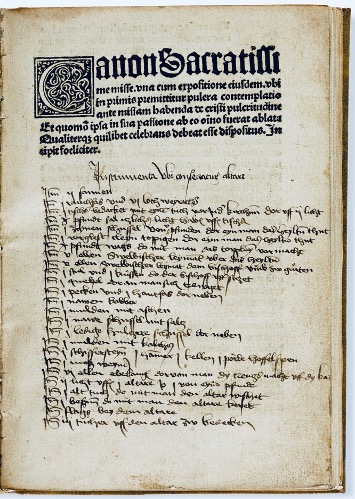
Two North American copies.
#6
658J. Eusebius -(275-339)
(La vita el transito) Eusebius Cremonensis: Epistola de morte Hieronymi; Aurelius Augustinus, S: Epistola de magnificentiis Hieronymi; Cyrillus: De Miraculis Hieronymi).

[Venice, Hannibal Foxius, 1 June 1487]. $6,000

Octavo 16.7x12cm. Signatures: a–i8. 72 leaves, 36 lines, Roman letter, rubricated with capital letters in red ink. Several annotations in ink and marginal notes, first leaf mounted, 5 leaves, small wormholes touching the letters on the front edge of 4 leaves, 2 intermediate margins reinforced with old paper strips, small worming marks on 4 leaves. – Bound in twentieth century quarter Morocco, with a spine label “Transito di San Gerolamo, Venetia, 1487”

This collection of pseudonymous works are now considered to have been composed anonymously in the thirteenth or fourteenth century by Dominicans in Rome. These Epistles here attributed to threefamous Bishops who were contemporaries of St Jerome Eusebius of Cremona 347-420, Augustine ofHippo 354- 430 and Cyril of Jerusalem 313-386.,
ISTC ih00257000; Goff H257; H8645*;
GW 9466].
United States:
Walters Library & Huntington Library. ONLY


ntritter, and is believed to have been printed using funds provided by Santritter, as was Paulus Pergulensis’s Compendium logicae printed by E. Ratdolt in 1481. It includes the two-color printing and table-style printing at which Ratdolt excelled. Santritter himself was a printer, and there are five known titles of incunabula that he printed.
Goff H257; H 8645*; IGI 3743; Hunt 2881; Bod-inc E-060; Sheppard 4095; Pr 5014; BSB-Ink E-126; GW 9466
https://data.cerl.org/istc/ih00257000
#7
Pelbartus de Themeswar No US Copy (not in Goff) No UK


Beside being quite rare, it has extensive and mostly complete provenance, a contemporary binding with a blind stamped title, rubrication.

305J Pelbartus de Themeswar (1430-1504)

Sermones Pomerii fratris Pelbarti de Themeswar diui ordinis sancti Francisci de Sanctis: Jncipiunt feliciter.
Hagenau(Augsburg): Heinrich Gran, for Johannes Rynman, 30 September, 1501. [imp[re]ssi … p[er] industriu[m] Henricu[m] Gran i[n] imp[eri]ali oppido Hagenaw: expe[n]sis ac su[m]ptib[us] p[ro]uidi Joha[n]nis Rynman Finiu[n]t feliciter: Anno … millesimoq[ui]nge[n]tesimoprimo. vltimo die Septe[m]bris] Price $ 7,000
Folio 12 x 8 inches Probably about the fourth edition. ( the listings for this book are all pretty sloppy despite Gran’s placing the exact dates in the colophon:20 feb 1499, 10 November 1499, 8 June 1500,
COLLATION:Completely unpaginated throughout, Signatures: pi6 [chi]6 a-b8 c6 d-e8 f6 g-h8 i6 k-l8 m6 n-o8 p6 q-s8 t6 v-x8 y6z8 A8 B6 C-D8 E6 F-G8H6 I-K8 L6 M-N8 O6 P-Q8 R6 S-T8 U6X-Y8 Z6 [&]8 leaves 12 and 358 blank . ( 13, 357 ff. ) TYPE: two columns, 58 lines per page plus headline, gothic letter, with guide letters and spaces for numerous four and six line ornamental capitals, contemporaneously hand rubricated in red ink throughout.

This copy is bound contemporary blind-stamped leather over wooden boards from an Augsburg workshop operating between 1482 and 1532 (Kyriss 79). Front board panelled with two blind rolls, one formed of arches, the other of birds and flowers, panel filled with further use of bird and flower blind roll and surmounted by blind-lettered title “POMERIUS*S”. Rear board panelled with same bird and flower blind roll, panel infilled with diagonally crossing blind fillets. There is Early monastic ink title to fore-edge and ink inscription to front free endpaper, nineteenth century ink inscription to front pastedown, wormholes to opening and closing leaves, a couple of unobtrusive wormholes extending into first few quires touching a few letters, corners of two leaves torn well clear of text, leaf A8 soiled at edges and possibly supplied from another copy, occasional very light paper browning otherwise internally clean. Binding worn with minor chips and losses, rebacked, upper edge of rear board damaged exposing wood beneath (not affecting blind rolls), remains of hasps and clasps, light marks to centre of each board where central brass bosses were once affixed.

The Bavarian binding and inscription to its front free endpaper indicate very early acquisition by the medieval #1) Benedictine Monastery of the Abbey of Irsee, Bavaria. Upon the dissolution of Bavarian monasteries in 1803 the volume was acquired by #2) Munich Court Library; a nineteenth century ink inscription to the front pastedown notes the copy to have been a duplicate and it was doubtless sold between 1815 and 1859 when the library instigated a series of large auctions to dispose of surplus items. Sometime after 1880 it was acquired by the. #3) Benedictine monastery of Erdington Abbey, Birmingham, England, established for monks expelled in Bismarck’s kultur-kampf from Beuron, Prussia. In 1922 the Erdington monastery was dissolved following return of its monks to Beuron after World War I, and its library appears to have been subsequently disbursed.
BIBLIOGRAPHICAL REFERENCES: Included in the Incunabula Short Title Catalogue, ISTC ip00252500, citing holdings at 15 locations globally with none in the US or UK; Hain 12557 (describing an imperfect copy). An attractive copy of this rare early work in entirely original state with substantial provenance.
Fourth or so edition of this collection of sermons by Pelbartus de Themesvar, Hungarian Franciscan at the St.John Monastery in Buda. The popular text was first published in 1499 He was born in 1430 in Temesvár, Hungary (now Timişoara, Romania). In 1458 he went to the University of Kraków. In 1463 he was licensed in Theology. Possibly in 1471 he left Kraków as a doctor, then in 1483 he is mentioned in the Franciscan Community Annales of St. John Monastery in Buda, the Hungarian Capital city. After 1483 his writings began to be published in print. The first printed edition of his Sermons dates from 1498. In 1503 a printed version of his lecture notes was published. Pelbartus died on 9 January 1504 in Buda, as a highly distinguished author and professor. Hungarian versions of his writings in manuscript date from 1510.
ISTC No.ip00252500; Hain 12557*; VD16 P1165; Sajó-Soltész p. 767; Günt(L) p.65; Wilhelmi 479a; GW M30525. https://www.gesamtkatalogderwiegendrucke.de/docs/M30525.htm
https://data.cerl.org/istc/ip00252500
Holdings
AustriaGraz, FranziskanerZB (imperfect)
Scheibbs, Kapuziner
Schwaz, Franziskaner (Ink U1/1-02) EstoniaTallinn Arch GermanyBerlin, Staatsbibliothek (3)
Gotha ForschLB
Greifswald GeistlMin
Leipzig UB
Mainz GM/StB (2, Ink.1107,2553)
München, Bayerische Staatsbibliothek
München MetropolitanKap (I117/1a)
München UB
Rostock UB
Wolfenbüttel, Herzog August Bibliothek HungaryBudapest Bibl national
Number of holding institutions 15

___________________________
#9
Peregrinus de Opole, Jacobus de Voragine, Nicolaus de Dinkelsbuel . 1479
238J Peregrinus of Opole (1305-1327) Jacobus de Voragine (1229-1298) & Nicolaus de Dinkelsbühl (1360-1433)
Peregrinus: Sermones de tempore et de sanctis. Add: Jacobus de Voragine: Quadragesimale. Nicolaus de Dinkelsbuel: Concordantia in passionem dominicam. Est autem huius operis ordo talis. Primo ponuntur sermones d[omi]nicales de tempore per anni circulu[m]. Secundo de sanctis, Tercio q[ua]dragesimale Jacobi de Foragine, Q[ua]rto concordantia quatuor euangelista[rum] in passiiones d[omi]nicam a magistro Nicolao Dinckelspubell collectam.”/ At end of leaf m8: “Sermones Peregrini de tempore finiunt.
[Ulm: Johann Zainer, not after 1479] (A copy now in Munich BSB has an ownership inscription dated 1479) Price $11,000.

Folio 27 x 20 cm. “Pars I (188): a-d8, e-k8/6, l-m8, A-C8, D-I8/6, K-N8; (N8 blank and removed) “Pars II (50.): a-f8/6, g8;” 3.”Pars III (40.): A-E8/ [276 (instead of 278The two blank leaves are missing. 162 & 188.] Rubicated throughout. Bound in Calf over wooden boards, with catches With typical blind stated vines as seem on many Zainer books,rebacked back restored using old material, cover covers rubbed and with small missing parts). I have located only two U.S.copies both defective. Like many of Zainer’s books it has quite a few in manufacturing faults which are evidence of how the book was made, which are explored in Claire Bolton’s book The fifteenth-century printing practices of Johann Zainer,Ulm. 1473-1478 among the are: Drag marks from inked letters, Poor register, frayed edge on cloth impression marks, corse thread weave cloth impressions This copy has very interesting Provenance.


Peregrinus of Opole was a Silesian Dominican friar, Prior in Wrocław and Racibórz and Provincial of the Polish-East German Order.
He was twice elected a provincial of his Order and became designated an inquisitor of Wrocław by the pope John XXII. His major literary achievement is this twofold collection of Latin sermons: Sermones de tempore (sermons on the feasts of the liturgical year) and Sermones de sanctis (sermons on feasts of particular saints). “Peregrinus of Oppeln was Prior of the Polish Dominican province (1305-12 &1322-27). His sermon sequences for the temporal and sanctoral liturgical cycles circulated widely in Germany and eastern Europe.

Jacobus de Voragine wrote several series of sermons, The Lenten sermons (Quadragesimale) were written between 1277 and 1286. These sermons were only slightly less popular than his “Legend,” and also known as ‘Golden’ on account of their popularity (there are more than 300 known manuscript copies). The genre of the Sermones quadragesimale did not exist as a distinct genre before the 1260’s This Dominican best-seller author Jacopo da Voragine, and the works of preachers from his own generation, like Peregrinus von Opeln [See above] have a strong sermo modernus structure and contain numerous exempla drawn from the world of nature.
¶Nicolaus de Dinkelsbuel. Magister in 1390, BUT The ascription of the Concordantia to Nicolaus de Dinkelsbühl (c 1360-1433) is mistaken. Although he is known as the author of a passion story ( Collecta et praedicata de passione Christi. 1472). he did not produce a concordance to it, But he is in fact listed as one of the authors cited in the work. (See A Madre, Nicolaus de Dinkelsbühl, Leben und Schriften, 1965, p 310.)
Only two North American copies, both defective.
Harvard University (- ff 189-278)
Bryn Mawr College, (ff 239-278)
Goff P267; HC 12581*; C 4407; IGI 7404; IBP 4241; Madsen 3083; Voull(B) 2629,5; Hubay(Augsburg) 1582; Hubay(Eichstätt) 794; Borm 2059; Walsh 909; Rhodes(Oxford Colleges) 1340; BMC II 529; BSB-Ink P-183; GW M30917 – Wegener, Zainer 9 – BSB-Ink P-183 – Proctor 2542 ISTC ip00267000.
https://data.cerl.org/istc/ip00267000
Claire Bolton’s The Fifteenth-Century Printing Practices of Johann Zainer, Ulm, 1473–1478. Oxford: Oxford Bibliographical Society.2016;
cf. A. Schulte, Über das Feuchten des Papiers mit nassen Tüchern bei Joh. Zainer; in Gutenberg-Jb. 1941, (pp. 19-22)

Jamesgray2@me.com


Leave a Reply