

This week’s blog is descriptions of Seven incunabula not represented in NYC libraries.
| 284J | Aridstotle/Burley 1500. | https://data.cerl.org/istc/ib01301000 | Boston Public, Newberry Library, Library of Philadelphia, Uof Illinois, | 4 |
| 466J | Balthasar de Porta | https://data.cerl.org/istc/ib00039000 | Huntington , SMU, Yale | |
| 658J | Eusebius 1487 | https://data.cerl.org/istc/ih00257000 | The Walters Library, Huntington Library | 2 |
| 305J | Pelbartus de Themeswar 1501. | https://data.cerl.org/istc/ip00252500 | 0 | |
| 238J | Peregrinus of Opole | https://data.cerl.org/istc/ip00267000 | Bryn Mawr College, (ff 239-278) ,Harvard (- ff 189-278) | 2 |
| 502J | Petrus de Rosenheim 1480 | https://data.cerl.org/istc/ir00336000 | Harvard, Newberry, Yale ,Brown, Huntington ,LOC | 6 |
| 563J | Thomas Aquinas 1493± | https://data.cerl.org/istc/it00325000 | San Marino CA, Huntington Library | 1 |
284J Aristotle , –Gualtherus Burlaeus. (Walter Burley (c. 1275–1344/5 ))
Expositio Gualteri Burlei super decem Libros Ethicorum Aristotelis (Contains the text of Robert Grosseteste’s translation of the Nicomachean Ethics)
Venice: Simon de Luere for Andreas Torresanus, 4 September 1500 Price $15,000

Folio, 12 1/4 X 8 1/2 in. A8 a6b-x8 y10. Second edition after the first of 1481.


This copy is bound in contemporary 1/4 blind-tooled goatskin over wooden boards with 3 (of 4) metal catches on front cover, rebacked retaining most of original backstrip, conspicuous termite damage on front cover, rear cover replaced with modern board, endpapers renewed; contents washed with residual soiling on opening leaves, worming through much of volume generally not impairing legibility, crude restoration in blank margins at beginning and end .
Ethica Nicomachea, Books 1-10, in the Latin translation of Robertus Grosseteste( 1175-1253) , incipit “[O]Mnis ars et om[n]is doctrina similiter aut[em] [et] actus [et] electio bonum quodda[m] ap=pete[re] videt[ur]. J[de]o b[e]n[e] enunciaueru[n]t bonu[m] q[uo]d omnia appetu[n]t”, b1r-y9v; colophon (Venetijs impresse arte Simonis de Leure: impensis v[ir]o domini Andree Torresani de Asula. Anno M.D. die v[er]o, IIIJ. Septebris.,), y10r; printer’s register, y10r. Wood cut diagrams.
Walter Burley, was one of the most prominent logicians and metaphysicians of the Middle Ages

“The first Latin translations of Aristotle’s Nicomachean Ethics, the Ethica vetus and the Ethica nova, are the object of six commentaries from the first half of the thirteenth century, presumably written by Parisian arts masters. Typical for these early commentaries is the interpretation of Aristotle’s doctrine in the light of Christian religion. In 1246/1248, Robert Grosseteste achieved a complete translation of the Nicomachean Ethics. The first to write commentaries on it were Albert the Great (twice) and Thomas Aquinas. Both attempted to interpret Aristotle philosophically; the extent to which Aquinas nevertheless admitted theological views is disputed in scholarship. The commentary of Aquinas was a major source for many other commentaries of the late thirteenth and early fourteenth centuries
Goff; b-1301 ; BMC 15th cent.,; v, 576 (ib. 24667); GW; 5779; ; Hain-Copinger; *4144; Harman, m. incunabula in the University of illinois library at urbana-champaign (1979); 191; ISTC (online); ib01301000; Proctor; 5269; Pellechet; 3080 lines df (2002)
https://data.cerl.org/istc/ib01301000
Locations: Boston Public Library
The Newberry Library
Free Library of Philadelphia
University of Illinois
For the first edn. 1481 (Goff 1300) 2 Locations: Harvard University, St. Bonaventure University, Franciscan Institute, Holy Name Library.
Aristotle’s ethics in the italian renaissance (ca. 1300–1650): the universities and the problem of moral education. Brill, Leiden. 2020
Iacopo Costa. The Ethics of Walter Burley. Alessandro D. Conti. A Companion to Walter Burley. Late Medieval Logician and Metaphysician, A Companion to Walter Burley : Late Medieval Logician and Metaphysician, pp.321-346, 2013, Brill’s Companions to the Christian Tradition, ISSN : 1871-6377 ; 41. ⟨halshs-00843864⟩
Conti, Alessandro, “Walter Burley”, The Stanford Encyclopedia of Philosophy (Summer 2016 Edition), Edward N. Zalta (ed.), URL = <https://plato.stanford.edu/archives/sum2016/entries/burley/>.


)0(
466J Balthasar de Porta (fl. 1487- 1499)
Expositio Canonis Missae. (Canon sacratissime misse: unacum expositione eiusdem: ubi in primis premittit pulchra contemplatio ante missam habenda de christi pulcritudine. Et quo mo[d]o ipsa in sua passione: ab eo o[mn]ino fuerat ablata. Qualiterque quilibet celebrans debeat esse dispositius incipit foeliciter.)
[Leipzig : Gregorius Böttiger (aka Werman), about 1495. Price: $12,000
Chancery half-sheet Quarto: 18.5 x12.5 cm. Signatures: aa-dd6, 24 of 24 leaves. Editio princeps, text in gothic letter, including a set of large caps, large woodcut initial and display face on title page, long list in a contemporary hand beneath printed title; This copy is bound in antique parchment .
Balthasar de Porta’s Canon Missae, also contains the proposal of the Exposition of the Eucharist before the celebration of mass . This commentary on the Mass, has verses taken from the Jesuida of Hieronymus de Vallibus, which are used in the appropriate context to illustrate or emphasize the author’s meaning. We know very few facts about the life of Balthasar de Porta , a Cistercian monk who served as Provisor at the order’s College (Saint Bernard) at Leipzig until about 1499. In the same years, he also published another work about Mass, the Expositio mysteriorum missae (Leipzig: Kacheloven, 1494) and a work on the heretical Bohemian Brethren, Conclusiones contra quorundam Bohemorum errores (Lepzig: Böttiger, about 1494), in which Balthasar refutes specific “errors” of the Hussite beliefs. Balthasar de Porta was Provisor of the Cistercian College of St. Bernhard in Leipzig (fl. 1487-1499).
Goff B39; H 2345*; GfT GfT: Gesellschaft für Typenkunde des XV. Jahrhunderts. Veröffentlichungen. 33 parts. Leipzig [etc], 1907-39. 521, 522; Pell 1753; BSB-Ink B-25; GW 3216; ISTC ib00039000. US copies: Huntington Library (2), Southern Methodist Univ, Yale University https://data.cerl.org/istc/ib00039000
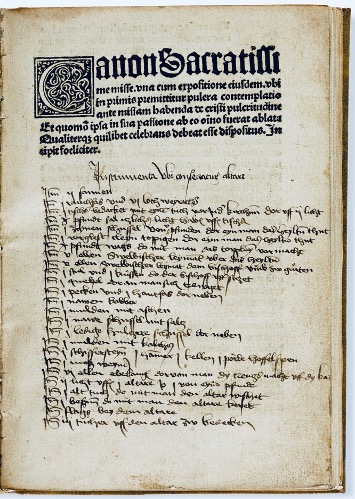
Two North American copies.
)-0-(
658J. Eusebius -(275-339)
(La vita el transito) Eusebius Cremonensis: Epistola de morte Hieronymi; Aurelius Augustinus, S: Epistola de magnificentiis Hieronymi; Cyrillus: De Miraculis Hieronymi).

[Venice, Hannibal Foxius, 1 June 1487]. $6,000

Octavo 16.7x12cm. Signatures: a–i8. 72 leaves, 36 lines, Roman letter, rubricated with capital letters in red ink. Several annotations in ink and marginal notes, first leaf mounted, 5 leaves, small wormholes touching the letters on the front edge of 4 leaves, 2 intermediate margins reinforced with old paper strips, small worming marks on 4 leaves. – Bound in twentieth century quarter Morocco, with a spine label “Transito di San Gerolamo, Venetia, 1487”

This collection of pseudonymous works are now considered to have been composed anonymously in the thirteenth or fourteenth century by Dominicans in Rome. These Epistles here attributed to threefamous Bishops who were contemporaries of St Jerome Eusebius of Cremona 347-420, Augustine ofHippo 354- 430 and Cyril of Jerusalem 313-386.,
ISTC ih00257000; Goff H257; H8645*;
GW 9466].
United States:
Walters Library & Huntington Library. ONLY


ntritter, and is believed to have been printed using funds provided by Santritter, as was Paulus Pergulensis’s Compendium logicae printed by E. Ratdolt in 1481. It includes the two-color printing and table-style printing at which Ratdolt excelled. Santritter himself was a printer, and there are five known titles of incunabula that he printed.
Goff H257; H 8645*; IGI 3743; Hunt 2881; Bod-inc E-060; Sheppard 4095; Pr 5014; BSB-Ink E-126; GW 9466
https://data.cerl.org/istc/ih00257000
]-[
Pelbartus de Themeswar No US Copy (not in Goff) No UK


Beside being quite rare, it has extensive and mostly complete provenance, a contemporary binding with a blind stamped title, rubrication.

305J Pelbartus de Themeswar (1430-1504)

Sermones Pomerii fratris Pelbarti de Themeswar diui ordinis sancti Francisci de Sanctis: Jncipiunt feliciter.
Hagenau(Augsburg): Heinrich Gran, for Johannes Rynman, 30 September, 1501. [imp[re]ssi … p[er] industriu[m] Henricu[m] Gran i[n] imp[eri]ali oppido Hagenaw: expe[n]sis ac su[m]ptib[us] p[ro]uidi Joha[n]nis Rynman Finiu[n]t feliciter: Anno … millesimoq[ui]nge[n]tesimoprimo. vltimo die Septe[m]bris] Price $ 6,000
Folio 12 x 8 inches Probably about the fourth edition. ( the listings for this book are all pretty sloppy despite Gran’s placing the exact dates in the colophon:20 feb 1499, 10 November 1499, 8 June 1500,
COLLATION:Completely unpaginated throughout, Signatures: pi6 [chi]6 a-b8 c6 d-e8 f6 g-h8 i6 k-l8 m6 n-o8 p6 q-s8 t6 v-x8 y6z8 A8 B6 C-D8 E6 F-G8H6 I-K8 L6 M-N8 O6 P-Q8 R6 S-T8 U6X-Y8 Z6 [&]8 leaves 12 and 358 blank . ( 13, 357 ff. ) TYPE: two columns, 58 lines per page plus headline, gothic letter, with guide letters and spaces for numerous four and six line ornamental capitals, contemporaneously hand rubricated in red ink throughout.

This copy is bound contemporary blind-stamped leather over wooden boards from an Augsburg workshop operating between 1482 and 1532 (Kyriss 79). Front board panelled with two blind rolls, one formed of arches, the other of birds and flowers, panel filled with further use of bird and flower blind roll and surmounted by blind-lettered title “POMERIUS*S”. Rear board panelled with same bird and flower blind roll, panel infilled with diagonally crossing blind fillets. There is Early monastic ink title to fore-edge and ink inscription to front free endpaper, nineteenth century ink inscription to front pastedown, wormholes to opening and closing leaves, a couple of unobtrusive wormholes extending into first few quires touching a few letters, corners of two leaves torn well clear of text, leaf A8 soiled at edges and possibly supplied from another copy, occasional very light paper browning otherwise internally clean. Binding worn with minor chips and losses, rebacked, upper edge of rear board damaged exposing wood beneath (not affecting blind rolls), remains of hasps and clasps, light marks to centre of each board where central brass bosses were once affixed.

The Bavarian binding and inscription to its front free endpaper indicate very early acquisition by the medieval #1) Benedictine Monastery of the Abbey of Irsee, Bavaria. Upon the dissolution of Bavarian monasteries in 1803 the volume was acquired by #2) Munich Court Library; a nineteenth century ink inscription to the front pastedown notes the copy to have been a duplicate and it was doubtless sold between 1815 and 1859 when the library instigated a series of large auctions to dispose of surplus items. Sometime after 1880 it was acquired by the. #3) Benedictine monastery of Erdington Abbey, Birmingham, England, established for monks expelled in Bismarck’s kultur-kampf from Beuron, Prussia. In 1922 the Erdington monastery was dissolved following return of its monks to Beuron after World War I, and its library appears to have been subsequently disbursed.
BIBLIOGRAPHICAL REFERENCES: Included in the Incunabula Short Title Catalogue, ISTC ip00252500, citing holdings at 15 locations globally with none in the US or UK; Hain 12557 (describing an imperfect copy). An attractive copy of this rare early work in entirely original state with substantial provenance.
Fourth or so edition of this collection of sermons by Pelbartus de Themesvar, Hungarian Franciscan at the St.John Monastery in Buda. The popular text was first published in 1499 He was born in 1430 in Temesvár, Hungary (now Timişoara, Romania). In 1458 he went to the University of Kraków. In 1463 he was licensed in Theology. Possibly in 1471 he left Kraków as a doctor, then in 1483 he is mentioned in the Franciscan Community Annales of St. John Monastery in Buda, the Hungarian Capital city. After 1483 his writings began to be published in print. The first printed edition of his Sermons dates from 1498. In 1503 a printed version of his lecture notes was published. Pelbartus died on 9 January 1504 in Buda, as a highly distinguished author and professor. Hungarian versions of his writings in manuscript date from 1510.
ISTC No.ip00252500; Hain 12557*; VD16 P1165; Sajó-Soltész p. 767; Günt(L) p.65; Wilhelmi 479a; GW M30525. https://www.gesamtkatalogderwiegendrucke.de/docs/M30525.htm
https://data.cerl.org/istc/ip00252500
Holdings
AustriaGraz, FranziskanerZB (imperfect)
Scheibbs, Kapuziner
Schwaz, Franziskaner (Ink U1/1-02) EstoniaTallinn Arch GermanyBerlin, Staatsbibliothek (3)
Gotha ForschLB
Greifswald GeistlMin
Leipzig UB
Mainz GM/StB (2, Ink.1107,2553)
München, Bayerische Staatsbibliothek
München MetropolitanKap (I117/1a)
München UB
Rostock UB
Wolfenbüttel, Herzog August Bibliothek HungaryBudapest Bibl national
Number of holding institutions 15

___________________________
X-X
Peregrinus de Opole, Jacobus de Voragine, Nicolaus de Dinkelsbuel . 1479
238J Peregrinus of Opole (1305-1327) Jacobus de Voragine (1229-1298) & Nicolaus de Dinkelsbühl (1360-1433)
Peregrinus: Sermones de tempore et de sanctis. Add: Jacobus de Voragine: Quadragesimale. Nicolaus de Dinkelsbuel: Concordantia in passionem dominicam. Est autem huius operis ordo talis. Primo ponuntur sermones d[omi]nicales de tempore per anni circulu[m]. Secundo de sanctis, Tercio q[ua]dragesimale Jacobi de Foragine, Q[ua]rto concordantia quatuor euangelista[rum] in passiiones d[omi]nicam a magistro Nicolao Dinckelspubell collectam.”/ At end of leaf m8: “Sermones Peregrini de tempore finiunt.
[Ulm: Johann Zainer, not after 1479] (A copy now in Munich BSB has an ownership inscription dated 1479) Price $11,000.

Folio 27 x 20 cm. “Pars I (188): a-d8, e-k8/6, l-m8, A-C8, D-I8/6, K-N8; (N8 blank and removed) “Pars II (50.): a-f8/6, g8;” 3.”Pars III (40.): A-E8/ [276 (instead of 278The two blank leaves are missing. 162 & 188.] Rubicated throughout. Bound in Calf over wooden boards, with catches With typical blind stated vines as seem on many Zainer books,rebacked back restored using old material, cover covers rubbed and with small missing parts). I have located only two U.S.copies both defective. Like many of Zainer’s books it has quite a few in manufacturing faults which are evidence of how the book was made, which are explored in Claire Bolton’s book The fifteenth-century printing practices of Johann Zainer,Ulm. 1473-1478 among the are: Drag marks from inked letters, Poor register, frayed edge on cloth impression marks, corse thread weave cloth impressions This copy has very interesting Provenance.


Peregrinus of Opole was a Silesian Dominican friar, Prior in Wrocław and Racibórz and Provincial of the Polish-East German Order.
He was twice elected a provincial of his Order and became designated an inquisitor of Wrocław by the pope John XXII. His major literary achievement is this twofold collection of Latin sermons: Sermones de tempore (sermons on the feasts of the liturgical year) and Sermones de sanctis (sermons on feasts of particular saints). “Peregrinus of Oppeln was Prior of the Polish Dominican province (1305-12 &1322-27). His sermon sequences for the temporal and sanctoral liturgical cycles circulated widely in Germany and eastern Europe.

Jacobus de Voragine wrote several series of sermons, The Lenten sermons (Quadragesimale) were written between 1277 and 1286. These sermons were only slightly less popular than his “Legend,” and also known as ‘Golden’ on account of their popularity (there are more than 300 known manuscript copies). The genre of the Sermones quadragesimale did not exist as a distinct genre before the 1260’s This Dominican best-seller author Jacopo da Voragine, and the works of preachers from his own generation, like Peregrinus von Opeln [See above] have a strong sermo modernus structure and contain numerous exempla drawn from the world of nature.
¶Nicolaus de Dinkelsbuel. Magister in 1390, BUT The ascription of the Concordantia to Nicolaus de Dinkelsbühl (c 1360-1433) is mistaken. Although he is known as the author of a passion story ( Collecta et praedicata de passione Christi. 1472). he did not produce a concordance to it, But he is in fact listed as one of the authors cited in the work. (See A Madre, Nicolaus de Dinkelsbühl, Leben und Schriften, 1965, p 310.)
Only two North American copies, both defective.
Harvard University (- ff 189-278)
Bryn Mawr College, (ff 239-278)
Goff P267; HC 12581*; C 4407; IGI 7404; IBP 4241; Madsen 3083; Voull(B) 2629,5; Hubay(Augsburg) 1582; Hubay(Eichstätt) 794; Borm 2059; Walsh 909; Rhodes(Oxford Colleges) 1340; BMC II 529; BSB-Ink P-183; GW M30917 – Wegener, Zainer 9 – BSB-Ink P-183 – Proctor 2542 ISTC ip00267000.
https://data.cerl.org/istc/ip00267000
Claire Bolton’s The Fifteenth-Century Printing Practices of Johann Zainer, Ulm, 1473–1478. Oxford: Oxford Bibliographical Society.2016;
cf. A. Schulte, Über das Feuchten des Papiers mit nassen Tüchern bei Joh. Zainer; in Gutenberg-Jb. 1941, (pp. 19-22)

>:<
“One of the earliest printed books on the ars memorativa or mnemotechnics”


502J Petrus de Rosenheim. (1380-1432). Nom probable : Petrus Wiechs
[incipt Roseum memoriale divinorum eloquiorum] /
[Köln] : [Southern Germany : n.pr., about 1480-90?] or [Cologne? : n.pr., about 1483] or [Ludwig von Renchen?], 1483 Deutschland (Oberrhein?). $ ON HOLD
Quarto (21 x 15 cm). ( a-f8 ) [1-68]. [48] a1 blank and lacking. Text in one column, 32 lines. Type: 80G. Initials painted in red, rubricated in red ink throughout . First edition .
Dated in Goff and IGI about 1483 “The edition is assigned by Proctor to the printer Ludwig von Renchen, active in Cologne from 1483 to ca. 1495, while ISTC gives Southern Germany between 1480-1490 and GW tentatively suggests Oberrhein, 1483.
This copy is bound in a simple quarter vellum binding over paste paper boards Gothic script, rubricated, red and blue hand-painted initials, 92 unnumbered pages. A very good copy, old repair to the original first blank leaf, a few spots, pale stain at the lower blank corner of the first quires. Rubricated in red throughout.

This is one of the earliest printed books on the ars memorativa or mnemotechnics the rare first edition of the Roseum memoriale composed by the German Benedictine monk Petrus of Rosenhaym (Upper Bavaria), written between 1423 and 1426 for Cardinal Giulio Branda di Castiglione. Petrus of Rosenhaym composed numerous treatises, sermons, and verses: the Roseum memoriale is surely his most famous work, enjoying wide popularity during the fifteenth century and first half of the sixteenth century.
Each couplet commences with a different letter in the order of the alphabet (omitting K, X, Y, Z, but including vowel I). These letters correspond to the numbers that appear on the cuts, and together form a method of memorizing the events of the Scripture as told by each of the Evangelists. It is a poem composed of 1,194 verses followed by an epilogue of seventy-three hexameters, in which every chapter of the Bible (excluding the Psalms) is summed up in a distich. The mnemotechnic method here employed is extremely complex: the hexameters of each section of the summary form an acrostic of the letters of the alphabet.
Based on Latin verses about Holy Scripture, it uses characteristic couplets (distiches) to express the main content of all chapters of the Old and New Testament. This introduction makes it possible to easily find every quote in the Bible. A highly popular and broadly used manual, its copies could be found in almost every European church after the invention of the printing press it was printed in several different locations. This early medieval incunable has not been clearly dated (This edition) researchers attribute it to the Upper Rhine region sometime between 1480 and 1483. After studying at the University of Vienna, Petrus de Rosenhaym, along with his friend Nikolaus Seyringer, moved to Subiaco, where he entered the Benedectine order. In 1413, he was appointed prior to the cloister of Rocca di Mondragone near Capua. In 1416, he took part in the Council of Konstanz, and later he was prior in Melk (Lower Austria). After 1423, he was appointed ‘cursor biblicus’ and ‘magister studentium’.
Dated in Goff and IGI about 1483 “The edition is assigned by Proctor to the printer Ludwig von Renchen, active in Cologne from 1483 to ca. 1495, while ISTC gives Southern Germany between 1480-1490 and GW tentatively suggests Oberrhein, 1483.
ISTC ir00336000; Goff R336; BMC I 312; ; GW M32724; Polain(B) 3128; IBE 4559; IGI 7668; IBP 4380; Sajó-Soltész 2676; Madsen 3549; Borm 2134; Hubay(Würzburg) 1704; AmBCat 199; Walsh 492; Oates 867; Pr 1517;; BSB P-362; Van der Haegen II,2:16,4?; Young 278;
https://data.cerl.org/istc/ir00336000
S. Tiedje, “The Roseum Memoriale divinorum Eloquiorum Petri de Rosenheim: A Bible Summary from the Fifteenth Century”, L. Dolezalová – T. Visi, Retelling the Bible. Literary, Historical, and Social Contexts, Frankfurt a.M.-Berlin et al. 2011, pp. 335-353;
Copies in the United States of America:
Brown , Harvard, Library of Congress, Huntington, Newberry, Yale.


o||o
Thomas Aquinas on Sacrament of Penance ca. 1493.

563J Thomas Aquinas
Quaestiones junta doctrina circa confessionem seu Sacramentum poenitentiae.
[Rome : Johann Besicken, about 1493-94]. Collijn assigns this to Guldinbeck. Price $4,500


Octavo 19 x 13.5 cm Signatures : a8 Fol. 8 blank and present. Old bibliographies assigned this to Plannck, later revised to Besicken. Bound in later quarter vellum. Institutional stamp and numbers on the first leaf. With the bookplate of the Library of the college of New Rochell the gift of James Edward Tobin. with call numbers in pencil and number in pen and debased stamp on the title.

VERY RARE ISTC cites only 9 copies; 1 in the US at Yale.
“Quaestiones circa confessionem seu Sacramentum poenitentiae” translates to “Questions regarding confession or the Sacrament of Penance” in Latin, This text is extracted from the Summa Theologica where St. Thomas discusses various aspects of the Catholic sacrament of confession, including its nature, necessity, and proper practice.

Besicken worked at Basel in 1483, and at Rome from 1493 until 1510, partly with various partners. Most of the woodcut capitals employed by Besicken and his partners are black ground capitals some with foliage decorations and others with branch-work; all enclosed in a frame line which form squares in the corners. The present incunable has such an example on a1. His imprints are generally rare.

Reference works. Goff T325; R 395; Mich 341; IBE 1729; IGI 3151; IBP 1681; SI 3781; Coll(S) 1410; Martín Abad T-106; Borm 810; GW 7350
https://data.cerl.org/istc/it00325000


Leave a Reply