


1) 887J: Agnes de Langeac (1602–1634) . ? Hyacinth Cunibert (ƒl1670’s)
Das geistreiches Leben der Wohl-Ehrwürdigen Mutter Agnetis a Iesu, deß H. Prediger-Ordens. Welche Anfangs die Dritte Regel deß H. Vatters Dominici angenommen;… in unsere Teutsche Sprach ubersetzet worden durch Hyacinthum Cunibert.

Köln, P. Steinbüchel 1671.
Price $2,900
Signatures: 12 Bl., 336 Bound in contemporary full calf. First German edition, The first French Vie was indeed published 1635 in Le Puy-en-Velay (where she was born) and then reissued in Lyon and Paris during the 1630s–40s.
Endpaper stamped, title with manuscript ownership, browned and partly brown-spotted partly heavily rubbed and bumped, back cover with worm trails..
The spiritual life of the Most Reverend Mother Agnetis a Iesu, of the Holy Order of Preachers. Agnes of Jesus (Agnès Galand, also called Agnès de Langeac) who was a French Dominican nun and mystic born in Le Puy-en-Velay. She entered the Dominican convent at Langeac in 1623 and became prioress. Agnes is remembered for her mystical visions, intense asceticism, and especially her role as a spiritual adviser to influential churchmen of the Counter-Reformation era. One of her most important connections was to Jean-Jacques Olier, founder of the Sulpicians, who regarded her as a prophetic guide and drew from her counsel in shaping his vision for clerical reform in France. Agnes’s cult was less about local miracles and more about inserting a universal Dominican female mystic into the spiritual arsenal of Catholic renewal in Central Europe.
In 1994 She was beatified by Pope John Paul II, which reflects the enduring impact of her reputation as a model of Dominican piety and mystical spirituality. Her life belongs to a central Catholic project of the seventeenth century: restoring discipline, devotion, and clerical holiness in response to both Protestant reform and internal Catholic laxity.
Translated into German by Hyacinthus Cunibert (Hyazinth Cunibert, O.P.), a Dominican active in the German provinces. His task was to adapt French mystical lives into accessible German, reinforcing Dominican female models for a German-speaking Catholic readership.
Agnes de Langeac, born Agnes Galand in Le Puy-en-Velay on 17 November 1602, entered the Dominican convent of Saint Catherine at Langeac in 1623. Upon professing her vows, she took the name Agnes of Jesus and quickly became known for her humility, strict asceticism, and extraordinary mystical gifts. Her life within the cloister was marked by visions, prophecies, and ecstatic experiences that were carefully recorded by confessors and fellow nuns, and which emphasized obedience, purity of heart, and a deep devotion to Christ crucified. Within a short span of time she was elected prioress, a position she held until her early death.
Although she remained enclosed, her influence reached well beyond the convent walls. She became the spiritual adviser of Jean-Jacques Olier,who later founded the Sulpician order, and through him she left a mark on the wider program of Catholic clerical reform in seventeenth-century France. In this sense, Agnes embodied a paradox common to many female mystics of her age: a life of silence and enclosure that nevertheless exercised a far-reaching spiritual authority.
Agnes died at Langeac on 19 October 1634 at the age of only thirty-two. Her reputation for sanctity led almost immediately to the circulation of devotional biographies. The first French Vie appeared in 1635, only a year after her death, and it quickly established her as a model of Dominican piety. Translations followed, with a German edition printed at Cologne in 1671 by Peter Steinbüchel, translated by the Dominican Hyazinth Cunibert, and later versions in Dutch and Italian. These printed lives carried her reputation across Central Europe and into new Catholic devotional contexts.
Agnes of Jesus was remembered above all as a woman who combined mystical vision with practical counsel, shaping the course of Catholic renewal through the lives of those she guided. Her sanctity was formally recognized much later, when Pope John Paul II declared her blessed on 20 November 1994. Today she remains a figure of Dominican identity and of Catholic reform, remembered not for a body of writings of her own—she left only dictated visions and prayers—but for a spiritual presence that inspired both contemporaries and later generations.
Scarcity.
VD17 ID: 12:117406L. ; OCLC: 718237200
https://www.digitale-sammlungen.de/en/view/bsb10787514?page=,1
First German edition (Cologne: Steinbüchel, 1671).
Verified institutional copies at BnF (4-LN27-8140 (A)) and Toulouse, Couvent Saint-Thomas d’Aquin (012 B AGN. LAN Lan.). Registered in VD17 (12:117406L). OCLC (718237200 Switzerland BIBLIOTHEQUE CANTONALE ET UNIVERSITAIRE. ; OCLC: 1075175021 zerØ copies
2) 977J Anselm, Saint, Archbishop of Canterbury, (1033-1109)
D. Anselmi Archiepiscopi Cantuariensis Theologorum Sui Temporis Facile Principis Operum Omnium Tomus … 4 Continens Diversas Ad Diversos Ab Eodem Exaratas Epistolas Tribus Libris Comprehens, Ac Hactenus Nunquam Editas, Et R. D. Joannis Picardi Bellovaci Ad S. Victoris Parisiensis Augustiniani Canonici Industria Annotationibus Ad Easdem Illustratas.
Agrippinae : Ex officina Cholin. sumptibus Petri Cholini, 1612 Price $2,300

Folio (four parts in one volume) 36 cm. Signatures: v1: π² *⁶ **⁸ (**8 blank) A-N⁶ O⁸; v. 2: Aa-Zz⁶ Aaa-Sss⁶ Ttt⁸; v. 3: *⁸ Aa-Yy⁶ (Yy6 blank); v. 4: π² (π2 blank) A-O⁶ P⁴ (P4 blank) (dagger)]⁸
Bound in a contemporary German blind-stamped pigskin binding over wooden boards, with a central oval panel stamp and multiple decorative roll borders; retaining the original brass catches but lacking clasps.
Earlier printed editions of Anselm’s works, issued from the mid-16th century and often associated with the editorial work of Antoine de Mouchy (1494–1574), circulated widely in Paris and Cologne, frequently without explicit attribution in later reprints. The present 1612 Cologne edition marks a significant development in this tradition, introducing the recension of Jean Picard (d. 1615), who revised the text on the basis of manuscript comparison, incorporated works here stated to be printed for the first time, and furnished the corpus with editorial annotations.
Anselm of Canterbury was born in Aosta around 1033 and entered the Norman abbey of Bec, where he became one of the most admired teachers in Europe. The early Anselm is a monastic intellectual, deeply concerned with meditation, logic, prayer, and the disciplined use of reason in theological reflection. The Monologion and Proslogion emerge from that world—not as public disputations, but as exercises in thinking carefully about what can and cannot be said about God.
After the Norman Conquest, Canterbury became deeply entangled with royal government, and Anselm—almost against his own temperament—was drawn into the machinery of power. When he became Archbishop of Canterbury in 1093, he inherited a church caught between reform ideals and the ambitions of the Norman kings. As one of the great advocates of rational clarity he spent much of his later life navigating situations where reason alone could solve very little. He was exiled more than once, struggled constantly over the limits of royal authority in church affairs, and became a central figure in the Investiture Controversy in England. The famous “ontological argument” matters not because it proves belief mechanically, but because it demonstrates a method: the attempt to follow an idea as far as reason can carry it, while remaining honest about the limits of certainty. In that sense, Anselm’s writings remain less a collection of answers than a discipline of thinking.


3) 940J Francis Bacon
Of The Advancement And Proficience Of Learning or the Partitions Of Sciences ix Bookes Written in Latin by the Most Eminent Illustrious & Famous Lord Francis Bacon Baron of Verulam Vicont St Alban Counsilour of Estate and Lord Chancellor of England. Interpreted by Gilbert Wats.
Oxford: Printed by Leon: Lichfield, Printer to the University, for Rob: Young, & Ed: Forrest, 1640 [colophon dated 1640] Price $7,500

Small Folio 26 x 17.5 cm. Signatures: ¶4, ¶¶2, ¶¶¶1, A2, B-C4, aa-gg4, hh2, †4, ††2, †1, A-Z4, Aa-Zz4, Aaa-Qqq4, Rrr2. Complete.

This copy has the usual minor rust otherwise the paper is quite crisp and clean, with the original type impression still visible. This is a nice copy, of a very important book. Bound in early full calf rebacked. It is stored in a custom red Morocco box.
“And even the title page it now becomes clear, announces this figure, for the Pillars of Hercules there also represent the temple of the world through which the ship of apocalyptic exploration passes, just as one passes through the twin pillars before Solomon’s Temple. Thus when discussing the Great Instauration’s motto, plus ultra, and Daniel’s prophecy in The Advancement of Learning, Bacon says, ‘For it may be truly affirmed to the honor of these times, and in a virtuous emulation with antiquity, that this great building of the world had never through–lights made in it, till the age of us and our fathers.’ The engraver Thomas Cecill [who engraved the image for the 1620 edition. The engraver here is W. Marshall, after Cecill] saw this great building as Solomon’s Temple.” (quoted from Francis Bacon and Modernity, by Charles Whitney, page 33) An engraved portrait of Bacon is bound before the title. It is dated 1626.
“Partitiones Scientiarum, a survey of the sciences, either such as then existed or such as required to be constructed afresh—in fact, an inventory of all the possessions of the human mind. The famous classification on which this survey proceeds is based upon an analysis of the faculties and objects of human knowledge. This division is represent by the De Augmentis Scientiarum [The Advancement of Learning].”
“Bacon’s grand motive in his attempt to found the sciences anew was the intense conviction that the knowledge man possessed was of little service to him. ‘The knowledge whereof the world is now possessed, especially that of nature, extendeth not to magnitude and certainty of works.’ Man’s sovereignty over nature, which is founded on knowledge alone, had been lost, and instead of the free relation between things and the human mind, there was nothing but vain notions and blind experiments. … Philosophy is not the science of things divine and human; it is not the search after truth. ‘I find that even those that have sought knowledge for itself, and not for benefit or ostentation, or any practical enablement in the course of their life, have nevertheless propounded to themselves a wrong mark, namely, satisfaction (which men call Truth) and not operation.’ ‘Is there any such happiness as for a man’s mind to be raised above the confusion of things, where he may have the prospect of the order of nature and error of man? But is this a view of delight only and not of discovery? of contentment and not of benefit? Shall he not as well discern the riches of nature’s warehouse as the beauty of her shop? Is truth ever barren? Shall he not be able thereby to produce worthy effects, and to endow the life of man with infinite commodities?’ Philosophy is altogether practical; it is of little matter to the fortunes of humanity what abstract notions one may entertain concerning the nature and the principles of things. This truth, however, has never yet been recognized; it has not yet been seen that the true aim of all science is ‘to endow the condition and life of man with new powers or works,’ or ‘to extend more widely the limits of the power and greatness of man.’” (quoted from the Encyclopedia Britannica, eleventh edition, vol. 3, page 145.)
STC 1167, F. FBL. HD. LC. PML. Gibson 141B
4). 694J Francis Bacon 1561-1626
The Essayes or counsels, civill and morall, of Francis Lo. Verulam, Viscount St. Alban.
London: Printed by Iohn Hauiland, and are sold by R. Allot, 1629. Price $3,800

Quarto, Signatures A-2V⁴ 2X² (a)² 2Y-3C⁴. Bound in the original limp vellum,(lacking ties) recently recased and a little rumpled but a very large, clean and unsophisticated copy of an early quarto edition.
“[Bacon’s] Essays, the fruits of his political and social observations, were first published in 1597, enlarged in 1612, and again in 1625. This 1629 edition contains all 58 essays. And is the First edition to contain The colors of good and evil and has divisional title page; register is continuous. Some copies may have been issued without this, but the present copy has it.
“Of Bacon’s literary, as distinct from his philosophical and professional works, far the most popular and important are the Essays [they] are the most original of all Bacon’s works, those which, in detail, he seems to have thought out most completely for himself, apart from books and collections of commonplaces. The last edition [referring to that of 1625, the first to contain all fifty-eight essays] teems indeed with quotations and illustrations, but they are suggested by his own matter and do not suggest it. Though the Essays have the same title as the larger collection of Montaigne, the two works have little in common, except that rare power of exciting interest and the unmistakable mark of genius which is impressed on them both.” (DNB)

His long attempt to reform the intellectual habits of the European mind began with the publication of The Advancement of Learning in 1605, which attacked the unprofitable scholasticism that inhibited the growth of knowledge and the mental prejudices that helped to keep men in ignorance. Above all he deplored the poor and confused state of knowledge about the operations of the natural world. Novum Organum, begun about 1608, published 1620, called for a systematic study of the natural world and of the causes of things, and proposed the inductive method as the most reliable instruments of enquiry. Bacon worked out the principles of the experimental method in this book, and developed them in De Augmentis, 1623. Sylva Sylvarum, a proposal of 1,000 experiments to be undertaken, was published posthumously in 1627, together with New Atlantis, a Utopian fragment written about 1617 that urged the foundation of a college for scientific research. A short book that enjoyed much popularity in his lifetime was De Sapientia Veterum, 1609 (translated as The Wisdom of the Ancients, 1619), which tried to demonstrate that the myths of the Greeks were coded accounts of their knowledge of the physical world.” (Quoted from The Seventeenth Century, by Graham Perry, pages 264-265.)
STC 1149; Gibson 15 Pforzheimer 31.
5) 963J. John Browne’s Myographia Nova:


963J John Browne 1642-1700?
Myographia nova: or, a graphical description of all the muscles in the humane body, as they arise in dissection: distributed into six lectures. At the Entrance into which, Are Demonstrated the proper Muscles belonging to each Lecture, now in General Use at the Theatre in Chirurgeons-Hall, London, and illustrated with two and forty copper-plates accurately Engraven after the Life, not only with their Names, but their Uses, fairly delineated on each Plate, as much as can be exprest by Figures; with an Explanation of their Names throughout the whole Discourse: As also their Originations, Insertions, and Uses, at large, in their proper Descriptions, and various useful Annotations, and curious Observations both of the Author’s, and other Modern Anatomists. Together with a Phoilosophical and Mathematical Account of the mechanism of muscular motion, and an Accurate and Concise discourse of the heart and its Use, with the circulation of the blood, etc. and with a compleat Account of the Arteries and Veins, as to their outward Coats, proving them to be made with Circular Fleshy Fibres, by whose Contractions their Trunks become Narrowed, and the Fluid Particles of the Blood are sent forwards into all the Parts of the Body. Digested into this New Method, by the Care and Study of John Browne, Sworn Chirurgeon in Ordinary to the King’s Most Excellent Majesty, and late Senior Chirurgeon of St. Thomas’s Hospital, Southwark.
London: sold by Thomas Shelmerdine, at the Rose-Tree in Little-Britain, 1705. Price $3,300

Folio 31 cm. Signatures [π]5, (a)2 (b)4 t8 (t)2 B-C2, (d)1,D-Z2 Aa-Tt2, Uu1Xx-Zz2 Aaa-Bbb2 (complete [Hh with repair]. In addition to the preceding collation, text complete with 41 (of 41) plates including the portrait frontispiece and 2 un-numbered plates. Includes dedications to William III and Earl of Sunderland, printing privilege, preface, 8 letters and poems of commendation list of subscribers and a Treatise on Muscular Dissection by Dr Bernard Connor at beginning. Richard Lower’s appendix of the heart occupies pp. 177/183. On pp. 171/176 is a tract by John Bernoulli “Mathematical disquisitions concerning muscular motion communicated in the Lypswick transactions” with its own plate” –Third edition.( stated as ‘The second edition, with additions.’) This is in good internal condition throughout with some wear, stained. Modern calf-backed marbled boards by D&D Galeries.

First published in 1681 under title: A compleat treatise of the muscles. The description of the muscles is based on William Molins’ Myskotomia, and the plates partly on Guilio Casserio’s Tabula anatomicae. According to Lowndes, the copies of this work that contain Browne’s portrait are printed on large paper. “Browne was a well-educated man, and likely a good surgeon, as he was certainly a well-trained anatomist according to the standard of the day. […] His treatise on the muscles consists of six lectures, illustrated by elaborate copper-plates, of which the engraving is better than the drawing. It is probably the first of such books in which the names of the muscles are printed on the figures. Browne’s portrait, engraved by R. White, is prefixed in different states to each of his books” (DNB).John Browne, physician to King Charles II, James II and William III, came from Norwich and gained surgical experience in London and in the navy, being wounded in the Anglo-Dutch war of 1665-67. About 1675 he was appointed surgeon-in-ordinary to Charles II and surgeon at St Thomas’s Hospital in 1683. He published other works on medicine, including the first recorded description of cirrhosis of the liver (1685) and the best surviving account of touching for the king’s evil (1684). His most important contribution was one of the clearest early descriptions of cirrhosis of the liver. Browne was subjected to a scathing attack by James Young (1647/1721) in which the present work was shown to be plagiarized from works of Casserio and William Molins. The nearly 40 anatomical plates were, with few exceptions, taken from Lolins’Myekotomia. Browne did not respond to Youngs criticism, but did make extensive changes to his text and issued future editions of the book under the title Myographia nova.”. (Heirs of Hippocrates N° 642 1681 ed.).


6) 926J Madeleine de La Calprenède (1618-1668)
Les Œuvres diverses tant en Vers qu’en Proses; dediees a Madame de Mattignon par Octavie.
A Paris, chez Jacques Le Gras, à l’entrée de la gallerie des Prisonniers. Avec privilege du Roy.1658
Price $3,800 .

Duodecimo: 13x 7.5cm. signatures: ã4, A-E12, F10, G11 (lacking G12) (Bound without a leaf of privilege, apparently as usual (cf Berès). First and only edition. This copy is bound in 18th century calf with gilt spine and label ; some pale damp staining.
First and only edition — and the sole publication of the poet Madeleine de La Calprenède, née de Lyée, a member of the Gascon family that produced the novelist Gautier de La Calprenède. Written under the name Octavie, the volume gathers fifty-nine short poems — sonnets, odes, and a single rondeau — addressed to “Madame de Mattignon,” in whose salon La Calprenède likely moved. Alternating voices of Octavie and Lucidor create a gender-reversed dialogue of love, illness, and devotion. Several pieces dwell on the physical realities of the body: a pair of sonnets describe bloodletting(pp. 133-134), while a striking sequence (pp. 56-59) reflects on her own smallpox, rare among female poets of the Grand Siècle.
The work survives in very few examples. OCLC records only one copy in the United States (Library of Congress) and a small handful in European holdings (BnF, Arsenal, Bodleian). Absent from Cioranescu’s listings of later seventeenth-century women poets and long overlooked in discussions of early modern “préciosité,” it represents one of the earliest independent poetic collections by a French woman outside court patronage.

7) 969J Fontenelle, Le Bovuer DeBeranard (1657-1757); Aphra Behn (1640-1689), tr. Antonius van Dale (1638-1708).
The History of Oracles, and the CHEATS of the pagan priests. In two parts. Made English.
London : printed in the year, 1688. and sold by most Booksellers. Price $4,500

Octavo X A8 a2 B-P8 Q4; $4 (-a2, Q2,Q3,Q4. First edition. Bound in contemporary speckled calf, corners rubbed, occasional light foxing, title stabilised with tissue, repairs to front and rear gutters, light pencil annotations and manicules.
This text is a translation of Bernard Le Bouvier de Fontenelle’s Histoire De Oracles(1687) by Aphra Behn. This work on debunking the Oracles of Ancient Greece and Rome as frauds of the priests used to manipulate the masses, rather than under Demonic influence as suggested by the Church. This is an abridged version of Antonius van Dale’s’ Latin work De Oraculis Ethnicorum (1683). Van Dales argument against the supernatural and the role of the Devil in the pagan oracular tradition was highly influential but was not popularized until Fontelle s adapted version two decades later. Appearing a generation after Margaret Cavendish’s Blazing World (1666), Behn’s translation of Fontenelle participates in the same reconfiguration of authority—no longer imagining new worlds of knowledge but actively dismantling inherited systems of belief.” Aphra Behn was one of the first English women to earn her living by her writing. She broke cultural barriers and opened public space for women writers. She was employed by Charles II to work as a spy in Antwerp. During the turbulent political times of the Exclusion Crisis, she wrote an epilogue and prologue that brought her into legal trouble; she thereafter devoted most of her writing to prose genres and translations. Issued in 1688, Behn’s translation of Fontenelle stands at the intersection of Restoration literary culture and the emerging skepticism of the Royal Society—here transforming classical oracles from sites of divine speech into instruments of human deception. The History of Oracles… was the penultimate work to be published before her death in 1689. The dedication by Behn is to Lord Jeffreys, known as the “hanging judge”. He became notable during the reign of King James II, rising to the position of Lord Chancellor. His conduct as a judge was to enforce royal policy, resulting in a historical reputation for severity and bias. Jeffreys historical notoriety comes from his actions in 1685, after Monmouth s Rebellion, where he was responsible for a high number of executions. Estimates of the numbers executed for treason have been given as high as 700. Behn’s dedication has been criticised as a “triumph of sycophancy”. Her name does not appear in the work, but the dedication is signed A.B. This dedication was removed from later editions.
Behn s decision to translate the book -and her translation- shed light on her philosophical, religious, and political views. The controversial nature of the book is perhaps reflected in Behn s decision to sign the translation only as “A. B.” See Mary Todd’s discussion of the book, below, for Behn s translation, her alignment with Hobbes, Lucretius, and Fontenelle, etc. Fontenelle s Oracles: Bernard Le Bovier de Fontenelle s The History of Oracles (1687) is a rationalist critique of ancient pagan oracles, challenging the belief that they were supernatural communications from demons. The work is structured into two dissertations: Demons and Possession: Fontenelle argues that oracles were not delivered by demons but were fabrications by pagan priests to manipulate the populace. He critiques the Christian tradition that attributes oracular messages to demonic forces, suggesting instead that these were human deceptions. He emphasizes the importance of verifying facts before attributing unexplained phenomena to supernatural causes. The oracles did not suddenly fall silent when Christ was born; they sputtered on for centuries until paganism itself died out. Fontenelle frames “The History of Oracles” as two long “discourses.” In the first he tackles a question that had exercised both pagan philosophers and early Christian apologists: were the famous responses of Delphi, Dodona, and the rest of the ancient oracles really spoken by demons? Fontenelle’s reply is an unequivocal No. He points out that Scripture never states that demons managed pagan shrines and therefore leaves Christians free to judge the matter on rational grounds. Because the Bible is silent, Fontenelle argues, it would be rash to fill the gap with tales of invisible spirits; in fact, the very silence obliges us to take the contrary position and assume no such license was ever granted to malevolent beings. He notes, too, that the Fathers of the Church had relied on impressive stories rather than evidence, and that respect for their authority has allowed the notion to stagger on long after its foundations had crumbled. Having dismissed the demon-hypothesis, Fontenelle attributes the workings of oracles to priestly fraud. He shows how oracular colleges-controlled access to the god, gathered private intelligence from travelers, opened sealed letters by night, and manufactured ambiguous verses to fit every possible outcome. The Pythian shrine at Delphi is his favorite example. There, the lone figure visible to the worshippers was a woman perched on a tripod; her writhing, shrieks and contorted gestures served as a public display of “possession,” while the real authors of the oracle male priests remained hidden. The same pattern recurs elsewhere: at Trophonius in Boeotia crowds were first stupefied with perfumes, drug-laced waters and frightening noises before being lowered through a shaft and brought up half-dazed, ready for any interpretation the priests cared to impose. Fontenelle is alert to the fact that women figure prominently in this theatre yet wield little authority.
O’Donnell BA6; Wing (CD-ROM, 1996), F1413; ESTC: R13813; T.C. 2:230
8). 950J. Jeanne-Françoise Frémyot, de Chantal, Saint (1572-1641)
Vive Iesvs :petite covstvme de ce monastere de la Visitation saincte Marie d’Annessy .
A Paris : [éditeur non identifié],1642. Price $3,800

Octavo 16.5 x 10 cm. Signatures: A-P8. Bound in contemporary full vellum, with two folding organizational plates bound at the end. This copy preserves a small but highly significant cluster of contemporary manuscript annotations, confined to a discrete sequence of pages (pp. 64–67) governing elections, inter-house requests, the comportment of Sisters sent on foundations, and the regulation of novices’ dress, rank, and discipline. These annotations are not devotional marginalia but administrative rubrics: brief headings, procedural clarifications, and enforcement cues designed to facilitate rapid consultation.
In the preface by Sister Jeanne-Françoise Frémiot writes:
“”These little Customs, my Sisters, will free our dear houses who desire them, from the difficulty they had in asking us questions about the little difficulties that happen to them, because, it is an admirable thing, to see the great affection that they have to conform in everything to this first Monastery and to preserve by this means the holy conformity between us”

The hand is consistent throughout and appears to be that of a Superior, Mistress of Novices, or convent secretary, using the Petite Coustume as a working governance manual. The notes clarify operational practice (“how elections are conducted,” “how Sisters are to comport themselves in travel,” “second communions,” “silence and good order”), and identify juridical limits where elections or requests carry—or do not carry—formal authority. Their placement corresponds exactly with the printed tables and procedural sections, indicating informed, sustained institutional use.

The volume concludes with two folding and tabular plates that are integral to the Petite Coustume’s purpose and use. Far from decorative, these plates function as operational diagrams, translating the text’s prescriptions into visual systems for governance: the registration of foundations, the regulation of movement within the cloister, and the allocation of communal labor. They give concrete form to practices that would otherwise remain abstract, showing how the customs of the
Annecy motherhouse were meant to be replicated, scaled, and applied in individual Visitation houses.

The Catholic Encyclopedia tells us that this is her masterpiece and that it is now unavailable . ( https://www.newadvent.org/cathen/08282c.htm )
9) 966J Maupas du Tour, Henri Couchon de, Bp. 1600-1680, Frémyot ,Jeanne-Françoise de Chantal, Saint.
a Vie de la vénérable mère Jeanne Françoise Frémiot, fondatrice, première mère et religieuse de l’ordre de la Visitation de Saincte Marie, par Messire Henry de Maupas Du Tour,….
Paris, Simeon Piget, 1658. Price: $2,800

Octavo 16x 11 cm. Signatures: å8,e6, A-Z8, Aa-Zz8, Aaa-Ee8 Bound in a contemporary full vellum binding. Vellum a bit soiled, lacks flyleaves,. There are two paper flaws on leaf 173/4 and 595/6 with minor and mostly marginal paper flaw, affecting two letters. With the book Plate of HubertI Janssenii. With the phrase associated with St. Augustine of Hippo and later St. Anselm of Canterbury. “Credite ut intelligas et omnia disce”

Henri de Henri de Maupas du Tour (c. 1600–1680), bishop of Le Puy and later Évreux, drew on testimony from the first generation of Nuns of the Visitation to produce a life of Jeanne-Françoise Frémyot de Chantal, helping to define the spiritual character, early traditions, and devotional practices of the Order of the Visitation of Holy Mary in print.
The work is organized less as a continuous narrative than as a sequence of moral episodes, tracing Jeanne de Chantal from noble birth through marriage, widowhood, and finally religious life. The table of chapters makes clear the didactic structure: each stage of life is treated as a distinct field of virtue—household governance, obedience, suffering, and spiritual direction—so that the reader encounters not simply a history, but a set of ordered examples.
“Mets moy comme un cachet sur ton cœur… car l’amour est fort comme la mort”
(Song of Songs 8:6). https://datb.cerl.org/estc/R12265

10) 907J Gassendi, Pierre (1592-1655); Galilei, Galileo (1564-1642); Kepler, Johannes (1571-1630
Petri Gassendi Institutio Astronomica: Juxta Hypotheseis tam Veterum quàm Recentiorum. Cui accesserunt Galilei Galilei Nuncius Sidereus; et Johannis Kepleri Dioptrice. Tertia editio prioribus Correctior.
London: Jacob Flesher for William Morden, 1653. $12,000

Octavo: 18.3 x 11.8 cm. 3 parts in one volume: [16], 199, [1]; 173, [1] p., 4 leaves of plates. Signatures: A-N8, O4; A-L8(including the final blank leaf). SECOND EDITION THUS, Fourth edition overall of Gassendi. . Bound in 17th century English calf boards with an expert rebacking back fly leaf with contemporary notes; sewing renewed, with spine label. The internal text is very generally clean and crisp with only slight aging. The first title page is printed in red and black. Galileo’s “Sidereus Nuncius” and Kepler’s “Dioptrice” are introduced by separate title pages. There are several 17th century inscriptions of members of the Holden family on title page regarding ownership of the book, including John and Obadiah; This copy is Ex libris Professor, Astronomer, Historian & Bibliophile Owen Gingerich.
The text is illustrated with astronomical woodcuts including images of the moon, showing its uneven, mountainous surface as discerned by Galileo through the telescope and four full-paged woodcut illustrations of stars (the Pleiades, Orion’s belt, the Praesepe and Orion Nebulas.)

Gassendi’s “Institutio Astronomica,” has been called the first modern astronomy textbook. It is divided into three sections: the first details the so-called theory of the spheres, the second describes astronomical theory, and the third discusses the conflicting ideas of Brahe and Copernicus.
Theis edition is important for the inclusion of two seminal works of telescopic astronomy: Galileo’s “Sidereus Nuncius” (first ed. Venice, 1610), in which announces his discovery of Jupiter’s moons, and Kepler’s “Dioptrice” (first ed. Augsburg, 1611), Kepler’s brilliant explanation of how the telescope works.Galileo’s Discoveries with the Telescope:”Galileo’s ‘Starry Messenger’ contains some of the most important discoveries in scientific literature. Learning in the summer of 1609 that a device for making distant objects seem close and magnified had been brought to Venice from Holland, Galileo soon constructed a spy-glass of his own which he demonstrated to the notables of the Venetian Republic, thus earning a large increase in his salary as professor of mathematics at Padua. Within a few months he had a good telescope, magnifying to 30 diameters, and was in full flood of astronomical observation.

”Through his telescope Galileo saw the moon as a spherical, solid, mountainous body very like the earth- quite different from the crystalline sphere of conventional philosophy. He saw numberless stars hidden from the naked eye in the constellations and the Milky Way.
Above all, he discovered four new ‘planets’, the satellites of Jupiter that he called (in honor of his patrons at Florence) the Medicean stars. Thus Galileo initiated modern observational astronomy and announced himself as a Copernican. (Printing and the Mind of Man)


Kepler’s Explanation of the Telescope: ”In order that the enormous possibilities harbored in the telescope could develop, it was necessary to clear up the theoretical laws by which it worked. And this achievement was reserved solely for Kepler. With the energy peculiar to him, inside of a few weeks, in the months of August and September of the same year, 1610, he composed a book tracing basically once and for all the laws governing the passage of light through lenses and systems of lenses. It is called ‘Dioptrice’, a word that Kepler himself coined and introduced into optics. […]”In problem 86 in which he shows ‘how with the help of two convex lenses visible objects can be made larger and distinct but inverted’ he develops the principle on which the astronomical telescope is based, the discovery of which is thus tied up with his name for all time. Further on follows the research into the double concave lens and the Galilean telescope in which a converging lens is used as objective and a diverging lens as eyepiece. By this suitable combination Kepler discovers the principle of today’s telescopic lens. Even this scanty account sows the epoch-making significance of the work. It is not an overstatement to call Kepler the father of modern optics because of it. (Max Caspar, “Kepler”, pp. 198-199) Kepler’s work is also the first to announce Galileo’s discovery that Venus has phases like the moon.
Wing G293; Cinti 155; Sotheran, I p. 75 (1476); cf. PMM 113 and Dibner, Heralds of Science, #7 (the 1610 edition)

11) 899J Geistliche Schöpfung (Menrad Molther; August von Lantzcron)
Geistliche Schöpffung und Reise dess wahren Israels auss Egypten, durch die Wüste in das gelobte Land :darinnen viele biszanhero unter Mosis-Decke gelegene Wörter und Namen der heiligen Schrift erklärt … werden, damit der egyptische Welt-Mensch … zur Aufferstehung in Christo geführet werde : dazu uns beydes das Alte und Neue Testament gegeben ist. Testament und Abschrifft der zwölf Patriarchen, der Söhnen Jacobs, wie ein jeder vor seinem End seine Kinder gelehret, zur Forcht Gottes und gottseligem Leben vermahnet hat
Franckfurt a. M : In Verlegung Christoff Le Blon, 1664/5. Price $3,500

Quarto 21cm Signatures: [A]4, B–Z4, Aa–Mm4 ([6], 200, 64 pp. (64-page appendix is sometimes separately titled Geistlicher Anhang). With engraved allegorical title by Adam and 50 copperplate illustrations by C. Meyer. Bound in full contemporary vellum.

This anonymous or pseudonymous book—sometimes attributed to Johann Georg Gichtel (1638–1710) or one of his circle and it belongs to the wave of German mystical and spiritual-allegorical literature inspired by Jacob Böhme, Valentin Weigel, and Johann Arndt.

The first part (Geistliche Schöpfung) reinterprets the Creation narrative as an inner cosmology: the rebirth of the soul as a microcosmic Genesis.
The second part (Reise des wahren Israels aus Egypten durch die Wüste in das gelobte Land) allegorizes the Exodus as the Christian’s mystical journey toward regeneration and divine union, turning the stages of Israel’s journey into steps of purification, illumination, and perfection. Each section combines Scriptural glosses, mystical commentary, and alchemical–psychological allegory—Egypt = material bondage; the wilderness = inner trial; Canaan = divine unity. It reflects the pervasive 17th-century habit of reading the Bible esoterically, decoding “words and names of Scripture lying under the veil of Moses.”
The Engraved title-page by “Adam”, often identified as Michael Adam (active in Frankfurt ca. 1650–1670), showing the six days of creation as an inner drama within the soul. 50 copperplates by C. Meyer (Conrad or Christoph Meyer, 1621–1689), a Frankfurt engraver and draftsman known for emblematic and devotional cycles.


Each image corresponds to a stage of the Exodus and its spiritual meaning—paralleling the plates in Johann Arndt’s Paradies-Gärtlein or the Emblemata Sacra of Boetius à Bolswert.
Together, text and image create a “spiritual emblem book” of exceptional richness and typographic sophistication. Many plates are signed “C. Meyer sc.” and have lengthy engraved captions blending Scripture and meditative verse.
The Geistliche Schöpfung represents the transition from Lutheran devotional orthodoxy to theosophical inwardness, anticipating the Radical Pietist and Philadelphian currents of the later 17th century. Its heavy use of biblical allegory, cosmic correspondences, and “inner Exodus” imagery reflects Böhme’s “Wiedergeburt im Geiste” and Arndt’s “Wahre Christenthum.”
VD17 12:637460N (variant issues recorded with slightly different collation).
Landwehr, Emblem and Fable Books, no. 318. Praz, Studies in Seventeenth-Century Imagery, p. 459.
Löwe, Theologie und Theosophie in Deutschland, § 243. Hollstein (Meyer) nos. 201–250 for the plate series. Faber du Faur, Deutsche Illustrierte Barockliteratur, II 312
12) 845J Leigh’s Natural History 1700Leigh, Charles. 1662-1701?
The natural history of Lancashire, Cheshire, and the peak, in Derbyshire: with an account of the British, Phœnician, Armenian, Gr. and Rom. antiquities in those parts. By Charles Leigh, Doctor of Physick.
Oxford: Printed for the Author; and to be had at Mr. George West’s, and Mr. Henry Clement’s, Booksellers there; Mr. Edward Evet’s, at the Green-Dragon, in St. Paul’s Church-yard; and Mr. John Nicholson, at the King’s-Arms, in Little-Britain, London, 1700 . Price $3,500

Folio, 8 3/5 x 13 3/5 in..Signatures: π2, A2, a2, [a]1, b-c2, π5, ***2, B-Z2, Aa-Tt2, π6, A-Z2, Aa-Bb2, A-S2, [t]-[v]2, T-V2, π2, X-Z2, Aa-Oo2, Aaa-Ddd2. COMPLETE First edition. Overall, this is a really lovely copy. It is bound in nineteenth century quarter calf over decorated paper boards recently rebacked. The illustrations in this book are magnificent. They consist of twenty-two full-paged engravings of fossils, caves,

and other geological sites; a double-paged map with contemporary coloring; two pages of the arms of the subscribers; and a portrait of the author after Faithorne.
Leigh, remembered primarily as a naturalist and a Fellow of the Royal Society, was a physician by profession. He published several works, “the most important of which is a ‘Natural History of Lancashire, Cheshire, and the Peak of Derbyshire’.” (Thomas)
Leigh’s approach, while empirical in cataloging natural phenomena, often intertwined observation with speculative explanations. For instance, he presented fossils and unusual artifacts as evidence of a global flood, a perspective rooted more in theological interpretation than in the rigorous skepticism Descartes championed. However, Leigh’s detailed observations of the environment, flora, and fauna reflect an early attempt at systematic classification, akin to the empirical aspects of Cartesian methodology. His work also mirrors the era’s fascination with the “wonders” of nature, blending scientific inquiry with the mystical and the unexplained.
The text of this volume is most intriguing; it is, all in one, a catalogue of antiquities, an archaeological survey, and a freak show, medical book and classical history book. This book embodies the transitional phase of early modern science, where observation began to challenge traditional narratives, yet was still deeply influenced by them. Leigh’s work serves as a testament to the evolving nature of scientific inquiry during the period. One of the author’s many goals is to demonstrate and prove, by producing artifacts and animals from far flung corners of the world, that a huge flood covered the whole earth and dislodged hippos from the homelands, planting them in the mud of Lancashire. His investigations begin with a description
of the weather and the physical environment (the temperature and pressure of air, the “principles” of mineral waters, soil and coal, minerals and metals) and performs experiments to demonstrate the properties of these various substances and their effects upon humans and animals. He also describes the flora and fauna, with several long passages on trees and plants, and an entire chapter dedicated to marine biology and “Fossile Plants”. With this evidence, Leigh ‘proves’ the historical reality of the “Universal Deluge” by producing artefacts in Lancashire that were never naturally occurring and therefore must have been swept to England in the Flood.

‘In Book II, Leigh turns to a discussion of Physick, beginning with a description and comparison of variously textured solid substances, including shells, taken from “a man’s leg, a man’s stool, the bladder of a hog” and other surprising places. The rest of the second book concerns various ‘distempers’ including an account of a “The Pestilential Fever raging in Lancashire, in the years 1693, 94, 95, 96”. Leigh discusses the symptoms of each illness, provides case studies, offers medicinal cures, and posits causes, giving the reader a vivid and unadulterated understanding of the state of 17th century Medical arts.
Wing L975.

The Dictionary of National Biography, 1885-1900, Volume 32 tells us, LEIGH, CHARLES (1662-1701 ?), physician and naturalist, son of William Leigh of Singleton-in-the-Fylde, Lancashire, and great-grandson of William Leigh [q.v.], B.D., rector of Standish, was born at Singleton Grange in 1662. On 7 July 1679 he became a commoner of Brasenose College, Oxford, where he graduated B.A. on 24 May 1683. Wood records that he left Oxford in debt and went to Cambridge, to Jesus College, as is believed. He graduated M.A. and M.D. (1689) at Cambridge. He was on 13 May 1685 elected F.R.S. When Wood wrote his ‘Athenæ Oxonienses,’ Leigh was practising in London; but he lived at Manchester at a later date, and had an extensive practice throughout Lancashire.
Some of his papers read before the Royal Society are printed in the ‘Philosophical Transactions,’ and he published the following separate works: 1. ‘Phthisologia Lancastriensis, cui accessit Tentamen Philosophicum de Mineralibus Aquis in eodem comitatu observatis,’ 1694, 8vo; reprinted at Geneva, 1736. 2. ‘Exercitationes quinque, de Aquis Mineralibus; Thermis Calidis; Morbis Acutis; Morbis Intermittentib.; Hydrope,’1697, 8vo. 3. ‘The Natural History of Lancashire, Cheshire, and the Peak in Derbyshire; with an account of the British, Phoenic, Armenian, Gr. and Rom. Antiquities found in those parts,’ Oxford, 1700, fol. This contains a good portrait after Faithorne as frontispiece. He also wrote three pamphlets in 1698 in answer to R. Bolton on the ‘Heat of the Blood,’ and one in reply to John Colebatch on curing the bite of a viper.
He married Dorothy, daughter of Edward Shuttleworth of Larbrick, Lancashire, with whom he received a moiety of the manor of Larbrick, afterwards surrendered in payment of a debt owing by Leigh to Serjeant Bretland. He left no issue. His widow died before 1717.
He is said to have died in 1701, but there is some doubt on this point, as Hearne, writing on 30 Oct. 1705 (MS. Diary, iv. 222), says : ‘I am told Dr. Leigh, who writ the “Natural History of Lancashire,” has divers things fit for the press, but that he will not let them see the light because his History has not taken well.’

[Wood’s Athenæ Oxon. (Bliss), ii. 643, iv. 609; Fish-wick’s Kirkham (Chetham Soc.), pp. 183, 189; Nicholson’s Engl. Hist. Libr. ed. 1776, p. 13; Earwaker’s Local Gleanings, 4to, i. 68; Ormerod’s Cheshire (Helsby), i. xxxiii; Dugdale’s Visitation of Lancashire (Chetham Soc.), p. 183; Malcolm’s Lives, 1815, 4to; Whitaker’s Whalley, 1818, p. 26; Gough’s Brit. Topogr.; Corresp. of K. Richardson of Bierley, p. 25; Raines’s Fellows of Manchester College (Chetham Soc.), i. 184; Derby Household Books (ChethamSoc.), p. 119; Thoresby’s Corresp. i. 390; J. E. Bailey’s MSS. in Chetham Library, Bundle No. 7.]

13) 971J Morton, John, 1671?-1726.
The natural history of Northampton-Shire; with some account of the antiquities. To which is annex’d a transcript of Doomsday-Book, so far as it relates to that county. By John Morton M. A. Rector of Oxendon in the same County, and Fellow of the Royal Society: Formerly of Emanuel-College in Cambridge.
London : printed for R. Knaplock, and R. Wilkin at the King’s-Head, in St. Paul’s Church-Yard, MDCCXII. [1712]. Price $4,500

Folio35 x 22 cm. Signatures: Signatures: A2,(a)2,B-Z2,Aa-Zz2, Aaa-Zzz2, Aaaa-Zaaa2,Aaaaa-Zzzzz2,Aaaaaa-Zzzzzz2, Aaaaaaa2 (a)-(o)2 14plates & map . Bound in contemporary paneled calf and rebacked later morocco with decoratively blind-embossed calf boards raised bands gilt decoration and lettering on spine all edges red speckled, bookplate and small stamps for the Law Society armorial bookplate for : St. John Percivale Baronet of Burton in the County of Cork in Ireland” on verso of title-page. John Perceval, 1st Earl of Egmont (1683‒1748), represents an early interest among Ireland’s aristocracy in creating better living conditions for people in British prisons. Perceval worked closely with James Oglethorpe on this issue, ultimately helping to establish the American colony of Georgia in 1732 as a haven for English subjects who had been imprisoned for debt. In 1700 he undertook a carefully planned tour of England, and in 1701 he was elected a fellow of the Royal Society.
There is some minor spotting to end-papers slight marginal browning not affecting text, small tear in centre fold of map repaired. This is an extremely rare item in fine condition internally.
First edition of Morton’s systematic natural history of Northamptonshire. Compiled over the course of a decade, Morton’s Natural History provides a careful account of the natural history, minerals, fossils, and geography of the county, accompanied by fourteen large copper-engravings. Though he limited his research strictly to Northamptonshire, Morton built on correspondence with Ray, Sloane, Nicolson, and others, subsequently gave nearly one thousand of his specimens to Sloane. Particularly striking are the engraved plates, many of which were individually dedicated to aristocratic patrons and Fellows of the Royal Society. These dedications read like a ‘Who’s Who’ and reveal the collaborative and social character of early English scientific culture, where natural history depended upon networks of clergy, collectors, noble patrons, and learned societies.


The plates therefore function not merely as illustrations, but also as acknowledgments of intellectual sponsorship and participation in the wider culture of empirical inquiry. Their elaborate Baroque cartouches, heraldic devices, and carefully rendered specimens beautifully capture a transitional moment in English science, when observation and experiment were still closely intertwined with aristocratic patronage and the ceremonial culture of learning. Morton records petrifications, shells, mineral formations, and botanical specimens alongside Roman roads, medieval remains, parish traditions, and economic observations about the county. The inclusion of a transcript of Domesday Bookfurther expands the project from simple topography into an attempt at total description across time. In Morton’s hands Northamptonshire becomes both a scientific field of inquiry and a historical landscape, examined with the same careful attention whether the subject is a fossil embedded in stone or the remains of an ancient settlement.
Hanson, 1550; ESTC T147393

971J Morton
971 Morton


14) 884J Mourath, Johann, S. J († ca. 1684) [ Xainctonge, Anne de, HA(1567–1621)]
Leben und Tugenden Annae Xantoniae, Stiffterin der in der Freien-Grafschafft Burgund aufgericht- und von Ihro Bäpstl. Heiligkeit Innocentio dem Zehenden unnd Eilften bestättigten Gesellschaft S. Ursulae.
Gedruckt zu Zug Bei- und durch Heinrich Ludwig Muos 1681. Price $4,100

Quarto 19X 15cm Signatures: )?( 7 )?( )?(1, A-Z4, Aa-Ss4 With engraved frontice. Full contemporary calf over wooden boards with one (of two) clasps, parts lightly stained, the endpapers and flyleaf with small worm marks A beautiful copy of the First edition.
This work recounts the life and virtues of Anne de Xainctonge (1567–1621), foundress of the Ursulines of the Freigrafschaft Burgund, approved by Popes Innocent X and XI. and confirmed by Her Papal Holiness Tenth and Eleventh. Mourath’s biography is characterized as part of the Jesuit hagiographical tradition of promoting recently established congregations and their exemplars of female piety. Anne de Xainctonge’s foundation of the Sisters of St. Ursula was a bold experiment in female pedagogy during the Catholic Reformation. Modeled consciously on the Jesuits, her community adopted Ignatian constitutions and methods in order to “do for girls what the Jesuits did for boys.” Uncloistered, they devoted themselves to free teaching for girls—an unusual and controversial mission that required papal approbation. Innocent X (1648) and Innocent XI (1678) confirmed their institute, lending legitimacy to this new vision of women’s religious life: active, apostolic, and educational. Their work spread across eastern France, Switzerland, and southern Germany, leaving a lasting mark on Catholic education for women.
Leben und Tugenden Annae Xantoniae captures this story at a key moment, less than sixty years after Xainctonge’s death. His Jesuit biography frames her as a hagiographic exemplar of female sanctity whose “virtues” validated a program of schooling and religious formation for girls. The book’s German vernacular, papal approvals on the title page, and Jesuit authorship made it a vehicle for defending the order’s legitimacy to skeptical audiences north of the Alps. In the world of post-Tridentine print, this volume is both edifying life and polemical defense: a testimony to how female education could be integrated into the Catholic renewal under Jesuit guidance.
VD17 12:118131E.; BBKL XVII, col. 1575f.; DeBacker-Sommervogel vol.V col.1342 nº1
1 US copy at JHU
15) 978J. Claude Perrault (1613-1688)
The natural history of animals containing the anatomical description of several creatures dissected by the Royal Academy of Sciences at Paris. Wherein The Construction, Fabrick and genuine Use of the Parts, are exactly and finely delineated in Copper Plates, and the whole Enriched with many Curious Physical and no less useful Anatomical Remarks, being one of the most Considerable Productions of that Academy. Done into English by a Fellow of the Royal Society. To which is added an account of the measure of a degree of a great circle of the earth, Published by the Members of the same Academy: English’d by R.W. Srs. With an alphabetical table of the Names of the several Animals mention’d in this Volume. And likewise an Alphabetical Index to make the Work Compleat. Publish’d by an Order of Council of the Royal Society
London : printed for R. Smith, at the Angel and Bible without Temple Barr, 1702. Price $5,500

Folio 297 x 200 mm Signatures: [π4, a2, b3, A3, B-Z4, Aa-Ii4, Kk-Nn2; [π]2, B-F4 . Frontispiece and 35 copper engraved plates, Engraved additional title. This copy was not bound with π2 another letterpress title for the second part [The Measure of the Earth,]. The plates each contain a general and several partial views of various animals after their dissection by the Royal Academy of Paris, of which Perrault was a member. – The last third of the work with an extensive contribution by the astronomer John Picard (1620-82) on the measurement of the Earth, illustrated with 5 excellently etched plates. –
Provenance: 1. Library of the Earls of Hopetoun., with their heraldic lithographic bookplate on the front pastedown. 2. Modern printed bookplate with the monogram “DP” and three rodents, also mounted on the front pastedown. The book block partly cracked at the front hinge. Endpapers with glue stains and various short, older handwritten entries, first and last pages slightly browned throughout. Discreetly trimmed, retaining a sufficient white margin. Foxing along the edges, otherwise a well-preserved copy with strong printing and blurred etched plates on mostly pure white paper.
Translated by Alexander Pitfield from the French work by Claude Perrault, first published in 1669 under the title: ‘Description anatomique d’un caméleon’, and later (in 1682) under the title: ‘Description anatomique de divers animaux.’ The ‘Account’ was translated by Richard Waller.

Perrault (1613–1688) was an architect and anatomist, an active contributor to the Académie des Sciences. The second part is by Picard (1620–1682), the first person to measure the size of the Earth with a reasonable degree of accuracy.
Perrault’s philosophy of medicine sprung from Galen, Greek physician of the Roman era, who understood biology in terms of the four humors (i.e., black bile, yellow bile, phlegm, and blood). As the Age of Enlightenment saw the development of animal and plant classification systems, believers in a mechanistic theory of animal function, like Perrault and Buffon resisted. In mechanism, living things are thought to be akin to complicated machines, containing parts that lack any intrinsic relationship to one another. Although Galenism and mechanism kept Perrault from make significant contributions to modern biology, his work maintains its own inherent scientific value, given the parameters of his philosophies, and also serves to document the steps and missteps along the way to a better understanding of biology. ESTC No.: T113853. https://datb.cerl.org/estc/T113853


978J. Claude Perrault


16) 955J Katherine Philips 1631-1664
Poems By the most deservedly Admired Mrs. Katherine Philips, The Matchless Orinda. To which is added Monsieur Corneilles Pompey & Horace,} Tragedies. With several other Translations out of French.
London: Printed by T.N. for Henry Herringman , 1678 $3,750

Folio 26.5 x 17cm. Signatures: [ ]2, A4, a-Z4, Aa-Tt4, Uu2. (five printed words on the margin of leaf 62 excised because of a stain I suspect missing about 3 words see image below) Fourth edition. (portrait 17x 9.8cm. mounted of Mrs Catherin Philips it is a bust of Katherine Phillips, on a pedestal within a niche; copy after an engraving by William Faithorne; used to illustrate the 1667 edition of Philips’s poems. Engraving Britis Museum # P,4.202 [Not the usual ‘ORINDA‘ by Faithorne ). This copy is bound in full contemporary calf. With the book plate of Robert Gathorn Hardy.
“The daughter of a London merchant, Katherine Fowler [her maiden name] was probably the first English woman poet to have her work published. She married a gentleman of substance from Cardigan, James Philips, and seems to have moved effortlessly into the literary circle adorned by Vaughan, Cowley, and Jeremy Taylor. She was best known by her pseudonym ‘Orinda’ and the name appears on the collection of her Letters, which give a useful picture of the early seventeenth-century literary world. Her translation of Corneille’s ‘Pompee’ was performed in Dublin in 1663 and a collection of her verses was published posthumously in 1664.” (Cambridge Guide to English Literature)

Wing P-2035, ESTC No.R19270. Bibliographic references for the Portrait.
O’Donoghue 1908-25 / Catalogue of Engraved British Portraits preserved in the Department of Prints and Drawings in the British Museum (3) Parkinson 2013 / A little gay history. Desire and diversity across the world (pp 13-14). https://datb.cerl.org/estc/R19270
Also see : https://mypoeticside.com/poets/katherine-philips-poems

17) 970J Plot, Robert, 1640-1696.
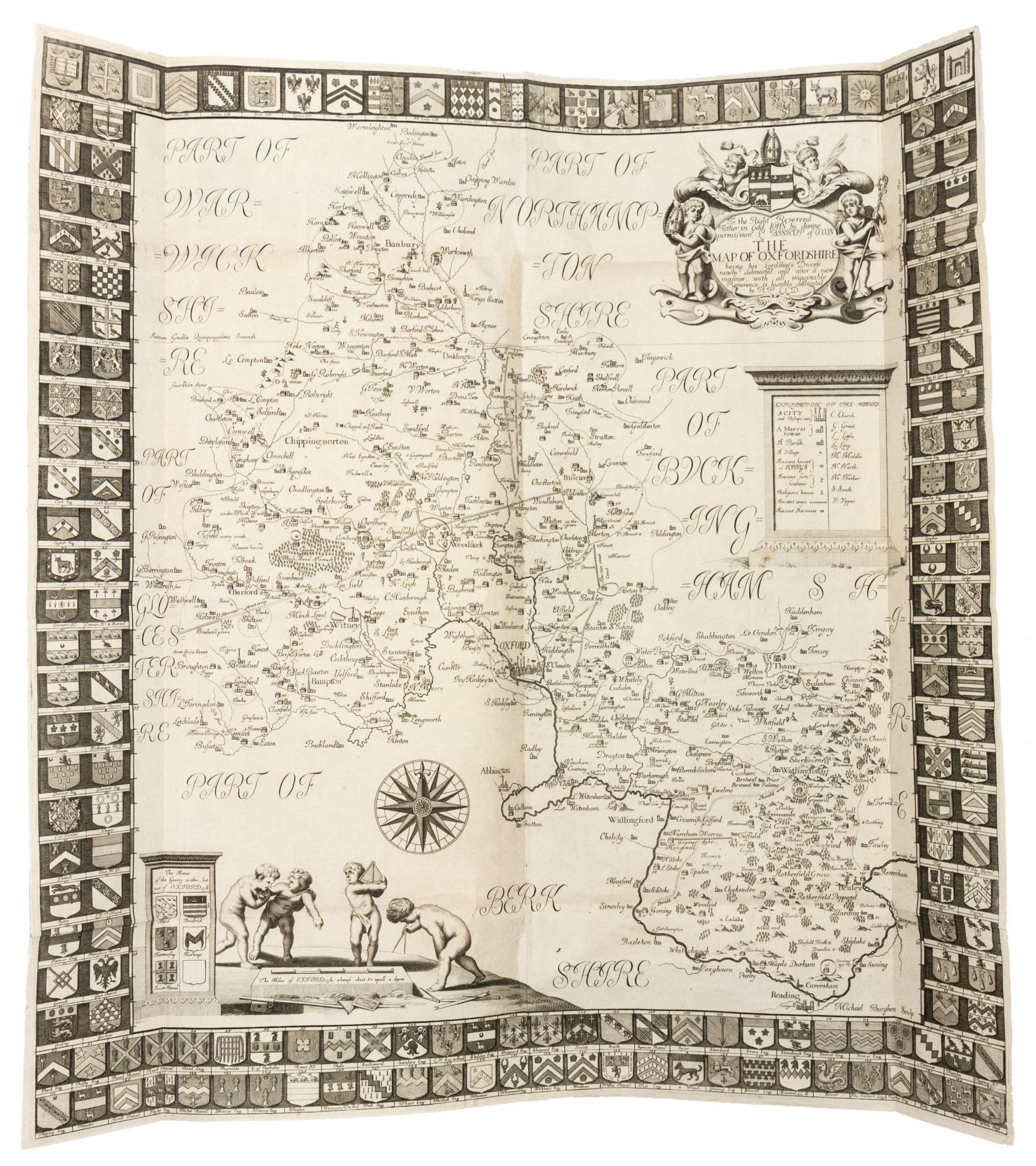
The natural history of Oxford-shire, being an essay toward the natural history of England. By R.P. LL.D.
Printed at the Theater in Oxford : and are to be had there: And in London at Mr. S. Millers, at the Star near the West-end of St. Pauls Church-yard, 1677. Price $6,000
Folio 32 x 20cm. Signatures: [a]² b⁴ A-2Y⁴ 2Z-3A² 3B². (Lacking final blank) 16 plates (including unnumbered map) : NotesR.P. = Robert Plot. At foot of title page: The price in sheets at the press, nine shillings. To subscribers, eight shillings. With an initial imprimatur leaf and a final leaf of errata (on 2Y4r).
FIRST EDITION. Illustrated with a large folding map of Oxfordshire and sixteen full-page engravings—fossils, minerals, plants, the remarkable Enstone waterworks, and other curiosities—engraved by Michael Burghers.
Of all late 17th-century English naturalists, few embody the restless, accumulative curiosity of the Baconian program as fully as Robert Plot. The Natural History of Oxford-shire is not simply a regional survey, but a working demonstration of how knowledge was to be gathered in the age of Francis Bacon: by collecting, observing, recording—without yet knowing what would prove significant.
Plot’s project begins in 1674 with an itinerary consciously expanding the antiquarian tradition. Where earlier surveyors catalogued manuscripts and monuments, Plot sought “all curiosities both of art and nature.” Within a year he had assembled a cabinet of minerals impressive enough to exhibit before the Royal Society; the book followed in 1677, securing his election as Fellow the same year.
The work proceeds not systematically, but inquisitively: from meteorological anomalies to echoes, mineral waters, soils, erosion (“deterration”), and finally to “formed stones”—fossils. Plot recognized stratification in embryonic form, describing the earth at Shotover Hill as composed of “several folds… including one another,” yet he stopped short of grasping the full geological implications. Like many contemporaries, he explained fossils as mineral crystallizations mimicking organic forms.
And yet—precisely in this mixture of accuracy and error—the book becomes historically decisive.
Among the engraved plates is the first published illustration of what we now recognize as a dinosaur fossil: a large femur from the Stonesfield quarry. Plot identified it cautiously, comparing it to an elephant bone in the Ashmolean collection, though later writers would elevate it to the remains of a giant. Only in the 19th century did Richard Owen working with Megalosaurus, Iguanodon, and Hylaeosaurus, define the group we call Dinosauria—retrospectively giving Plot’s image its extraordinary significance.
Plot’s natural history is thus not important despite its errors, but because of them. His emphasis on anomalies, exceptions, and the curious—what later critics called a “bizarre” or even “teratological” tendency—reflects a Baconian conviction that knowledge advances most rapidly at the margins of the known.

Equally important is the book’s practical dimension. Scattered throughout are detailed observations on agriculture, mining, and local industry, part of a deliberate effort to disseminate useful knowledge. In this respect, Plot’s work stands alongside the early Philosophical Transactions as an instrument of applied science.
His success as a collector and organizer of such material led directly to his appointment in 1683 as the first keeper of the Ashmolean Museum—arguably the first public museum in England—where the physical accumulation of specimens mirrored the intellectual accumulation represented in this book.

ESTC R7620; Wing P2586; Madan, 3130; Gibson 53


970 Robert Plot Oxford-shire881J Aristotle/ Joanne Baptista Ptolemaeo (1653-1726.)
18) 881J Aristotle/ Joanne Baptista Ptolemaeo (1653-1726.)
Philosophia mentis et sensuum secundum utramque Aristotelis methodum pertractata metaphysice, et empirice a Joanne Baptista Ptolemaeo.
Editio post Romanam, prima in Germania. Augsburg and Dillingen, Bencard; 1698.
Price $ 3,900

Folio.32.5 x 20cm. Signatures: π⁴, a-b⁴, A-5N⁴,):( -2):(⁴. [12 sheets, 839 pages, 8 sheets.] With engraved title vignette and 4 copper plates. – The copper plates with illustrations on kinetics, mechanics, astronomy, hydraulics and optics.- This copy is bound in blind-stamped alum tawed pigskin over wooden boards with handwritten title a beautiful example. Second edition (first published in Germany) (first published in Rome in 1696). -. – Title with handwritten title. Inscription “Monasterii Ursinensis” (= Irsee Monastery) and flyleaf with handwritten inscription of “P(ater) Benedikt (d. i. Michael) Remy,” brother of the painter and architect Magnus (Carl Ludwig) Remy, is responsible for the rehabilitation and painting of the Irsee Benedictine monastery in the late 17th century.The Library of the in 1802/03 dissolved benedictine Monastery Irse was integrated into the “Staats- und Stadtbibliothek Augsburg”. but other authorities say “In 1833, the greater part of the library was moved to Metten Abbey near Deggendorf.. Slightly browned and foxed, from p. 823 with a small wormhole, title and last leaf with bibliographical stamp (removed). Ibid. slightly stained, clasps missing.

Tolomei was born 3 December 1653 at Camberaia (or Gamberaia), between Pistoia and Florence, in the Grand Duchy of Tuscany. He received schooling in Florence; by age fifteen he studied law at the University of Pisa. On 18 February 1673, he entered the Society of Jesus in Rome. He was ordained a priest in 1684. Tolomei preached or lectured on Scripture (e.g. Sunday public lectures at the Church of the Gesù in Rome) to build his public reputation. Tolomei served as Procurator General of the Jesuits for a period before moving fully into academic work. He later occupied the Chair of Philosophy at the Roman College (Collegio Romano, which later becomes the Gregorian University) where he taught a course that resulted in Philosophia mentis et sensuum being printed. Eventually he also held the Chair of Theology, renewing controversial theology in the Jesuit scholastic context.
He became rector of the Roman College and of the German College at various points. He served as a consultor or adviser to various Roman congregations:
On 17 May 1712, Pope Clement XI made Tolomei a cardinal-priest, giving him the title of Santo Stefano al Monte Celio. As cardinal, Tolomei was a major theological adviser to the pope. He was involved in the controversies over Jansenism (notably the condemnation of the ideas of Pasquier Quesnel) and in doctrinal policing in the Church. Catholic. He died on 19 January 1726 in Rome, in the Roman College.
The Philosophia mentis et sensuum, Tolomei presented a scholastic-Aristotelian framework for philosophy of mind and senses, but tried to incorporate empirical data and recent discoveries. Many sources say he “welcomed every discovery of his time in the natural sciences” and wove them into his lecture course. His philosophical work was recognized outside Italy; his lectures were reprinted in Germany (1698) and elicited praise from Leibniz in a letter to M. A. Fardella.
His attempt to mediate between Aristotelian scholasticism and the experimental turn marks him as a transitional figure in Jesuit natural philosophy. The Philosophia mentis et sensuum (1696) is the key printed witness. It explicitly distinguishes metaphysice from empirice, attempting to give physics more autonomy for empirical/experimental concerns. .

Catholic Encyclopedia say that Tolomei “welcomed every discovery of his time in the natural sciences, and wove them into his lectures.” That reputation made his course distinctive compared to older, purely scholastic manuals. His updates were more curricular and philosophical, providing space for empirical sciences within a Jesuit framework.

VD17 12:642420B. ; De Backer-Sommervogel. vol.VIII, col86.nº2
19) 946J Thomas Sprat ((1635 – 20 May 1713)
The History of the Royal-Society of London, For the Improving of Natural Knowledge.
London : printed by T[homas]. R[oycroft]. for J. Martyn at the Bell without Temple-bar, and J. Allestry at the Rose and Crown in Duck-lane, printers to the Royal Society, MDCLXVII. [1667] Price $3,500

Quarto Signatures: [π] A-B⁴ A-Z⁴ Aa-Zz⁴Aaa-Iii⁴. First issue with “of” repeated on p.85 lines 6/7. This copy has the very rare frontispiece by Hollar, missing in many copies. Jackson I. Cope and Harold Whitemore Jones (1958, p.ix) speaks of large-paper copies, which had a frontispiece by Wenceslaus Hollar showing a bust of Charles II. It is presumed that all copies have the illustration of the Royal Society coat of arms on the half-title verso plus the two diagrammatic plates. Thus, copies can have either two or three plates. The existence of different-sized copies needs to be verified. The Huntington copy with the Charles II plate is no different in other respects. This copy is bound in original full calf.

A foundational charter of the Scientific Revolution.
Thomas Sprat’s History of the Royal-Society (1667) is the first official institutional manifesto of the Royal Society of London, issued only seven years after the Society received its royal charter and at the very moment when the “new science” was defining itself against scholastic and humanist traditions. Commissioned by the Fellows and written by one of its earliest members, it sets out—systematically and programmatically—the Society’s aims, methods, and philosophical commitments: empiricism, experiment, collective observation, plain style, mechanical explanations of nature, and a conscious break with the authority-based learning of the past. Sprat codifies what would soon be known as the “Baconian programme,” presenting the Society as the practical realization of Francis Bacon’s call for a cooperative, experiment-driven natural philosophy.

The book is equally important as a work of self-fashioning. Sprat defends the Society from critics, argues for the moral and political usefulness of experimental knowledge, and articulates its distinctive linguistic ideal—anti-rhetorical, stripped of ornament, trustworthy because transparent—which would shape English scientific prose for generations. The work is also one of the earliest published accounts of the laboratories, instruments, and experimental procedures of the founding Fellows—Boyle, Hooke, Wilkins, Wren, Wallis—making it a primary historical source for the early development of chemistry, microscopy, physiology, and mechanical philosophy.
The rare Wenceslaus Hollar frontispiece, present in this copy, is itself a visual statement of the Society’s identity: a temple of experimental knowledge flanked by scientific instruments and crowned by the Royal arms, asserting the cultural legitimacy and public mission of the new science. Many early copies lack it, making its presence a notable point of completeness.
Sprat’s History stands today as the first systematic exposition of the ethos that would dominate Enlightenment science: cooperative research, methodological skepticism, precise reporting, and the disciplined accumulation of empirical facts. It is, quite literally, the book that taught Europe how to recognize—and trust—the new experimental philosophy.
ESTC R16577; Wing S5032; Norman 1989; Keynes, Evelyn 178; Hooke 28
20) 943J Varet, Alexandre-Louis (1632–1676).
The Nunns Complaint against the Fryars. Being the charge given in to the Court of France, by the Nunns of St. Katherine near Provins, against the Fathers Cordeliers their Confessours. Several times printed in French; and now faithfully done into English.
London: Printed by E. H. [Edward Horton] for Robert Pawlett, at the Bible in Chancery-Lane near Fleet-street, 1676. Price: $3,200

Octavo x cm. Signatures: A⁸, a⁸, B-N⁸, O⁴ (O₃₄, advertisements) First Edition in English. A good copy in modern quarter calf and marble boards. Gilt titles and date to spine.
The charges levelled against the priests by members of the Poor Clare Order were not exclusively sexual but also took in the disorders committed by the Cordeliers in the temporal concerns of the Monastery of St Catherine a chapter that carries the running headline Riotous Wastes of the Revenue. This is the first English translation of Factum pour les religieuses de Sainte-Catherine-les-Provins, the explosive legal brief composed by Alexandre-Louis Varet on behalf of the Ursulines of Saint-Catherine-les-Provins during their prolonged litigation against the Cordelier confessors. Printer identified as Edward Horton by Wing. With the imprimatur on leaf O1v; final three leaves contain the table of contents and publisher’s advertisements.
First published in French in 1668, Varet’s Factum is among the most notorious examples of seventeenth-century convent scandal literature—a genre that exposed abuses of clerical authority while navigating the volatile politics of Gallicanism, monastic discipline, and female religious autonomy. This first English translation (issued only a year after Varet’s death) shows that the Provins affair resonated strongly beyond France, providing Protestant England with a rich example of Catholic disorder, fiscal mismanagement, and moral corruption.
The nuns’ accusations cut through the usual sensationalism and strike directly at the structural abuses of power within their convent. Their Factum documents a systematic takeover of Sainte-Catherine’s finances and governance: the Cordeliers, they argue, commandeered the strongroom, absorbed alms intended for the community, diverted endowments to their own uses, sold furnishings without consent, and drew freely on convent funds to support their private feasting and hospitality.
Chapters such as “Riotous Wastes of the Revenue” read as the nuns’ own audit of misrule—an itemized exposure of unauthorized expenditures and fiscal manipulation. The English translator amplifies this material not simply to scandalize, but to present a pointed example of clerical overreach at a moment when English readers were debating monastic property, ecclesiastical authority, and women’s legal standing.
In this framing, the nuns are not passive victims but forensic accountants of their own oppression, assembling evidence, defining charges, and challenging the friars’ misuse of corporate resources with striking confidence and precision.
While the text avoids direct accusations of sexual scandal, it circles them with rhetorical precision. The friars’ “familiarities,” “unchaste liberties,” and “private conferences” are described in language that deliberately invites the reader’s imagination to do the rest. These insinuations were powerful enough that the French authorities sought to suppress later printings.
What makes The Nunns Complaint against the Fryars exceptional is not the friars’ misconduct—abuses of authority in convents were sadly not unusual—but the collective, coordinated, and legally literate response of the women themselves. In the seventeenth century, cloistered women were juridically constrained, economically dependent, and structurally silenced. Yet the nuns of Sainte-Catherine-les-Provins defied all expectations by acting as a corporate legal body, gathering testimony, documenting grievances, commissioning an advocate, and presenting a formal factum before a royal court
Wing (CD-ROM, 1996), V110. ESTC No.R34691
https://datb.cerl.org/estc/R34691
21) 862J Judith Zins-Penninck (1631-1664) [Caton, William, translator]
Some worthy proverbs left behind by Judith Zins-Penninck, to be read in the congregation of the saints· Translated into English by one that testifieth, that God is no respecter of persons, for whosoever worketh righteousness, and feareth him, of what nation, countrey, trib or language soever he or she be, such find acceptance with the Lord. W.C.
London : printed for William Warwick, 1663. Price. $ 4,500

Judith Zinspenning, daughter Conrad Zinspenning and Catharina de Mol who were Mennonite, and afterwards a Baptist. Judith was married in 1652 to the Mennonite physician Jacob Willemsz Sewel. She showed such a deep religious inclination that her father said: “It is a pity that this girl is not a boy, who then in time might become an eminent instrument in the church.” Judith joined the Quakers in 1657, after hearing William Ames. She became an eloquent minister, visited England in 1663, was author of A Serious Reproof to the Flemish Baptists, 1660, a Book of Proverbs (translated into English by William Caton, London, 1663), An Epistle, and other short books. She died at Amsterdam on 10 September 1664, aged 34. Her husband predeceased her.
“You foolish Virgins, how have you been sleeping away your precious time“
With Quakerism she found the lively inner “Spirit.” The Sewels left the Mennonites and became ardent “instruments” of Quakerism. The Sewel home became a place for Quaker meetings. She was the first woman to lead worship services.
In 1663 she traveled to England with William Ames’ successor William Caton, where she developed further intimate contacts with the Quakers. She preached and wrote several books, including Een ernstige berispinge aen de leeraers van de ulaemsche doops-gesinde gemeinte ende de leeden derselve In Amsterdam : [publisher not identified], 1660 . She became a victim of a plague epidemic on her return to The Netherlands. Years later her son noted Dutch historian and lexicographer Willem Sewel published her writings in Eenige schriften en zendbrieven. . . nu tot verderen dienst gemeen gemaakt (1684). He also included a warm tribute to her in his Historie.
The present work is in fact a letter comprised of a series of proverbs of various lengths and on a great variety of subjects, focused on achieving wisdom and love through service and obedience to God and by supporting “them that are stumbling.” The work is signed in type “Your Friend and Sister, Judith Zins-Penninck” and datelined at the end from Colchester on June 2, 1663. The text is an English translation by Quaker William Caton (1636-1665) of the original Dutch. Zins-Penninck (or Zinspenning, as her name is sometimes found) was a deeply religious Mennonite until she was converted to Quakerism by missionary William Ames in 1657. She became a valuable missionary herself, hosting Quaker meetings at her house and preaching the Quaker doctrine in England in 1663, the same trip that produced the present work. Sadly, she contracted the plague on her way back from England to the Netherlands and died the next year.
•Note. The subsequent history of William Bradford in America, his work, and
his connection with the Keith schism, is part of Pennsylvania history.
ºNote. Judith Zins-Penninck or Zins-Penning, was a Dutch woman, the wife
of Jacob Williamson Sewel, and the mother of William Sewel, the well-known Quaker
historian. She died at Amsterdam, in the, 7th month, 1664. A copy of the above
tract, which is somewhat rare, is in the Haver ford College Library. (See Smith’s
Catalogue of Friends’
ESTC No.: R25223; Wing Z13; Smith, J. Descriptive catalogue of Friends’ books, II, p. 979.
https://datb.cerl.org/estc/R25223
Locations :1) Folger Shakespeare, 2)Friends Historical Society of Swarthmore College, 3)Harvard, 4)Haverford, 5)Huntington, 6)Yale .
I could not find any book by Judith Zins-Penninck in APC . In the 1906 book auctions records I only found this !

“William Warwick, bookseller in Colchester (?), 1663. His name is found on the imprint to a pamphlet entitled Some Worthy Proverbs Left Behind by Judith Zins-Penninckt to Be Read in the Congregation of the Saints.’ Translated into English by one that testifieth that God is no respecter of persons, for whosoever worketh righteousness, and feareth him, of what Nation, Countrey, Tribe or Language soever he or she be, such find acceptance with the Lord. W[illiam] C[aton], London, Printed for William Warwick, 1663.”
W. Warwick also printed “A Testimony,” etc., to Edward Burrough, in 1662; and William Ames’s “Sound out of Zion,” in 1663. The imprint, as given by Smith, “London. Printed and are to Be Sold by William Warwick,” would seem to imply that in 1662 and 1663, Warwick was resident in London, and not Colchester, as the Dictionary supposes. (Smith 1 : 367 ; 1 : 28.)”
This is about a third of my 17th century books, use the search option on my blog to see if I have what you are looking for. Next week I will post a list of my 16th century books. ‘CC2’ .
For university and special collections purchases, I am accustomed to working within committee timelines and budget cycles. Titles may be placed on hold during review, and flexible invoicing arrangements can be discussed where appropriate. I welcome inquiries at jamesgray2@me.

Short Link to catalogue CC1: https://wp.me/p3kzOR-9ww

James E. Gray Booksellers 46 Hobbs Road Princeton Ma 01541
617-678-4517
jamesgray2@me.com


Leave a Reply