
“Eyb stressed two things throughout the Margarita: to be able to write well and to be disposed to live properly.”

Albrecht von Eyb (who has a few more than the usual variations of his name [see
https://data.cerl.org/thesaurus/cnp01316161]
364J Albrecht von Eyb 1420-1475
Margarita Poetarum

[publisher not identified] or [Venezia: Albertino da Lessona, 1502]. $2,900


Folio a8 B-X8 [Y]8 (this copy is lacking the final gathering signed with numbers 1-4 only comprising a Materiarum-tabula which is not present). Gatherings a-I have printed decorated intitials; K-X have blanks (some with printed guides) for manuscript initials. It is bound in full seventeenth century vellum with spine label.
The first printing of the Margarita Poetica was printed by Johannes Sensenschmidt in1472 , between 1472 and 1503 there appeared at least a dozen editions [In this edition the marginal index letters correspond to those of 1493 Venice edition]. Eyb went to Italy and devoted himself to humanistic study at the Universities of Pavia and Bologna. He returned to Germany in 1451, having been appointed Canon at Eichstätt and Bamberg. From 1452 to 1459 he was again a student at Bologna, gaining the degree of doctor in 1459. The Margarita is named after Eyb’s mother and was written in 1459.
Fabriccius observed the “Eyb stressed two things throughout the Margarita: to be able to write well and to be disposed to live properly.”
In a contrast to “Ars Dictaminis” (perhaps the Middle Ages version of TEXTING) von Eyb uses this work to re-Introduce Cicero’s Vetera Rhetorica. While certainly there are many late medieval texts on letter writing, Eyb as can be seen in the structure of this book is greatly influenced by the Vetera Rhetorica.
The Content are in three parts, the first EPISTOLA SIVE PROLOGUS, is a revised and augmented versionOF M.T.C. (CICERO) with excerpts taken from classical authors and Italian humanists and formulas for letter-writing.
The second part AUCTORITATES consists of an anthology of prose writers (including Cicero, Lactantius, Macrobuius, Plutarchus, etc.).
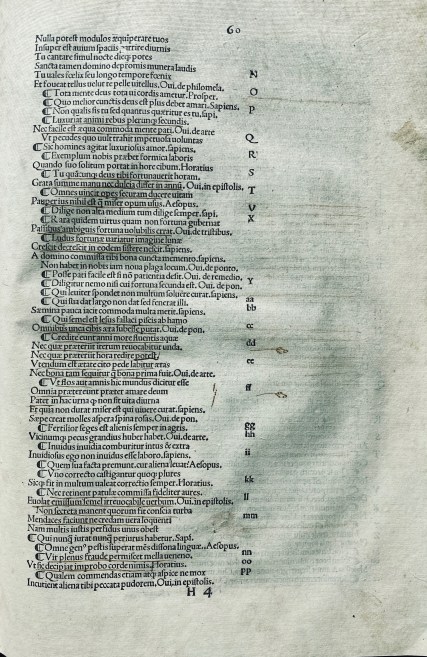
The third part ORATIONES: contains selections from Petrarch, dramatic poets (Terence,
Seneca, Plautus), and a variety of humanist speeches by Renaissance copyists, letter-writers and philosophers, including Johannes Lamola, Poggius Florentinus, Galeatius Sforza and the author himself.

Below is a web version :Note: kostenfrei Materials specified: Volltext // 2012 digitalisiert von: Bayerische Staatsbibliothek, München. Exemplar mit der Signatur: München, Bayerische Staatsbibliothek — 2 Var. 17
http://www.mdz-nbn-resolving.de/urn/resolver.pl?urn=urn:nbn:de:bvb:12-bsb10150222-0


Leave a Reply