633J. Book of Hours, Use of Rome most likely produced in England mid fifteenth century.
Duodecimo, 10.5 x 8.5 cm. . 196 parchment leaves of parchment, including tipped-in illuminations on the verso that are coordinated with facing richly foliated leaves on the next recto. No catchwords visible, but ranges of chartae demonstrate a predominant use of quinternions. Restored binding (tight) with new cords to secure the gatherings.
$Sold
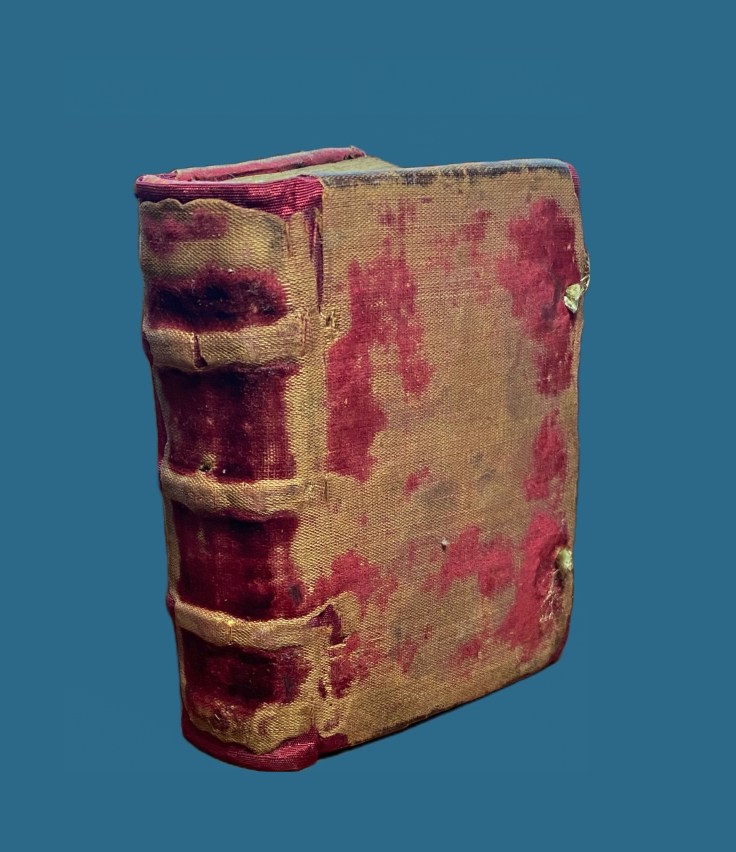
Bound in early red velvet over past boards mostlikely English as well. This is a Beautiful 15th-Century Book of Hours. Illuminated Latin manuscript on parchment 196 chartae (ms. pages), numbered in a modern hand on recto.
Illustrated with twelve full- page painted miniatures, with an additional 20 pages with elaborate foliated decoration (full page ornamentation) of delicate floral and vine tracery design in a full palette of greens, blue, red and gold leaf. Throughout are elaborate letter devices with raised and gilt-gesso accents. The fine and very regular calligraphy, mostly seventeen lines per charta (ms. page), is predominantly in a brownish ink, with touches of red tracery decoration on all pages (those not counted as having a diaper design).
The twelve miniature paintings include:
A portrait of Christ’s face (1), (see above)
The crucifixion(17),
The Madonna and child (28),
an angel holding a staff and letter (41),
the visitation of a seraph(71),
Solomon on his throne and woman at his feet with two bleeding infants(84),
The flight out of Egypt(92),
Monks by a Coffin (130) ,
St. Jerome with his lion(141),
St. Anthony with his pig with his hem aflame (191),
St. George slaying the dragon(191),
St. Catherine and her wheel(195).
Binding: red velvet, possibly contemporary, with three raised bands on spine. Condition: cover velvet heavily worn. Fabric clasps mostly missing. A few leaves — ones with the fuller decoration and painting — have suffered some worming, mostly by edges, with some of these gaps repaired with clear material meant to stabilize. (Holes and loss not disconcerting or especially conspicuous, in our view.) While we would consider it possible that the highly decorated pages without facing paintings might once have had such, we think it likelier that this Book of Hours has suffered no such loss, as there is no evidence of excision. The edges of particular leaves (see for ex. cc. 171-172) demonstrate soiling from the thumbs of the original user (users) of the book. More extensive traces of “thumb soiling” will also suggest additional information on provenance.
Thanks to the restoration and resultant tight binding and lack of catch-words (probably due to trimming), as well as the use of tipped-in miniatures, the exact nature of the gatherings can only be confirmed by unbinding the manuscript. However, there are some sections of the ms that seem to confirm that the standard quire is the quinternion (10): for instance: cc. 131–170 (410).
General observations: 196cc. complete. The manuscript is the product of three artisans: a single copyist for the text, a rubricator and a fine miniaturist (whose work is confined to the tipped-in, single chartae that are of a thicker parchment, and always on the verso of the charta: 16, 28, 40, etc. [above]). The collaboration among the three artisans, clearly coordinated between the copyist and rubricator is consistently demonstrated on the richly adorned “foliation pages”, invariably a recto that faces the miniaturist’s verso, to create two facing “pages” of illumination and foliation with coordinated palettes.
The final “memorie” to saints Ioannes (John), George (193v) and Katherine (195v) are worthy of
additional study in locating the manuscript’s original, daily use.
A fine example of the Rome use with local amendments. The work of all three artisans is superb.
I have been selling books printed before 1700 since1991. Please feel free to contact with any early book questions, I'll try and answer them.
Jamesgray2@me.com




Leave a Reply