

Sixteen Reformation Books, 1499–1533
This catalog presents sixteen works from the opening decades of the Reformation, spanning the years 1499 to 1533. Together they illustrate the shift from late medieval theology to the defining controversies of early Lutheranism.
Highlights include the editio princeps of the Augsburg Confession and its Apology, printed at Wittenberg by Georg Rhau in 1531, with extensive contemporary annotations. Other volumes trace the course of reform through sermons, polemics, and devotional texts that shaped the emerging Protestant tradition.

This blog begins with The Augsburg Confession, first presented in Latin and German at the Diet of Augsburg on 25 June 1530, is widely regarded as the oldest and most authoritative of the Lutheran creeds — a defining document that cohesively articulated Lutheran doctrine amidst intense ecclesiastical controversy.
This particular copy, printed in Wittenberg by Georg Rhau (1531), is exceptionally rare: an “editio princeps” of the Confession paired with its Apology, meticulously annotated on nearly every page, lending it both scholarly significance and remarkable provenance.
Augsburg Confession 1530 Annotated on almost every page!

711J Philip Melanchthon (1497-1560), Luther, Martin . (1483-1546)
Confessio fidei exhibita invictiss. Imp. Carolo V. Caefari Aug. in Comiciis Auguftae. Anno M.D.XXX. Addita est Apologia Co(n)fessionis Psalm. 119 Et loquebar de te stimonijs tuis in conspectu
Wittenberg: Georg Rhau, 1531. Price $22,000 
Octavo, 5.25 x 3.5. This edition is an impression of the “editio princeps” printed in the same year. a-d8, e4,9e4 blank and present) f-n8, A-P8, Q4, Q4 blank and present.
The title page has a woodcut illustration. This is bound in full modern calf over wooden boards in an antique style, it is a very nice copy with annotations on every page.

The Augsburg Confession is “the oldest and most authoritative of the Lutheran creeds,” and a major historical document, in which the revolution of Martin Luther assumed organized political action and permanently changed the religious and national identity of Europe. “It was drafted by Melanchthon, on the basis of Luther’s Marburg, Schwabach, and Torgau articles, and bore the signature of seven German princes….On 25 June, 1530, copies of it, in Latin and German, were presented to Charles V, at the diet of Augsburg, and the German version of it was read aloud before the secular and ecclesiastical Estates of the Empire. Charles retained his Latin copy which he brought with him to Spain, giving the other into the custody of the Archbishop of Mainz.”

In a remarkable calm and able “Answer” to the Confession, controversialists such as Eck, Wimpina, and Cochlaeus analyze the Confession, giving praise and censure where either is due. Melanchthon retorted with an “apologia” which Lutherans generally regard as their second symbolic book; Charles refused to accept it, because of the violent language against the Catholic Church. (summarized from the Catholic Encyclopedia)
“Although the emperor prohibited the printing of the evangelical confession without his special permission, during the diet six German editions and one in Latin were published….Their inaccuracy and incorrectness induced Melanchthon to prepare an edition to which he added the Apology. Thus originated the so-called editio princeps of the Augustana and Apology, which was published in the spring of 1531. This edition was regarded as the authentic reproduction of the faith professed before the emperor and empire.” (Schaff-Herzog)
This is the back of the title to the Apologia with an index!


¶
Martin Luther On the “The Sermon on the Mount”
In a remarkable sermon series delivered between 1530 and 1532, Martin Luther meticulously unpacked the profound truths of Matthew’s Sermon on the Mount — chapters 5 through 7 — preaching with extraordinary depth and precision, often dedicating five printed pages of commentary to a single line of Scripture.
These Wednesday lectures, offered during Johann Bugenhagen’s absence, illuminate Luther’s interpretive genius: weaving biblical language, doctrinal clarity, and the Reformation’s urgency into every segment of the text. This presentation preserves both the spirit and the structure of those lectures, inviting readers to experience the unfolding of a theological journey that shaped Protestant exegesis. Each section follows Luther’s own line-by-line method, bringing the familiar words of Jesus to vivid, intellectual life.

Luther, Martin Luther (1483-1546)
Das fünffte, Sechste vnd Siebend Capitel S. Matthei.
Wittenberg , Joseph Klug 1532. $4,500

Luther preached these sermons on Matthew 5-7 on Wednesdays in 1530-32 while Bugenhagen, the regular weekday Preacher, was away in Lubeck on Reformation-related business. : Luther proceeds line by line, some times giving one line from Matthew five pages of commentary! Here is a shortened example: from the greek. And His commentary.


Quarto, 8 1/4 X 6 1/2 inches . First edition A-Z4, a-z4, aa-nn4, oo2, pp4 (241 Leaves ) Bound in full modern calf, a very nice copy. Contemporary manuscript marginalia in red!
¶ Benzing, Lutherbibliographie, 3011 /// Hohenemser 2586 /// Kuczyński 1746 /// Jackson 1089 /// Pegg, Bibliotheca, 883 /// Pegg, Great Britain, 1923 /// Pegg, Swiss, 2988 /// VD16 L 4754 . Item #751
Here is a shortened example: from the greek. And His commentary.

 V. 3. Blessed are the poor in spirit, for theirs is the kingdom of heaven.
This is a delightful, sweet and genial beginning of his sermon. For he does not come, like Moses or a teacher of law, with alarming and threatening demands; but in the most friendly manner, with enticements and allurements and pleasant promises. And indeed, if it had not been thus recorded, and if the first uttered precious words of the Lord Christ had not been given to us all, an over-curious spirit would tempt and impel everybody to run after them even to Jerusalem, yes, to the end of the world, if one might hear but a word of it all. Then there would be plenty of money forthcoming to build a good road, and every one would boastingly glory how he had heard or read the very words that the Lord Christ had spoken. O what a wonderfully happy man would he  be held to be who should succeed in this! That is just the way it surely would be if we had none of our Savior’s words written, although much might have been written by others; and every one would say: Yes, I hear indeed what St. Paul and his other apostles have taught, but I would much rather hear what he himself said and preached. But now that it is so common, that every one has it written in a book, and can read it daily, nobody regards it as something special and precious. Yes, we grow tired of them and neglect them, just as if not the high Majesty of heaven, but some cobbler, had uttered them. Therefore we are duly punished for our ingratitude and contemptuous treatment of these words by getting little enough from them, and never feeling or tasting what a treasure, force and power there is in the words of Christ. But he who has grace only to recognize them as the words of God and not of man, will surely regard them as higher and more precious, and never grow tired or weary of them.
Kindly and sweet as this sermon is for Christians, who are our Lord’s disciples, just so vexatious and intolerable is it for the Jews and their great saints. For he hits them a hard blow in the very beginning with these words, rejects and condemns their doctrine and preaches the direct contrary; yes, he denounces woe against their way of living and teaching, as is shown in the sixth chapter of Luke. For the substance of their teaching was this: If it goes well with a man here upon earth, he is happy and well off; that was all they aimed at, that God should give them enough upon earth, if they were pious and served him; as David says of them in <19E401> Psalm 144: “Our garners are full, affording all manner of store; our sheep bring forth thousands and ten thousands in our streets; our oxen are strong to labor; there is no breaking in or going out; there is no complaining in our streets.”.
Price: $4,500.

Part II
The authors of the works in this list.
Saint Athanasius, Theophylactus de Achrida, Richardus de Sancto Victore, Poliziano, Basilius Caesariensis, Lochmair, Biel, Morgenstern, Melanchthon, Luther, Tauler, Emser, Fischer, Cochlaeus, Huberinus, Wimpfeling.
547Ja. Saint Athanasius, Patriarch of Alexandria, 295-373. Theophylactus de Achrida,; 1055-1126. Richardus de Sancto Victore,; 1110-1173. Ambrogio Traversari 1386-1439. Cristoforo Persona; 1416-1485. Angelo Poliziano; 1454-1494. Nicolas Béraud; 1473-1550. Desiderius Erasmus; 1496-1536

Athanasii Episcopi Alexandrini Sanctissima, Eloqventissimaqve Opera ¶Commentarij in epistolas Pauli ¶Contra Gentiles Liber vnus ¶De incarnatio[n]e Verbi … ¶Disputatio contra Arrium. ¶In vim Psalmorum opusculum. ¶Exhortatio ad Monachos. ¶De passione Imaginis domini nostri Libellus. ¶Epistolæ nonnullæ Romanorum Pontificum ad Athanasium, et Atanasij ad eosdem. ¶Que̜ omnia olimia[m] latina facta Christophoro Porsena, Ambrosio Monacho, Angelo Politiano interpretibus, vna cum doctissima Erasmi Roterodani [sic] ad pium lectorem paraclesi.
Bound with
547Jb. Basilius Caesariensis. 330–379 Jacques Lefèvre D’Etaples. c. 1450–1536.
Basilii Magni Caesariensium in Cappadocia Antistitis sanctissimi opera plane diuina, variis e locis sedulo collecta: & accuratio[n]e ac impe[n]sis Iodici Badii Ascensii recognita & coimpressa, quorum index proxima pandetur charta.
Parisiis: Joanne Paruo [i.e., Jean Petit] , [1519].
[bound with]
Paris: Venundantur eidem Ascensio [i.e., Badius Ascensius, 1520]. Price $5,000

Two Folios bound together; leaf size: 32 x 22 cm. Signatures: ad. I) a-z8,&8,A-H8,I6,K8, aaa-ggg6,hhh4,iii6(iii6 is blank & present) ad. II)A¹0, a-x⁸, y⁶, z⁴ Both are first editions of quite influential books.
Bound in Alum-tawed pigskin, elaborately tooled in blind over wooden boards with metal and leather clasps; one clasp perished. Binding with one corner tip broken off; small hole in leather on rear board; dust-soiled. Inside, some early marginalia and underlining in red; narrow arc of old, light water staining to fore-edges of one part. Pages generally very clean. This is a pleasing copy of two substantial books edited and assembled by very notable scholars contemporary to the publications of the works.

St. Athanasius’s text was translated into Latin by three noted Renaissance scholars, and edited by Nicholas Beraldus, and has the added prestige of apparatus by Erasmus. The title-page is printed within a four-piece woodcut border, with the title in red and black, and the page bears the famous Petit printer’s device. The St. Basil is from Badius Ascensius’s press and he acted as the editor, the translators having been Johannes Argyropoulos, Georgius Trapezuntius, and others(see above and below ). The title-page uses the same four-part woodcut title-page border as found on the St. Athanasius, bound in at the front, which makes much sense given the familial relationship between Ascensius and Petit.

Moreau II Nr. 2242m; P. Renouard, Bibliographie des impres (Paris, I908)s II, I46
Athanasius was the greatest champion of Catholic belief of Incarnation that the Church has ever known and in his lifetime earned the characteristic title of “Father of Orthodoxy”, by which he has been distinguished ever since. “Athanasius the Apostolic, was the 20th bishop of Alexandria (as Athanasius I). His intermittent episcopacy spanned 45 years (c. 8 June 328 – _2 May 373), of which over encompassed five exiles, when he was replaced on the order of four different Roman emperors. Athanasius was a Christian theologian, a Church Father, the chief defender of Trinitarianism against Arianism, and a noted Coptic Christian (Egyptian) leader of the fourth century. Athanasius’ earliest work, Against the Heathen – _On the Incarnation (written before 319), bears traces of Origenist Alexandrian thought (such as repeatedly quoting Plato and using a definition from Aristotle’s Organon) but in an orthodox way. Athanasius was also familiar with the theories of various philosophical schools, and with the developments of Neo-Platonism. Ultimately, Athanasius would modify the philosophical thought of the School of Alexandria away from the Origenist principles such as the “entirely allegorical interpretation of the text”. Still, in later works, Athanasius quotes Homer more than once (Hist. Ar. 68, Orat. iv. 29). Athanasius was not a speculative theologian. As he stated in his First Letters to Serapion, he held on to “the tradition, teaching, and faith proclaimed by the apostles and guarded by the fathers.” He held that not only was the Son of God consubstantial with the Father, but so was the Holy Spirit, which had a great deal of influence in the development of later doctrines regarding the Trinity.
Athanasius’ “Letter Concerning the Decrees of the Council of Nicaea” (De Decretis), is an important historical as well as theological account of the proceedings of that council, and another letter from 367 is the first known listing of all those books now accepted as the New Testament.
Moreau II Nr. 2242m; P. Renouard, Bibliographie des impres (Paris, I908)s II, I46
Basil the Great is sapientissimus, potentissimus, sanctissimus, piissimus.
This volume includes the following works: the Hexameron, translated by Argyro- pulos for Sixtus IV; Adversus Eunomium, translated by George of Trebizond at the re- quest of Cardinal Bessarion and sent by him to Eugenius IV; Gregory Nazianzen’s funeral oration on Basil the Great in the translation of Raphael Volaterranus; a large selection of Basil’s sermons and several letters, also translated by Volaterranus; and, finally, the De institutis monarchorum, RuEinus’ trans]ation, adaptation, and fusion of Basil’s two monastic rules, the Regulaefusius tractatae and Regulae brevius tractatae. Texts in Migne, P.G. XXIX, XXX, XXXI and F. Boulenger, Gre’goire de NazEanze. Dis- coursfunebres en l’honneur de sonfrere Ce’saire et de Basile de Cesarete (Paris, I908), pp. S8-23I. Argyropulos’ Hexameron was sent to Badius from Rome by Lefevre (fol. Ir and Badius’ preface: ‘Nuper autem divi Basilii vere magni monumenta aeterna cedro dignissima ab urbe Roma ad nos usque perlata, hinc ad negocia sua profecturus, prelo nostro commisit’). It and the translations of Volaterranus had been printed in Rome by Mazochius in September and December 1515 (Panzer, nº, 255, no. 92 and 256 no. 9S); in June 1508 Matthias Schurer printed Basilfi Oratio de invidia, Nic. Perotfo interprete in Strasbourg (Panzer, VI, 42, no. I3I); the letters on reading the pagan classics and on the solitary life were well known; but Badius’ is the first printing of so important a collection of Basil’s works.
BL STC France (16th cent.); Ind Aur III, 311; Wierda, 2006,; p. 210, nr. 40 p. 42; Moreau 1511-1520: 2246; Imprimeurs et libraires parisiens du 16. sie_̀cle … Bade-438/


<>
Sammelband 1499-1513
Pre Reformation collection on updating the mass.
5 part Sammelband 537Ji-v This volume is Sammelbandof five printed books. Four from the early sixteenth century and one printed in the late fifteenth.
Basel, Mainz, Oppenheim, Speyer, Straßburg, 1499-1515. Price $ 6,000
Five Chancery Quarto volumes, 20 x 15.5 cm These copies are bound together in early {1550} blind stamped pigskin over wooden boards with the remains of clasps.
With the monastic ownership stamp of The Fransiscian Klosters of Engelberg.
.i)Lochmaier,Parochiale curatorum 1514. ii)Biel,Epitoma expositionis sacri canonismissae.. 1499 iii) Directorium Misse de nouo 1509 iv) Interpretationes et declarationes terminorum .indulgentiarum. 1515 v) Morgenstern Sermones-mu[n]dip[er]uersum 1513
This binding is blind stamped with roll tooling with tools signed by S.S. & dated 1550, and two different central panels stamps with the remains of clasps. Titles of works contained in this volume on spine in an early hand.Thefirst work in this sammelband has a repaired margin ripped out section of the title page, removing some of the decorative border, and a few words from the back of the page.
537Ji. Michael Lochmair ; Wilhelm Nesen.
Parochiale curatorum a Michaele Lochmayers Iurisconsulto ac Theologie concinnatumexquisitissimaque diligentia doctioris hominis emaculatum
Basel, M. Furter, 1514.( [Basle] : Gaspar HaflachiusMichaele [sic] Furter Basilee vrbis inquilino [dedit] imprimendū) Gaspar Hastachius … Que[m] ego Michaele Furter Basilee vrbis Inquilino dedi imprimendu[m] …
Anno. M.ccccc.xiiij. Mensis Julij] 1514

Chancery quarto: 20 x 14cm. Signatures:π4 a6 b-l8/4m-t4/8v 4 x6. This is an early edition of a work on the rights and duties of pastors by Lochmaier, preacher and professor of canon law and theology in Viennaand a canon of the cathedral of Passau.Before Lochmaier’s “Parrochiale curatorum”, parish handbooks were usually written by the individual parish priests for their own use, as no reliable, official or general handbook existed. The “Parrochiale curatorum” describes all that a parish priest needs to know, and as such it is the first work to remedy the greatlack of such a work, which had otherwise occasioned merely individual efforts. Thefirst printing of the work appeared without place and without date, but not earlier than 1493. A reproduction of this edition appeared in Leipzig in 1497 (by Kachelofen), and in 1498 this, the third edition of the work, appeared in Hagenau. In 1499 Lotter produced yet an edition of the work, in Leipzig, and in 1500 Furter produced one in Basle. All these editions are scarce..VD16, L 2231; Adams L 1392; Hieronymus 132. ; GW M18659; Panzer VI, 191, 123
537ii. Gabriel . Biel, edited by Wendelin Steinbach, Heinrich Bebel, Friedrich Meynberger
Epitoma expositionis sacri canonis missae.
Hrsg. von W. Steinbach. Mit Beigabe von H. Bebel. Speyer, Konrad Hist, (um 1500). Thüwing[e]n : [Johann Otmar für Friedrich Meynberger], 1499 
Quarto 22x __cm Signatures: A-B4 C8 D4 E8 F4 G8 H4 I8 K4 L8. – Bl. L8. Mit 1 Textholzschnitt. 64 nn. Bll. (l.w.).
With a letter to Friedrich Meynberger, Tübingen February 20, 1499, ed. by Wendelin Steinbach. With a poem to the clergy and to Wendelin Steinbach by Heinrich Bebel and with an epitaph to Gabriel Biel.- Second of Biel’s writings posthumously edited by Wendelin Steinbach. “B. wrote the ‘Epitome …’ with regard to the ‘simplicices sacerdotes’, which are ‘scolasticarum sublimatum minus exercitati’. Incidentally, it is not a mere excerpt from the larger work (the ‘Expositio’), but one independent processing “(Steiff, Tübingen 6 for edition 1499).
There are two things that everyone “knows” about Gabriel Biel (d. 1495).1 The first of these things is that Biel was heavily influenced by William of Ockham. Although other scholars appear in the most important of Biel’s scholastic works, his Collectorium circa quattuor libros Sententiarum (written from 1484 on) — we meet time and again Thomas Aquinas, John Duns Scotus, Robert Holcot, Adam Wodeham, Gregory of Rimini, and Pierre d’Ailly — Biel tells us explicitly that his purpose is to capture the meaning of Ockham’s Sentences commentary in abbreviated form.2 The second of the things that everyone knows about Biel is that he was read by the young Martin Luther and that Biel acted as something of a conduit through which some later-medieval scholastic thought was channeled to the Reformation and perhaps beyond.- Somewhat stained or finger-stained.
United States of America: Arne Pettersen, Tuckahoe NY Concordia Seminary, Pritzlaff Memorial Library Duke Univ. Library,Library of Congress, Rare Book DivisionLutheran Theological Seminary, Krauth Memorial Library San Marino CA, Huntington Library, The Newberry Library :
ISTC. https://data.cerl.org/istc/ib00654000
Oberman, H.A. 1963 The Harvest of Medieval Theology: Gabriel Biel and Late Medieval Nominalism. Cambridge, Massachusetts: Harvard University Press (rpt. Durham, North Carolina: The Labyrinth Press, 1983 ).
III
46537Jiii. Anonymous
Directorium Misse denovo perspectum & emendatum. Maguntie [… s[e]c[un]d[u]m frequentiorem cursum diocesis Magunitn. …]. Directorium Misse de novo perspectum & emendatum
(Mainz),Friddericu(m).Heumann,1509.
Quarto . The beautiful title woodcut shows St. Martin on horseback sharing his cloak with two beggars, similar to the canon picture of the Missale Moguntinum by Joh. Schoeffer, 1507. The woodcut is monogrammed “HRA” (Nagler 1429: “Unknown woodcutter, who at the beginning was active in Mainz in the 16th century. “). .VD 16, D 2017.
.IV
47537Jiv. Anonymous
Interpretatio(n) es et declarationes Terminoru(m) indulgentiaru(m) scilicet. Quid sit quadragena, septena, carena, et in quibus differant. De institutione festi Corporis Christi. siue Eucharistie Sacramet̄o. Cūtransumptis Bullarum desuper confectarum .
(Oppenheim, J. Köbel, um 1515).
Quarto . 6 leaves. –¶ “Köbel graduated in arts and lawfrom Heidelberg University in 1491. He appears to have then studied mathematics at Cracow and is said to have been a fellow student of Copernicus there. He learnt the publishing trade as editor and proof reader for Heinrich Knoblochtzerin Heidelberg. In 1494 he married a woman from Oppenheim and settled there as secretary to the city council.”R. M. Gascoigne, A chronology of the history of science 1450-1900, Garland Pub., 1987, p.413.VD 16, I 242.
537Jv Georg. Morgenstern.
Sermones co[n]tra omne[m] mu[n]di p[er]uersum statu[m] que[m] de[us] gloriosus et equitas naturalis da[m]nat. Egregij et famosissimi domini Gregorij Morge[n]stern, Decretorum doctoris celeberrimi, Qui iura canonica in gymnasio. Liptzensi q[ua]m fideliter docuit. Ex secunda recognitione.
Straßburg, W. Schaffner, 1513
.Quarto Signatures: a-q6, r4 The Final leaf is a very detailed Crucifixion woodcut. With some, isolated water marks. On the Last 2 ll. with traces of ink, woodcut not affected, penultimate sheet with a smaller tear in the edge and stamp on recto. Second printing by Schaffner who is famous for the first printing of the “Hortulus animae” in 1498.This is Georg Morgenstern’s only known published work “Sermones contra omnem mundi perversum statum” (Sermons Against the Whole Perverse State of the World). Little is known about Morgenstern, except that he was a doctor of canon law and taught at the Univeristy of Leipzig. VD 16 M 6350; Muller 54, 13.; BM STC Germany,; p. 628
V
537JV Georg. Morgenstern.
Sermones co[n]tra omne[m] mu[n]di p[er]uersum statu[m] que[m] de[us] gloriosus et equitas naturalis da[m]nat. Egregij et famosissimi domini Gregorij Morge[n]stern, Decretorum doctoris celeberrimi, Qui iura canonica in gymnasio. Liptzensi q[ua]m fideliter docuit. Ex secunda recognitione.
Straßburg, W. Schaffner, 1513.
Quarto Signatures: a-q⁶, r⁴ 93 Final leaf with a very detailed Crucifixion woodcut. Partly browned, isolated water marks. Last 2 ll. with traces of ink, woodcut not affected, penultimate sheet with a smaller tear in the edge and stamp on recto. Second printing by Schaffner who is famous for the first printing of the “Hortulus animae” in 1498. Georg Morgenstern’s only known published work “Sermones contra omnem mundi perversum statum” (Sermons Against the Whole Perverse State of the World). Little is known about Morgenstern, except that he was a doctor of canon law and taught at the Univeristy of Leipzig.
VD 16 M 6350; Muller 54, 13.; BM STC Germany,; p. 628
– Partly browned, isolated water marks. Last 2 ll. with traces of ink, woodcut not affected, penultimate sheet with a smaller tear in the edge and stamp on recto.
(•)
176J Phlip Melanchthon

Declamatiuncula in D. Pauli doctrinam : Epistola ad Iohannem Hessum theologum
Vuittenbergae [i.e. Wittenberg] : Apud Melchiorem Lottherum iuniorem, 1520 $4,500
Quarto 7 ¼ x 5 ¼ inches. A-B4, C6.This is bound in modern boards with a sheepskin spine.
To say that Melanchthon saw how to rescue dialectics for use in the humanist curriculum, however, does not undermine his deep commitment to the rhetorical methods of his time. In the Romans commentaries of the 1530s, he goes on the warpath against the Romanists, enthusiasts and Origenists, defending his Apology of the Augsburg Confession in the process. Large portions of Luther’s preface were in fact merely a reworking of Melanchthon’s exegesis. Scholars have expended an inordinate amount of effort to locate and date Melanchthon’s earliest biblical lectures. The construction of introductions and outlines to biblical books stretches back into the history of the early church. In Pauline studies today, the role of justification by faith in the apostle’s writings looms large.”
( Timothy J. Wengert : A Companion to Paul in the Reformation, pp 129-164: 2009)
Harfelder (Melanchthon); Nr. 23; Beuttenmüller, Melanchthon,; Nr. 71; BM STC German,; p. 610; VD 16; M 2913
X-X
Three important letters By Martin Luther
522J Martin Luther 1483-1546.
Drey Biechlin zü letst von dem Hochberümbtenn vnnd Ewangelischen Lerer Doctor Martin Luther aussgangenn. Nemlich von dem Deütschen Adel. der heiligē Mesz dem Babstumb zü Rom.
[Strasbourg] : [Matthias Schürer Erben], (1521-1522?). Price SOLD

Quarto 20 x 15 cm. Signatures: A-B 4 C 8 D-E 4 F 8 G-H 4 I 8 K-L4 M8 N-O4 P8 Q-R4 S6.
Bound in modern 1/4 deer with some hair still on the leather., water stained throughout with paper damage in the lower margin, not affecting the text contemporary marginal notes red and capitals stroked in red.
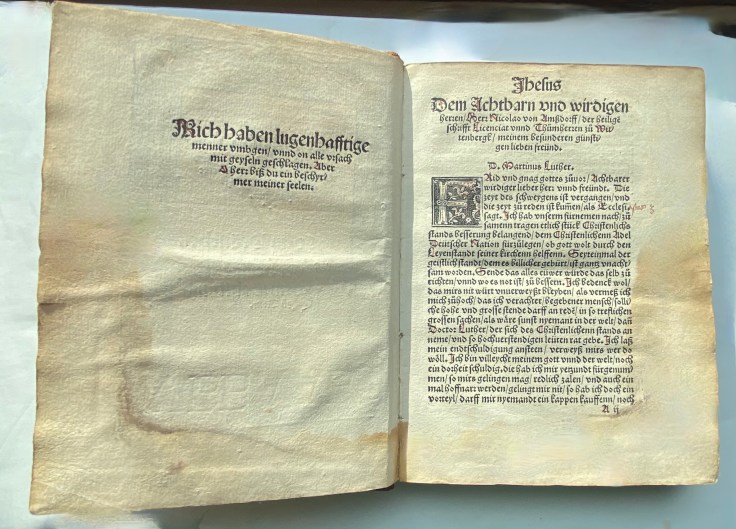

These three ‘letters’ Luther to Nicholas von Amsdorf, An Open Letter to the Christian Nobility of the German Nation” (August 1520):
The year 1520 saw the publication of the three great documents which laid down the fundamental principles of the Reformation. In the “Address to the Christian Nobility of the German Nation,” Luther attacked the corruptions of the Church and the abuses of its authority, and asserted the right of the layman to spiritual independence. In
“Concerning Christian Liberty,” he expounded the doctrine of justification by faith, and gave a complete presentation of his theological position. In the “Babylonish Captivity of the Church,” he criticized the sacramental system, and set up the Scriptures as the supreme authority in religion. In the midst of this activity came his formal excommunication, and his renunciation of allegiance to the Pope.
Luther’s writings, including these letters, led to his eventual excommunication by Pope Leo X and the beginning of the Protestant Reformation.
They highlighted the corruption and abuses within the Church and sparked debate about the role of faith, Scripture, and individual conscience in religious life.
https://www.digitale-sammlungen.de/en/view/bsb11230143?page=2,

VD 16 L 3763; Luther WA 6: 282 M (and 351 O, 400 P) ;Benzing (Luther) 12; Benzing (Schürer Erben [1961])
‡
Johann Tauler: intersection of medieval mysticism and Reformation printing culture.

655J Tauler, Johann. (1300-1361)
Ain fast edele, nutzliche vnd ergründte Sermon, nyemandt nachtaylig, noch lesterlich, sonder ainem yetlichen war Christen Menschen offt zu leßen fruchtpar des erleychten Doc. Joanns Tauleri auff die Wort Christi Joan. X. “Wer nit eingeet in den Schaffstall durch die Thür etc., der ist ain Dieb vnd Morder. Darbey verfast : Sechs nutzliche leere, darynn der inwendig vnd außwendig Mensch geregiert soll werden. Auch etliche kurtze, doch gantz andechtige Gebeet zu getruckt.
[Augsburg: Philipp Ulhart or S. Grimm], 1523. Price SOLD

Quarto, 20 x 15.5cm. First edition A5 This is bound in boards covered with an early leaf.
This is the first and only edition of these sermons. The present sermon under the motto “Whoever does not enter the stables, through the door. He is a thief and a murderer” (Joh. 10) was very well suited in the fight against the papacy, so that it was printed by the great Augsburg Reformation printer Ulhart the Elder .These sermons represents a fascinating intersection of medieval mysticism and Reformation printing culture. Tauler’s spiritually rich preaching into a compact, accessible form—one that could be distributed widely and repurposed to support emerging Protestant spirituality.
Martin Luther who called Taluer “a man of great experience” (ein Mann von großer Erfahrung). valued Tauler because of his insight into man’s fallen nature and the unconquerable distance between God and man. Exactly these aspects are stressed in the Tauler sermon discussed here. Tauler’s preaching was reinterpreted or even appropriated as a pro-Reformation text. Luther found resonance in Tauler’s emphasis on the human need for grace, the path to true spiritual union, and the critique of external, legalistic religion. Schwenckfeld was deeply influenced by Tauler’s inward, mystical Christianity. He recommended Tauler’s sermons to his followers as a guide to “spiritual rebirth” and direct union with God, bypassing reliance on external church structures. Arndt, whose Wahres Christentum (True Christianity) was foundational for Lutheran pietism, frequently drew from Tauler’s mystical depth. He cited Tauler as a model of inner renewal and practical devotion, helping to bridge medieval mysticism and later Protestant spirituality.
Tauler was “one of the greatest German mystics and preachers of the Middle Ages, who understood the depth of thought of Meister Eckhart , the intimacy of Suso, the fire zeal of Berthold von Regensburg combined.” (Wetzer-W.).
Tauler’s sermons, written only in German, circulated widely in the Middle Ages in Germany and the Low Countries. Since Martin Luther made marginal notes on his copy of the 1508 Augsburg edition of Tauler’s sermons and obviously valued him highly, Tauler’s works were later read by Protestants as well as by Catholics. Tauler was less erudite and more practical than Eckhart, and his teaching was built on the devotional habits of his day. As a result he was able to transmit much of Eckhart’s basic teachings when Eckhart himself was branded as heretical. Some of Eckhart’s sermons were preserved under Tauler’s name and found their way into print in the 1521 Basel edition of Tauler’s works.
BNHCat T 57; VD16 J 782; urn:nbn:de:bvb:12-bsb10165683-7
https://lobid.org/gnd/118621009
)-(
184J Jerome Emser (1477-1527)
Missae christianorum contra Luterana[m] missandi formula[m] Assertio.
[Dresden?] [Emserpresse?], 1524 SOLD

Quarto: Signatures: A-E⁴, F²../ Errata on p. [44] Bound in later boards.
At first Emser was on the side of the reformers, but like his patron he desired a practical reformation of the clergy without any doctrinal breach with the past or the church; and his liberal sympathies were mainly humanistic, like those of Erasmus and others who parted company with Luther after 1519. As late as that year Luther referred to him as “Emser noster,” but the Leipzig Debate in that year completed the breach between them. Emser warned his Bohemian friends against Luther, and Luther retorted with an attack on Emser which outdid in scurrility all his polemical writings. Emser, who was further embittered by an attack of the Leipzig students, imitated Luther’s violence, and asserted that Luther’s whole crusade originated in nothing more than enmity to the Dominicans, Luther’s reply was to burn Emser’s books along with Leo X’s bull of excommunication. Emser next, in 1521, published an attack on Luther’s Appeal to the German Nobility, and eight works followed from his pen in the controversy, in which he defended the Roman doctrine of the Mass and the primacy of the pope. At Duke George’s instance he prepared, in 1523, a German translation of Henry VIII’s Assertio Septem Sacramentorum contra Lutherum, and criticized Luther’s New Testament. He also entered into a controversy with Zwingli. He took an active part inorganizing a reformed Roman Catholic Church in Germany, and in 1527 published a German version of the New Testament as a counterblast to Luther’s. He died on the 8th of November in that year and was buried at Dresden. Emser was a vigorous controversialist, and next to Eck the most eminen of the German divines who stood by the old church. But he was hardly a great scholar; the errors he detected in Luther’s New Testament were for the most part legitimate variations from the Vulgate, and his own version is merely Luther’s adapted to Vulgate requirements. Emser’s crest was a goat’s head and Luther delighted in calling him “Bock-Emser” and “Ægocero” Luther, in his several dealings with Emser, called him a goat. Indeed, if you want to read something fun, read Luther’s utterly ‘dripping with pure contempt and loathing’ for Emser book titled Answer to the Hyperchristian, Hyperspiritual, and Hyperlearned Book by Goat Emser in Leipzig—Including Some Thoughts Regarding His Companion, the Fool Murner.
VD 16; E 1122
/|-|
Saint John Fisher “Sacri sacerdotij defensio”


815G John Fisher 1469-1535
Sacri sacerdotij defensio cõtra Lutherum, per Reuerendissimu Dominum, dominum Johannem Roffeñ. Episcopum, virum singulari eruditione omnifariam doctissimum, iam primum ab Archetypo euulgata. Cum tabula et repertorio tractatorum.

Colonie : Petri Quentel, 1525. SOLD
Octavo A8B4,a-G8. One of three eds. printed by Quentel in 1525. One of the others is in 4to (Kuczynski 821)–and the other, in 8vo, has title 1st line: “Sacri sacerdotij defensio” (Kuczynski 823)./ Ed. by “frater Johãnes Romberch” (leaf [2]). Marginal notes printed throughout./ Includes index, leaves A3–B1. This copy is bound in modern full calf.
“Sacri sacerdotii defensio contra Lutherum” is a defense of the priesthood by arguments in favor of tradition against innovation and a divine sanction of the priesthood. Fisher, the strongly ascetic, loyal Catholic, whose interest in the classical revival existed alongside an appreciation of the Cabala, is perhaps the best representative of the religion in England at the very beginning of the English Reformation.
Kuczynski, A. Thesaurus libellorum historiam Reformationis,; 822;
BM STC German, 1465-1600,; p. 458; Pegg, M
Pamphlets in Swiss libraries,; 2493; VD-16,; F-1238; Adams; F-547


)0(
173J. Johannes Cochlaeus (1479-1552. )
De Petro et Roma adversus Velenu[ m] Luthera num, libri quatuor, Iohannnis Cochlæi, artiu & sacræ Theologiæ professoris egregii atque ecclesia duiæ virginis Francfordien. Decani.
[Coloniae officina honesti civis Petri Quentell], Mense Februario 1525

Quarto 20 x 14.5 cm. (7 ½ x 5 ¾) inches Signatures:[A]4, B-Q4] unsigned. Bound in modern paper wrapper. Price $3,000
Johann Cochlæus Humanist and Catholic controversialist. He obtained his doctorate in 1517, and then by the advice of Pirkheimer went to Rome. There, under the influence of the Oratorio del Divino Amore, Cochlæus turned his attention to the cultivation of a religious life. Ordained at Rome, he went to Frankfort, and after some hesitation, arising no doubt from consideration for his friends, he entered the arena as the opponent of the Lutheran movement. His first works were “De Utroque Sacerdotio” (1520) and several smaller writings published in rapid succession. In 1521 he met the nuncio Aleander at Worms and worked untiringly to bring about the reconciliation of Luther. During the following years he wrote tracts against Luther’s principal theses on the doctrine of justification, on the freedom of the will, and on the teaching of the Church (especially the important work, “De Gratia Sacramentorum”, 1522; “De Baptismo parvulorum”, 1523; “A commentary on 154 Articles”; etc). Luther, to the vexation of Cochlæus wrote in answer only a single work, “Adversus Armatum Virum Cocleum”.
The Lutheran movement and the Peasants’ War drove him to Cologne in 1525. From there he wrote against the rebellion and Luther, its real author. After Emser’s death Cochlæus took his place as secretary to Duke George of Saxony, whom he defended against an attack of Luther based on the false charge of an alliance between the Catholic princes at Breslau Conjointly with Duke George he laboured strenuously in 1530, to refute the Augsburg Confession, and later directed against Melanchthon, its author, his bitter “Philippicae”. Because of a pamphlet against Henry VIII of England he was transferred in 1535 to a canonry in Meissen.. With indomitable ardour he published pamphlet after pamphlet against Luther and Melanchthon, against Zwingli, Butzer, Bullinger, Cordatus, Ossiander, etc. Almost all of these publications, however, were written in haste and bad temper, without the necessary revision and theological thoroughness, consequently they produced no effect on the masses. ” Forced to resign his benefice at Eichstätt in 1548, Cochlæus remained for a short time in Mayence to edit a work of Abbot Conrad Braun.
BM STC German,; p. 248; Adams,; C2265; Panzer,; VI, 391, 408; Pegg,; 674; Kuczynski,; 464; Hohenemser,; 3233; Spahn, Cochlaeus,; 30

)0(
A precursor to the Augsburg Confession in low German 1529


519J Caspar Huberinus. 1500-1553
Sibenzig schlusred odder pun cten von der Rech-ten hand Gottes vnd der gewalt Christi.
Wittemberg. [Colophon, A8r]: Gedrückt durch Ioseph Klugk: 1529 . Price SOLD
Quarto:15 x 10 cm. A8; 8 ff. Early 20th-century binding paper over boards. Some minor wear to extremities. Some marginal damp, leaves guarded and resewn. Provenance: Sold at Kiefer 19 April, 2013; bookplate on the front pastedown: Ex libris Martin Schupp; manuscript number to head gutter corner of title: R.596 Certainly from a sammelband.
This small 1529 tract can be read as a way of providing the laity and parish clergy with accessible “mini-Lutheran theology. This is a lists of 70 brief expositions on Luther’s doctrine, “rechte Hand Gottes” (dextera Domini), What is in the hand of God is a very tidy and accessible summary of the core tenets of Luther’s stem of the Reformation as they existed in 1529, a year before the Augsburg Confession. And Luther’s Large Catechism. Huberinus stood firmly with the Lutherans against Zwinglian positions (especially on the sacraments), and he used polemical and pastoral writing to defend Wittenberg doctrine in the 1520s–1540s.


VD16 H5418; Bertheau, Carl. “Huberinus, Caspar,” in Algemeine Deutsche Biographie, Vol. 13. (1881) pp 258– 259. : Gunther Franz, Huberinus-Rhegius-Holbein. Neiuwkoop: B. De Graaf, 1973. Gatch, M. Library of Leander van Ess, D2010: see also Schaff-Herzog Encyclopedia of Religious Knowledge& Biographisch-Bibliographische Kirchenlexikon ( BBKL )
Fairly rare in American institutions: I’ve found 5 copies. Columbia, Princeton, U of Mn Wilson Library (016.242 F857), Concorida Seminary .

)*(
Proto- Reformer Jakob Wimpfeling

666J Jakob Wimpfeling 1450-1528
Concordia curatorum: & fratrum mendicantiu[m]. Carmen elegiacum deplangens discordiam & dissensionem christianorum cuiuscunq[ue] status dignitatis aut professionis.
Straßburg: Johann Prüß, 1503 Price $SOLD

Quarto, 20 x 14 cm. Signatures a-b4. Bound in modern bords. Quite a few notes by a contemporary Rheinish scolar.
After studying philosophy, law, and theology at Freiburg, Erfurt, and Heidelberg (where he was rector of the university in 1481/1482), he served as cathedral vicar in Speyer from 1484 to 1498, then occupied a chair of poetry and rhetoric at Heidelberg until 1501 and finally worked as a teacher and writer in Straßburg and Schlettstadt.
Early treatise on the contemporary abuses of the mendicant friars (chiefly Thomist Dominicans) at Erfurt, penned by the proto- Reformer Jakob Wimpfeling under the pseudonym ‘Wigandus Trebellius’. Wimpfeling was a member of the celebrated circle of humanists centered on Strasbourg and nearby Sélestat in the late 15th century who maintained close ties with Erasmus. [Heiko Oberman (The Two Reformations, p. 39) identifies the Concordia curatorum as a bold contribution to pre-Reformation agitation in print.
The title translates roughly as Concord between the [secular] clergy and the mendicant monks. An elegiac poem lamenting the discord and disagreement among Christians of all statuses, dignities, and professions. The titular poem is found at the very end of the work, preceded by several letters on the same theme by a handful of contributors; the main text (a3r-b4v) is addressed to the reader by Wimpfeling [a.k.a. ‘Trebellius’]. In his chapter “Luther and the Via Moderna”, Heiko Oberman traces pre-Reformation movements for monastic reform and identifies Wimpfeling as an ardent defender of the convicted Erfurt heretic Johann Wesel, himself an outspoken critic of the abuse of church hierarchy who was eventually tried in 1479. Wesel’s unorthodox beliefs ranged from questioning the practices of monasticism, celibacy, and fasting, to refuting the infallibility of the pope. His writings were burned, and he was condemned to life-long imprisonment in an Augustinian monastery where he died in 1481. Wimpfeling’s text is particularly concerned with the discord in Erfurt, and mentions Wesel by name on b4v. “Wimpfeling wrote the treatise Concordia curatorum et fratrum mendicantium, ostensibly as a resolution of the long-standing rivalry between the secular clergy and the mendicant friars. In fact Wimpfeling defended Wesel and assailed the friars. It was published in Strasbourg in 1503 under a pseudonym, like so many other bold tracts of the times; Wesel, he wrote, was not condemned for heresy but for being a secular nominalist rather than a Dominican Thomist.”(Oberman, The Two Reformations, p. 39). Erfurt would remain a hotbed of religious rebellion: in 1510, Martin Luther’s own Augustinian convent there was among those which refused to obey the commands of the Order’s general, Johann Von Staupitz.
Jacob Wimpheling was born in 1450 in the Alsatian town of Schlettstadt. The son of a farmer, he attended the local Latin school run by the renowned Ludwig Dringenberg (1410-1477). He went on to earn a baccalaureate degree from the University of Freiburg and furthered his education at the universities in Erfurt and Heidelberg, earning a master’s degree in 1479 and a licentiate in theology in 1496. Before settling in Strassburg, Wimpheling held the positions of rector at the University of Heidelberg and cathedral preacher at Speyer.
Wimpheling edited the works of medieval theologians and important humanists such as Sebastian Brant, Erasmus, and Pico della Mirandola, but he also authored numerous pieces. He composed Latin poetry and a drama, pieces denouncing the morals of priests, and historical works about Germany including the Epitome rerum Germanicarum (Digest of German History), the first history that was exclusively devoted to Germany.

In addition to his interests in theology and history, Wimpheling was a proponent of education. He gained the reputation of being one of the most important education reformers in Germany. One of his earliest ventures was to urge the city of Strassburg to establish a more advanced system of schools in his work, Germania (Germany). Wimpheling also evaluated curriculum and advocated for new practices. He recognized the the importance of Latin in his Elegantiarum medulla (Kernel of Elegances) and articulated his theories about pedagogy in two works, the Isidoneus germanicus (Guide for Germans) and Adolescentia (Youth). The former focuses on methods and school life. Wimpheling identifies faults with previous teaching methods, particularly those associated with medieval Scholasticism and argues for teaching what is necessary, including Latin grammar based on examples from a list of authors he identified as essential to know. Wimpheling also discusses qualifications teachers should have. The latter work expands upon practices and asserts that moral education is equally important. Wimpheling encourages German teachers to teach authors who are grounded in sound moral and ethical principles and to help children develop and perfect their thought and dispositions. These three works were influential in the sixteenth-century efforts to reform German school curricula so that it included the study important works of pagan, Greco-Roman authors without contradicting notions of Christian piety.
VD 16 T 1850 &. T 1851


Leave a Reply