

- 176J Phlip Melanchthon

Declamatiuncula in D. Pauli doctrinam : Epistola ad Iohannem Hessum theologum
Vuittenbergae [i.e. Wittenberg] : Apud Melchiorem Lottherum iuniorem, 1520 $4,500
Quarto 7 ¼ x 5 ¼ inches. A-B4, C6.This is bound in modern boards with a sheepskin spine.
To say that Melanchthon saw how to rescue dialectics for use in the humanist curriculum, however, does not undermine his deep commitment to the rhetorical methods of his time. In the Romans commentaries of the 1530s, he goes on the warpath against the Romanists, enthusiasts and Origenists, defending his Apology of the Augsburg Confession in the process. Large portions of Luther’s preface were in fact merely a reworking of Melanchthon’s exegesis. Scholars have expended an inordinate amount of effort to locate and date Melanchthon’s earliest biblical lectures. The construction of introductions and outlines to biblical books stretches back into the history of the early church. In Pauline studies today, the role of justification by faith in the apostle’s writings looms large.”
( Timothy J. Wengert : A Companion to Paul in the Reformation, pp 129-164: 2009)
Harfelder (Melanchthon); Nr. 23; Beuttenmüller, Melanchthon,; Nr. 71; BM STC German,; p. 610; VD 16; M 2913
>0<
Three Last letters By Martin Luther
522J Martin Luther 1483-1546.
Drey Biechlin zü letst von dem Hochberümbtenn vnnd Ewangelischen Lerer Doctor Martin Luther aussgangenn. Nemlich von dem Deütschen Adel. der heiligē Mesz dem Babstumb zü Rom.
[Strasbourg] : [Matthias Schürer Erben], (1521-1522?). Price $ 2,900

Quarto 20 x 15 cm. Signatures: A-B 4 C 8 D-E 4 F 8 G-H 4 I 8 K-L4 M8 N-O4 P8 Q-R4 S6.
Bound in modern 1/4 deer with some hair still on the leather., water stained throughout with paper damage in the lower margin, not affecting the text contemporary marginal notes red and capitals stroked in red.
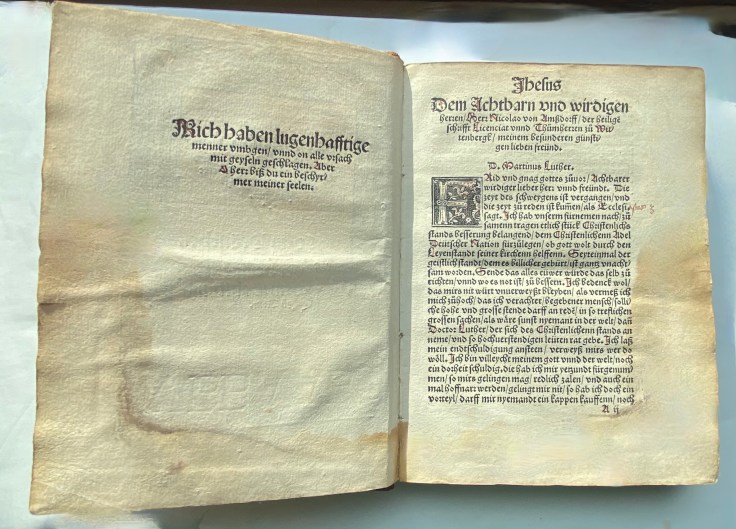

https://www.digitale-sammlungen.de/en/view/bsb11230143?page=2,

VD 16 L 3763; Luther WA 6: 282 M (and 351 O, 400 P) ;Benzing (Luther) 12; Benzing (Schürer Erben [1961])
}-{
Saint John Fisher “Sacri sacerdotij defensio”


815G John Fisher 1469-1535
Sacri sacerdotij defensio cõtra Lutherum, per Reuerendissimu Dominum, dominum Johannem Roffeñ. Episcopum, virum singulari eruditione omnifariam doctissimum, iam primum ab Archetypo euulgata. Cum tabula et repertorio tractatorum.

Colonie : Petri Quentel, 1525. $3,000
Octavo A8B4,a-G8. One of three eds. printed by Quentel in 1525. One of the others is in 4to (Kuczynski 821)–and the other, in 8vo, has title 1st line: “Sacri sacerdotij defensio” (Kuczynski 823)./ Ed. by “frater Johãnes Romberch” (leaf [2]). Marginal notes printed throughout./ Includes index, leaves A3–B1. This copy is bound in modern full calf.
“Sacri sacerdotii defensio contra Lutherum” is a defense of the priesthood by arguments in favor of tradition against innovation and a divine sanction of the priesthood. Fisher, the strongly ascetic, loyal Catholic, whose interest in the classical revival existed alongside an appreciation of the Cabala, is perhaps the best representative of the religion in England at the very beginning of the English Reformation.
Kuczynski, A. Thesaurus libellorum historiam Reformationis,; 822;
BM STC German, 1465-1600,; p. 458; Pegg, M
Pamphlets in Swiss libraries,; 2493; VD-16,; F-1238; Adams; F-547


)0(
173J. Johannes Cochlaeus (1479-1552. )
De Petro et Roma adversus Velenu[ m] Luthera num, libri quatuor, Iohannnis Cochlæi, artiu & sacræ Theologiæ professoris egregii atque ecclesia duiæ virginis Francfordien. Decani.
[Coloniae officina honesti civis Petri Quentell], Mense Februario 1525

Quarto 20 x 14.5 cm. (7 ½ x 5 ¾) inches Signatures:[A]4, B-Q4] unsigned. Bound in modern paper wrapper. Price $3,000
Johann Cochlæus Humanist and Catholic controversialist. He obtained his doctorate in 1517, and then by the advice of Pirkheimer went to Rome. There, under the influence of the Oratorio del Divino Amore, Cochlæus turned his attention to the cultivation of a religious life. Ordained at Rome, he went to Frankfort, and after some hesitation, arising no doubt from consideration for his friends, he entered the arena as the opponent of the Lutheran movement. His first works were “De Utroque Sacerdotio” (1520) and several smaller writings published in rapid succession. In 1521 he met the nuncio Aleander at Worms and worked untiringly to bring about the reconciliation of Luther. During the following years he wrote tracts against Luther’s principal theses on the doctrine of justification, on the freedom of the will, and on the teaching of the Church (especially the important work, “De Gratia Sacramentorum”, 1522; “De Baptismo parvulorum”, 1523; “A commentary on 154 Articles”; etc). Luther, to the vexation of Cochlæus wrote in answer only a single work, “Adversus Armatum Virum Cocleum”.
The Lutheran movement and the Peasants’ War drove him to Cologne in 1525. From there he wrote against the rebellion and Luther, its real author. After Emser’s death Cochlæus took his place as secretary to Duke George of Saxony, whom he defended against an attack of Luther based on the false charge of an alliance between the Catholic princes at Breslau Conjointly with Duke George he laboured strenuously in 1530, to refute the Augsburg Confession, and later directed against Melanchthon, its author, his bitter “Philippicae”. Because of a pamphlet against Henry VIII of England he was transferred in 1535 to a canonry in Meissen.. With indomitable ardour he published pamphlet after pamphlet against Luther and Melanchthon, against Zwingli, Butzer, Bullinger, Cordatus, Ossiander, etc. Almost all of these publications, however, were written in haste and bad temper, without the necessary revision and theological thoroughness, consequently they produced no effect on the masses. ” Forced to resign his benefice at Eichstätt in 1548, Cochlæus remained for a short time in Mayence to edit a work of Abbot Conrad Braun.
BM STC German,; p. 248; Adams,; C2265; Panzer,; VI, 391, 408; Pegg,; 674; Kuczynski,; 464; Hohenemser,; 3233; Spahn, Cochlaeus,; 30

)0(
1524 Emser’s and Luther’s views on the Mass

184J Jerome Emser (1477-1527)
Missae christianorum contra Luterana[m] missandi formula[m] Assertio.
[Dresden?] [Emserpresse?], 1524 $3,000

Quarto: Signatures: A-E⁴, F²../ Errata on p. [44] Bound in later boards.
At first Emser was on the side of the reformers, but like his patron he desired a practical reformation of the clergy without any doctrinal breach with the past or the church; and his liberal sympathies were mainly humanistic, like those of Erasmus and others who parted company with Luther after 1519. As late as that year Luther referred to him as “Emser noster,” but the Leipzig Debate in that year completed the breach between them. Emser warned his Bohemian friends against Luther, and Luther retorted with an attack on Emser which outdid in scurrility all his polemical writings. Emser, who was further embittered by an attack of the Leipzig students, imitated Luther’s violence, and asserted that Luther’s whole crusade originated in nothing more than enmity to the Dominicans, Luther’s reply was to burn Emser’s books along with Leo X’s bull of excommunication. Emser next, in 1521, published an attack on Luther’s Appeal to the German Nobility, and eight works followed from his pen in the controversy, in which he defended the Roman doctrine of the Mass and the primacy of the pope. At Duke George’s instance he prepared, in 1523, a German translation of Henry VIII’s Assertio Septem Sacramentorum contra Lutherum, and criticized Luther’s New Testament. He also entered into a controversy with Zwingli. He took an active part inorganizing a reformed Roman Catholic Church in Germany, and in 1527 published a German version of the New Testament as a counterblast to Luther’s. He died on the 8th of November in that year and was buried at Dresden. Emser was a vigorous controversialist, and next to Eck the most eminen of the German divines who stood by the old church. But he was hardly a great scholar; the errors he detected in Luther’s New Testament were for the most part legitimate variations from the Vulgate, and his own version is merely Luther’s adapted to Vulgate requirements. Emser’s crest was a goat’s head and Luther delighted in calling him “Bock-Emser” and “Ægocero” Luther, in his several dealings with Emser, called him a goat. Indeed, if you want to read something fun, read Luther’s utterly ‘dripping with pure contempt and loathing’ for Emser book titled Answer to the Hyperchristian, Hyperspiritual, and Hyperlearned Book by Goat Emser in Leipzig—Including Some Thoughts Regarding His Companion, the Fool Murner.
VD 16; E 1122
/|-|\
A precursor to the Augsburg Confession in low German 1529


519J Caspar Huberinus. 1500-1553
Sibenzig schlusred odder pun cten von der Rech-ten hand Gottes vnd der gewalt Christi.
Wittemberg. [Colophon, A8r]: Gedrückt durch Ioseph Klugk: 1529 . Price $2,750
Quarto:15 x 10 cm. A8; 8 ff. Early 20th-century binding paper over boards. Some minor wear to extremities. Some marginal damp, leaves guarded and resewn. Provenance: Sold at Kiefer 19 April, 2013; bookplate on the front pastedown: Ex libris Martin Schupp; manuscript number to head gutter corner of title: R.596 Certainly from a sammelband.
This small pamphlet is a lists of 70 brief expositions on Luther’s doctrine, “rechte Hand Gottes” (dextera Domini), What is in the hand of God is a very tidy and accessible summary of the core tenets of Luther’s stem of the Reformation as they existed in 1529, a year before the Augsburg Confession. And Luther’s Large Catechism.


VD16 H5418; Bertheau, Carl. “Huberinus, Caspar,” in Algemeine Deutsche Biographie, Vol. 13. (1881) pp 258– 259. : Gunther Franz, Huberinus-Rhegius-Holbein. Neiuwkoop: B. De Graaf, 1973. Gatch, M. Library of Leander van Ess, D2010: see also Schaff-Herzog Encyclopedia of Religious Knowledge& Biographisch-Bibliographische Kirchenlexikon ( BBKL )
Fairly rare in American institutions: I’ve found five copies. Columbia, Princeton, U of Mn Wilson Library (016.242 F857), Concorida Seminary .

X)-(X
Augsburg Confession 1530 Annotated on almost every page!

711J Philip Melanchthon (1497-1560), Luther, Martin . (1483-1546)
Confessio fidei exhibita invictiss. Imp. Carolo V. Caefari Aug. in Comiciis Auguftae. Anno M.D.XXX. Addita est Apologia Co(n)fessionis Psalm. 119 Et loquebar de te stimonijs tuis in conspectu
Wittenberg: Georg Rhau, 1531.  $22,000
Octavo, 5.25 x 3.5. This edition is an impression of the “editio princeps” printed in the same year. a-d8, e4,9e4 blank and present) f-n8, A-P8, Q4, Q4 blank and present.
The title page has a woodcut illustration. This is bound in full modern calf over wooden boards in an antique style, it is a very nice copy with annotations on every page.

The Augsburg Confession is “the oldest and most authoritative of the Lutheran creeds,” and a major historical document, in which the revolution of Martin Luther assumed organized political action and permanently changed the religious and national identity of Europe. “It was drafted by Melanchthon, on the basis of Luther’s Marburg, Schwabach, and Torgau articles, and bore the signature of seven German princes….On 25 June, 1530, copies of it, in Latin and German, were presented to Charles V, at the diet of Augsburg, and the German version of it was read aloud before the secular and ecclesiastical Estates of the Empire. Charles retained his Latin copy which he brought with him to Spain, giving the other into the custody of the Archbishop of Mainz.”

In a remarkable calm and able “Answer” to the Confession, controversialists such as Eck, Wimpina, and Cochlaeus analyze the Confession, giving praise and censure where either is due. Melanchthon retorted with an “apologia” which Lutherans generally regard as their second symbolic book; Charles refused to accept it, because of the violent language against the Catholic Church. (summarized from the Catholic Encyclopedia)
“Although the emperor prohibited the printing of the evangelical confession without his special permission, during the diet six German editions and one in Latin were published….Their inaccuracy and incorrectness induced Melanchthon to prepare an edition to which he added the Apology. Thus originated the so-called editio princeps of the Augustana and Apology, which was published in the spring of 1531. This edition was regarded as the authentic reproduction of the faith professed before the emperor and empire.” (Schaff-Herzog)
This is the back of the title to the Apologia with an index!


]=[
Luther on the Sermon on the Mount
Martin Luther On the “The Sermon on the Mount”

Luther, Martin Luther (1483-1546)
Das fünffte, Sechste vnd Siebend Capitel S. Matthei.
Wittenberg , Joseph Klug 1532. $4,500

Luther preached these sermons on Matthew 5-7 on Wednesdays in 1530-32 while Bugenhagen, the regular weekday Preacher, was away in Lubeck on Reformation-related business. : Luther proceeds line by line, some times giving one line from Matthew five pages of commentary! Here is a shortened example: from the greek. And His commentary.


Quarto, 8 1/4 X 6 1/2 inches . First edition A-Z4, a-z4, aa-nn4, oo2, pp4 (241 Leaves ) Bound in full modern calf, a very nice copy. Contemporary manuscript marginalia in red!
¶ Benzing, Lutherbibliographie, 3011 /// Hohenemser 2586 /// Kuczyński 1746 /// Jackson 1089 /// Pegg, Bibliotheca, 883 /// Pegg, Great Britain, 1923 /// Pegg, Swiss, 2988 /// VD16 L 4754 . Item #751
Here is a shortened example: from the greek. And His commentary.

 V. 3. Blessed are the poor in spirit, for theirs is the kingdom of heaven.
This is a delightful, sweet and genial beginning of his sermon. For he does not come, like Moses or a teacher of law, with alarming and threatening demands; but in the most friendly manner, with enticements and allurements and pleasant promises. And indeed, if it had not been thus recorded, and if the first uttered precious words of the Lord Christ had not been given to us all, an over-curious spirit would tempt and impel everybody to run after them even to Jerusalem, yes, to the end of the world, if one might hear but a word of it all. Then there would be plenty of money forthcoming to build a good road, and every one would boastingly glory how he had heard or read the very words that the Lord Christ had spoken. O what a wonderfully happy man would he  be held to be who should succeed in this! That is just the way it surely would be if we had none of our Savior’s words written, although much might have been written by others; and every one would say: Yes, I hear indeed what St. Paul and his other apostles have taught, but I would much rather hear what he himself said and preached. But now that it is so common, that every one has it written in a book, and can read it daily, nobody regards it as something special and precious. Yes, we grow tired of them and neglect them, just as if not the high Majesty of heaven, but some cobbler, had uttered them. Therefore we are duly punished for our ingratitude and contemptuous treatment of these words by getting little enough from them, and never feeling or tasting what a treasure, force and power there is in the words of Christ. But he who has grace only to recognize them as the words of God and not of man, will surely regard them as higher and more precious, and never grow tired or weary of them.
Kindly and sweet as this sermon is for Christians, who are our Lord’s disciples, just so vexatious and intolerable is it for the Jews and their great saints. For he hits them a hard blow in the very beginning with these words, rejects and condemns their doctrine and preaches the direct contrary; yes, he denounces woe against their way of living and teaching, as is shown in the sixth chapter of Luke. For the substance of their teaching was this: If it goes well with a man here upon earth, he is happy and well off; that was all they aimed at, that God should give them enough upon earth, if they were pious and served him; as David says of them in <19E401> Psalm 144: “Our garners are full, affording all manner of store; our sheep bring forth thousands and ten thousands in our streets; our oxen are strong to labor; there is no breaking in or going out; there is no complaining in our streets.”.
Price: $4,500.


Leave a Reply