


“Eyb stressed two things throughout the Margarita: to be able to write well and to be disposed to live properly.”

Albrecht von Eyb (who has a few more than the usual variations of his name [see
https://data.cerl.org/thesaurus/cnp01316161]
364J Albrecht von Eyb 1420-1475
Margarita Poetarum

[publisher not identified] or [Venezia: Albertino da Lessona, 1502]. $3,900


Folio a8 B-X8 [Y]8 (this copy is lacking the final gathering signed with numbers 1-4 only comprising a Materiarum-tabula which is not present). Gatherings a-I have printed decorated intitials; K-X have blanks (some with printed guides) for manuscript initials. It is bound in full seventeenth century vellum with spine label.
The first printing of the Margarita Poetica was printed by Johannes Sensenschmidt in1472 , between 1472 and 1503 there appeared at least a dozen editions [In this edition the marginal index letters correspond to those of 1493 Venice edition]. Eyb went to Italy and devoted himself to humanistic study at the Universities of Pavia and Bologna. He returned to Germany in 1451, having been appointed Canon at Eichstätt and Bamberg. From 1452 to 1459 he was again a student at Bologna, gaining the degree of doctor in 1459. The Margarita is named after Eyb’s mother and was written in 1459.
Fabriccius observed the “Eyb stressed two things throughout the Margarita: to be able to write well and to be disposed to live properly.”
In a contrast to “Ars Dictaminis” (perhaps the Middle Ages version of TEXTING) von Eyb uses this work to re-Introduce Cicero’s Vetera Rhetorica. While certainly there are many late medieval texts on letter writing, Eyb as can be seen in the structure of this book is greatly influenced by the Vetera Rhetorica.
The Content are in three parts, the first EPISTOLA SIVE PROLOGUS, is a revised and augmented versionOF M.T.C. (CICERO) with excerpts taken from classical authors and Italian humanists and formulas for letter-writing.
The second part AUCTORITATES consists of an anthology of prose writers (including Cicero, Lactantius, Macrobuius, Plutarchus, etc.).
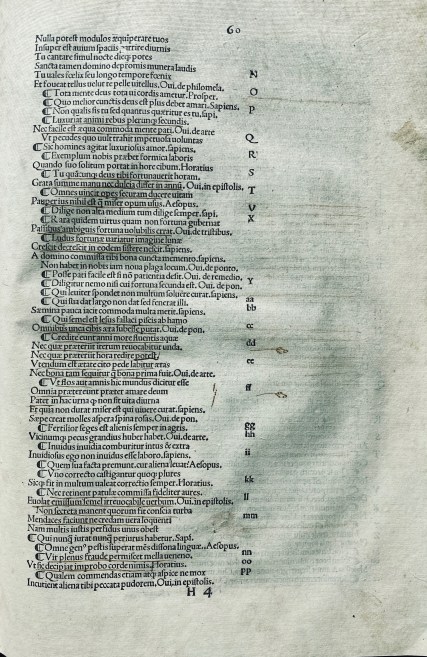
The third part ORATIONES: contains selections from Petrarch, dramatic poets (Terence,
Seneca, Plautus), and a variety of humanist speeches by Renaissance copyists, letter-writers and philosophers, including Johannes Lamola, Poggius Florentinus, Galeatius Sforza and the author himself.

Below is a web version :Note: kostenfrei Materials specified: Volltext // 2012 digitalisiert von: Bayerische Staatsbibliothek, München. Exemplar mit der Signatur: München, Bayerische Staatsbibliothek — 2 Var. 17
http://www.mdz-nbn-resolving.de/urn/resolver.pl?urn=urn:nbn:de:bvb:12-bsb10150222-0
<>\|/<>
666J Jakob Wimpfeling 1450-1528
Concordia curatorum :& fratrum mendicantiu[m]. Carmen elegiacum deplangens discordiam & dissensionem christianorum cuiuscunq[ue] status dignitatis aut professionis.
Straßburg: Johann Prüß, 1503 Price $3,500

Quarto, 20 x 14 cm. Signatures a-b4. Bound in modern bords.
After studying philosophy, law, and theology at Freiburg, Erfurt, and Heidelberg (where he was rector of the university in 1481/1482), he served as cathedral vicar in Speyer from 1484 to 1498, then occupied a chair of poetry and rhetoric at Heidelberg until 1501 and finally worked as a teacher and writer in Straßburg and Schlettstadt

Early treatise on the contemporary abuses of the mendicant friars (chiefly Thomist Dominicans) at Erfurt, penned by the proto- Reformer Jakob Wimpfeling under the pseudonym ‘Wigandus Trebellius’.
Wimpfeling was a member of the celebrated circle of humanists centered on Strasbourg and nearby Sélestat in the late 15th century who maintained close ties with Erasmus. Heiko Oberman (The Two Reformations, p. 39) identifies the Concordia curatorum as a bold contribution to pre-Reformation agitation in print.
The title translates roughly as Concord between the [secular] clergy and the mendicant monks. An elegiac poem lamenting the discord and disagreement among Christians of all statuses, dignities, and professions. The titular poem is found at the very end of the work, preceded by several letters on the same theme by a handful of contributors; the main text (a3r-b4v) is addressed to the reader by Wimpfeling [a.k.a. ‘Trebellius’]. In his chapter “Luther and the Via Moderna”, Heiko Oberman traces pre-Reformation movements for monastic reform and identifies Wimpfeling as an ardent defender of the convicted Erfurt heretic Johann Wesel, himself an outspoken critic of the abuse of church hierarchy who was eventually tried in 1479. Wesel’s unorthodox beliefs ranged from questioning the practices of monasticism, celibacy, and fasting, to refuting the infallibility of the pope. His writings were burned, and he was condemned to life-long imprisonment in an Augustinian monastery where he died in 1481. Wimpfeling’s text is particularly concerned with the discord in Erfurt, and mentions Wesel by name on b4v. “Wimpfeling wrote the treatise Concordia curatorum et fratrum mendicantium, ostensibly as a resolution of the long-standing rivalry between the secular clergy and the mendicant friars. In fact Wimpfeling defended Wesel and assailed the friars. It was published in Strasbourg in 1503 under a pseudonym, like so many other bold tracts of the times; Wesel, he wrote, was not condemned for heresy but for being a secular nominalist rather than a Dominican Thomist.” (Oberman, The Two Reformations, p. 39). Erfurt would remain a hotbed of religious rebellion: in 1510, Martin Luther’s own Augustinian convent there was among those which refused to obey the commands of the Order’s general, Johann Von Staupitz.
Jacob Wimpheling was born in 1450 in the Alsatian town of Schlettstadt. The son of a farmer, he attended the local Latin school run by the renowned Ludwig Dringenberg (1410-1477). He went on to earn a baccalaureate degree from the University of Freiburg and furthered his education at the universities in Erfurt and Heidelberg, earning a master’s degree in 1479 and a licentiate in theology in 1496. Before settling in Strassburg, Wimpheling held the positions of rector at the University of Heidelberg and cathedral preacher at Speyer.

Wimpheling edited the works of medieval theologians and important humanists such as Sebastian Brant, Erasmus, and Pico della Mirandola, but he also authored numerous pieces. He composed Latin poetry and a drama, pieces denouncing the morals of priests, and historical works about Germany including the Epitome rerum Germanicarum (Digest of German History), the first history that was exclusively devoted to Germany.
In addition to his interests in theology and history, Wimpheling was a proponent of education. He gained the reputation of being one of the most important education reformers in Germany. One of his earliest ventures was to urge the city of Strassburg to establish a more advanced system of schools in his work, Germania (Germany). Wimpheling also evaluated curriculum and advocated for new practices. He recognized the the importance of Latin in his Elegantiarum medulla (Kernel of Elegances) and articulated his theories about pedagogy in two works, the Isidoneus germanicus (Guide for Germans) and Adolescentia (Youth). The former focuses on methods and school life. Wimpheling identifies faults with previous teaching methods, particularly those associated with medieval Scholasticism and argues for teaching what is necessary, including Latin grammar based on examples from a list of authors he identified as essential to know. Wimpheling also discusses qualifications teachers should have. The latter work expands upon practices and asserts that moral education is equally important. Wimpheling encourages German teachers to teach authors who are grounded in sound moral and ethical principles and to help children develop and perfect their thought and dispositions. These three works were influential in the sixteenth-century efforts to reform German school curricula so that it included the study important works of pagan, Greco-Roman authors without contradicting notions of Christian piety.
VD 16 T 1850 u. T 1851
)-(
Wolf Traut excellent impression showing a beardless St Jerome (with lion!) in the wilderness 1503
Printed by Hieronymun Höltzel with woodcuts by Wolf Traut

533J Franz Balthasar (de Porta) (Fl 1480-1505)
Canon sacratissime misse : vna cum Expositione eiusde[m]. vbi in primis premittit[ur] pulchra contemplatio ante missam habe[n]da De cristi pulcritudine. Et quo[modo] ipsa in sua passione ab eo omnino fuerat ablata. Qualiteraq[ue] quilibet celebra[n]s debeat esse dispositus
In Jmperiali ciuitate Nurembergensi : Höltzel, 1503. $5,000
Quarto 16 x 10n cm. Signatures: A-E⁴ (E4 blank) Full-page woodcut on verso of title: an excellent impression showing a beardless St Jerome (with lion!) in the wilderness. Gothic type with Canon text in larger size

Wolf Traut clearly worked closely with several Nuremberg publishers and the names of Johann Weissenburger and Hieronymus Höltzel recur. The earliest woodcuts to be attributed to him are for this volume published in 1503.
VD16 M 5521; urn:nbn:de:bvb:12-bsb00007866-4; urn:nbn:de:bvb:12-bsb10990882-0; urn:nbn:de:bvb:12-bsb10990885-6 ; Katalog der Inkunabeln der Universitätsbibliothek Heidelberg, des …, Volume 1 p 883
Traut was a German painter and draughtsman working in the circle of Dürer. According to the biographer Johann Neudörfer, Traut was the son of the painter Hans Traut, a native of Speyer but active in Nuremberg from 1491. No documentation has survived with regard to his training but he probably began his studies with his father. Around 1505 he was in Dürer’s workshop, having probably completed his training, and together with Hans Baldung Grien and Hans Schäufelein he was involved in the design of prints to illustrate Ulrich Pinder’s book Der beschlossen Gart des Rosenkrantz Marie. By about 1511 Traut was working as an independent master on the altarpiece for the high altar of the Johanneskirche in Nuremberg (in situ), a work that reveals the marked influence of the prints of Dürer and Martin Schongauer. Over the following years and for the same church he painted Saint Barbara and Saint John the Evangelist (both Germanisches Museum, Nuremberg). Traut was also involved in the redecoration of the church at Heilsbronn, executing the altarpiece of The Eleven Thousand Virgins in 1513. Traut’s most important work, The Holy Kinship Altarpiece, was painted in 1514 for the Tuchmacherkapelle in Nuremberg (Bayerisches Nationalmuseum, Munich). It is notable for its brilliant colouring reminiscent of Dürer and its original frame in the form of a triple arch with profuse decoration of an Italianate type.
In addition to his altarpieces, Traut continued to produce designs for books associated with Dürer’s studio and in 1515 collaborated with that artist on the major graphic project of The Triumphal Arch for the Emperor Maximilian. His death in 1520 prevented him from undertaking the important commission that he had received from Cardinal Albrecht of Brandenburg for woodcuts of the treasures in the Stiftskirche in Halle an der Saale.
Secondary literature:
Weale, William Henry James. Bibliographia liturgica: Catalogus missalium ritus latini ab anno MCCCLXXV impressorum. Edited by Hanns Bohatta. London: Quaritch, 1928 (391)
Panzer, Georg Wolfgang. Annales typographici ab artis inventae origine ad annum MD, 11 volumes. Nürnberg: Johannes Eberhard Zeh, 1783-1803 (7:458, 130)
0°0
De Laudib[us] sancte Crucis
Nam digiti scripto laetantur, lumina visu Mens volvet sensu mystica verba Dei
“The fingers rejoice in writing, the eyes in seeing, and the mind at examining the meaning of God’s mystical words.”
The first printed facsimile of a manuscript.
351J. Hrabanus Maurus. 784-856?
Magnencij Rabani Mauri De Laudib[us] sancte Crucis opus. erudicione versu prosaq[ue] mirificum.
Phorçheim. [Pforzheim : In ædibus Thom[ae] Anshelmi., 1503. $3,600

Folio 30 x 21cm.: Signatures, Aa6, Bb4, a-k6, A-B6, C4 (last leaf blank).
THIS COPY LACKING A5 & 6, Bb1 and a1. [two woodcuts of Alcuin interceding on behalf of Rabanus before Pope Gregory iv, and of Rabanus presenting his poems to the Pope; a figured dedicatory poem to Louis the Pious ]. First Edition
Types 3:109R, 4:180G; 40 lines of transcribed verse + headline, 40 lines of commentary +  headline, red and black printing throughout, calligraphic woodcut initial (Proctor, fig. 24) M on title page, woodcut initials printed in red, and a figured prefatory poem, 28 carmina figurata, the first entirely xylographic, the remaining poems combining printed and xylographic letters with the versus intexti printed in red (except fig. xvi), enclosed by either woodcut figures (of the emperor, Christ, the Evangelists, Cherubim, etc.) printed in black or by Christian symbols and characters, most defined by metal rules in red.

This is a remarkable typographical achievement, probably the earliest attempt to reproduce a medieval manuscript. The greater portion of the work comprises a preface in verse and twenty-eight poems. “Hrabanus Maurus, the abbot of Fulda, wrote in the midst of the ‘new monasticism,’ a period associated with a revival of literacy and learning. In religious and secular spheres. This ‘script culture,’ as Rosamond McKitterick has it, used the written word not only as a mode of communication but as ‘a resource, a guide, a key, and an inspiration,’ especially in the devotional practice of Christianity.

Each of the twenty-eight picture poems that form In honorem sanctae crucis explores a different theme relating to the Cross through a complex interplay of word and image. The poems each have an equal number of letters per line, written continuously like a grid. By following the letters in the usual direction for a Latin text—from left to right, top to bottom—each grid reads as one long poem. But within each grid, certain letters are also marked out with colour and drawings to form pictures. The letters that make up these pictures read as separate short poems embedded within the larger poem. As such, each page of In honorem sanctae crucis presents a puzzle of words and pictures, full of hidden and interrelated messages for the reader to decode.

Proctor, R. Index to the early printed books in the British Museum,; 11747; Adams, H.M. Catalogue of books printed on the continent of Europe, 1501-1600, in Cambridge libraries,; R3; Catalogue of a collection of early German books in the library of C. Fairfax Murray,; 350; Panzer, G.W.F. Annales typographici,; VIII 227, 2; Pollard, A.W. Catalogue of books mostly from the presses of the first printers … collected by Rush C. Hawkins,; 189 Panzer, VIII, 227, no. 2. Proctor 11747. Fairfax Murray 350./ Last leaf blank./ Edited by Jakob Wimpheling.–cf. title page verso./ Illustrations: 2 woodcuts of the author presenting his book to the pope, and many woodcut figures (Christ, cherubs, crosses, symbols, etc.) printed on 28 pages of text. Some of the text within and near the outline figures is xylographic, the rest printed. The letters within the outlines are printed in red and may be read separately in a different sense. Printed in red and black, initials (except on t.p.) in red./ With label of Sinclair Hamilton. Peter Godman, Poetry of the Carolingian Renaissance (Norman: University of Oklahoma Press, 1985), 249.
G. RIGG AND G. R. WIELAND, ‘A CANTERBURY CLASSBOOK OF THE MID-ELEVENTH CENTURYANGLO-SAXON ENGLAND 4 (1974), 113-30. WILLIAM SCHIPPER, ‘HRABANUS MAURUS IN ANGLO-SAXON ENGLAND: IN HONOREM SANCTAE CRUCIS’, IN EARLY MEDIEVAL STUDIES IN MEMORY OF PATRICK WORMALD, ED. STEPHEN BAXTER, CATHERINE KARKOV, JANET L. NELSON, DAVID PELTERET (FARNHAM, SURREY; BURLINGTON, VT.: ASHGATE,

III
Suetonius ILLUSTRATED: This book, with the first Image of a Caesarian Section.

653J Tranquillus Suetonius approximately (69±- 122 AD) Commentary by Philippi Beroaldi and Marci Antonii Sabellici.
Suetonius Tranquillus VILLVS [de Vita Caesarum], cum Philippi Beroaldi et Marci Antonii Sabellici commentariis, cum figuris nuper additis.
Venice: Exacta per Ioa[n]nem Rubeum Vercelle[n]sem, 8. Jan. 1506 $7,500
Folio 33 x 15 cm. Signatures: aa⁴, a-z⁸, & ⁸, 9⁸,Rx ⁸, A-S⁸, T⁶ First edition illustrated with numerous woodcuts. This copy is bound in modern quarter vellum. Dampstain at upper right, and throughout light dampstain at headband. dampstaining in the headpiece towards the gutter, sporadically browned, in parts lightly (a few pp. more heavily) browned,{due to paper fault] at the beginning and at the end slightly worm-holed.


This is the first edition with woodcut title and 80 woodcuts in text and numerous initials. Particularly noteworthy is the depiction of the birth of Caesar (f. 1), la plus ancienne illustration de l’opération césarienne (Sander). The word formation sectio caesarea – caesarean section (actually from Latin caedere = to cut out) is related to this caesarean (section) birth of Caesar. De Vita Caesarum, a set of biographies of 12 successive Roman caesars, from Julius Caesar (of which the first few chapters are no longer extant) to Domitian. These biographies are written according to a fixed formula (appearance, family, quotes, history). Suetonius was a close friend of Pliny the Younger and became secretary to the Emperor Hadrian.

“The plan adopted by Suetonius in his Lives of the Twelve Caesars, led him to be more diffuse on their personal conduct and habits than on public events. He writes Memoirs rather than History. He neither dwells on the civil wars which sealed the fall of the Republic, nor on the military expeditions which extended the frontiers of the empire; nor does he attempt to develop the causes of the great political changes which marked the period of which he treats.When we stop to gaze in a museum or gallery on the antique busts of the Caesars, we perhaps endeavour to trace in their sculptured physiognomy the characteristics of those princes, who, for good or evil, were in their times masters of the destinies of a large portion of the human race. The pages of Suetonius will amply gratify this natural curiosity. In them we find a series of individual portraits sketched to the life, with perfect truth and rigorous impartiality. La Harpe remarks of Suetonius, “He is scrupulously exact, and strictly methodical. He omits nothing which concerns the person whose life he is writing; he relates everything, but paints nothing. His work is, in some sense, a collection of anecdotes, but it is very curious to read and consult.” “Combining as it does amusement and information, Suetonius’s “Lives of the Caesars” was held in such estimation, that, so soon after the invention of printing as the year 1500, no fewer than eighteen editions had been published, and nearly one hundred have since been added to the number. Critics of the highest rank have devoted themselves to the task of correcting and commenting on the text, and the work has been translated into most European languages.”
THE LIVES OF THE TWELVE CAESARS By C. Suetonius Tranquillus; Revised and corrected by T.Forester, Esq., A.M.

BM STC Ital. Books, 651. - Proctor-Isaac 12403; EDIT 16 CNCE 29626; Essling 1, 208. - Sander III, 7143. - Ebert 21895. Wellcome 1, 6139. Not in Mortimer, Italian Books.
XOX
453J Diogenes Lærtius; philosophorum vita

453J Diogenes Lærtius , (Tr: Ambrosius Traversarius 1386-1439.)
Diogenis lærtii historiographi de philosophorum vita decem per q[uam] fecundi libri ad bene beateq[ue] viuendu[m] co[m]motiui.
Paris : Guy or Jean Marchant, for Jean Petit, [about 1509]. {Venundantur Parisius in vico Diui Iacobi apud Leonem Argenteum. : Price: $3,600

Quarto. 20 x 14.5 cm. Signatures: A8, a-y8/4, z6 .Portrait of a weary philosopher at his writing table on verso of title page.(see back cover of this catalogue. Charming woodcut on last page (Marchant’s device). Some nice woodcut initials. Marginal annotations and underlinings. Wormholes. Modern binding in ¾ calf, marbled boards, marbles end leaves. With the Ex libris of Jos Nève. Lærtius divides all the Greek philosophers into two classes: those of the Ionic and those of the Italic school. He derives the first from Anaximander, the second from Pythagoras. After Socrates, he divides the Ionian philosophers into three branches: (a) Plato and the Academics, down to Clitomachus; (b) the Cynics, down to Chrysippus; (c) Aristotle and Theophrastus. The series of Italic philosophers consists, after Pythagoras, of the following: Telanges, Xenophanes, Parmenides, Zeno of Elea, Leucippus, Democritus, and others down to Epicurus. The first seven books are devoted to the Ionic philosophers; the last three treat the Italic school.
The work of Diogenes is a crude contribution towards the history of philosophy. It contains a brief account of the lives, doctrines, and sayings of most persons who have been called philosophers; and though the author is limited in his philosophical abilities and assessment of the various schools, the book is valuable as a collection of facts, which we could not have learned from any other source, and is entertaining as a sort of pot-pourri on the subject. Diogenes also includes samples of his own wretched poetry about the philosophers he discusses.
Diogenes is generally as reliable as whatever source he happens to be copying from at that moment. Especially when Diogenes is setting down amusing or scandalous stories about the lives and deaths of various philosophers which are supposed to serve as fitting illustrations of their thought, the reader should be wary. The article on Epicurus, however, is quite valuable, since it contains some original letters of that philosopher, which comprise a summary of the Epicurean doctrines. IEP

https://data.cerl.org/istc/id00226000 GW VII Sp.436a
Goff D226; H 6197?; Moreau ICP vol I p.317 nº68; Günt(L) 2256; Walsh 3631b; BMC(Fr) p.135; BM STC (F) S. 135; Renouard (M) Iehan Petit 833; Renouard (M) Jean Marchant 708)
§ Jean Petit’s 4th device on t.p.; Guy Marchant’s device (Silvestre 39) IA,; 153.795;).
Holdings
AustriaKlagenfurt, Archiv der Diözese Gurk, Bischöfliche Gurker Mensalbibliothek
FranceMoulins, Médiathèque Samuel Paty
Orléans, La Médiathèque
Poitiers, Médiathèque François Mitterrand
GermanyDarmstadt, Universitäts und Landesbibliothek (Inc-II-205)
Leipzig, Universitätsbibliothek
München, Universitätsbibliothek (4 Inc.lat. 983)
München, Bayerische Staatsbibliothek (2)
HungaryPannonhalma, Főapátsági Könyvtár / Bibliotheca Archiabbatiae Ordinis S. Benedicti de Sacro Monte Pannoniae
United Kingdom of Great Britain and Northern IrelandLondon, British Library (9039.e.16(3))
United States of AmericaCambridge, MA, Harvard University, Radcliffe Institute for Advanced Study, Schlesinger Library
worldwide number of holding institutions. 11
)) ((
A note on Gutenberg, with the comment
“a divine invention, and one quite apt for displaying human stupidity” (trans.)
557j. Baptistae Fulgosi. 1453-1504
De Dictis Factisq[ue] Memorabilibus collectanæ Camillo Gilino latina facta.
Milan, Giacomo Ferrari, 22 Juin 1509. Price $3,500

Imprint from colophon; which reads: Iacobus Ferrarius Mediolani. x k[a]l[endas] Iulias a redemptione Christiana anno M.D. VIIII. impressit.
Folio 31×21,5 cm. Signatures: A⁶ a-x⁸ y⁶ z⁸ aa-ff⁸ gg⁶ hh⁸ ii⁶ kk⁸ ll-mm⁶ nn-rr⁸ ss⁶ tt⁸ uu⁶. Editio princeps, a Latin translation of the Italian manuscript original, which was never printed. This copy is bound in full contemporary vellum.

There are comments on Francisco Pico dela Mirandola; Ludovico Sforza, Savonarola, Petrus Sermone-tus and Cardinal Riario among others. There is also a note on Gutenberg, (in the 12th chapter of book VIII signature LLii. Page 294) the comment:
“a divine invention, and one quite apt for displaying human stupidity” (trans.)

This is also one of the early books, recording the discovery of America.

On sig. LL2 the discovery by Columbus of a way to the Indies, shorter than any known before, is recorded, Fulgosi states that this new way was much easier, shorter, and better than the long and dangerous voyage round the Cape and through the Indian Ocean, by which, Vasco de Gama had sought the same regions. This, constitutes an interesting and very early notice of the two most important voyages in the annals of geographical discovery.

EDIT 16 CNCE 19894 JCB Lib. cat., pre-1675,; 1:49; Alden, J.E. European Americana,; 509/6; BM STC Italian, 1465-1600,; 281Thacher,; II, p. 100 (Miscellanea); Adams,; F1148; Isaac,; 13634; BM STC Italian, 1465-1600,; p. 281; NUC pre-1956Sabin; 26140; JCB; I, 49; Harrisse Additions; no. 34. Libreria Otto Lange. Catalogue No. 48. CATALOGUE OF BOOKS DEALING WITH NORTH AMERICA. Books published before 1551. (1925)
>°<
Humanists and Church Fathers: 295-1536 ad


Richardus de Sancto Victore,; 1110-1173. Ambrogio Traversari 1386-1439. Cristoforo Persona; 1416-1485. Angelo Poliziano; 1454-1494. Nicolas Béraud; 1473-1550. Desiderius Erasmus; 1496-1536.
[bound with]
547Jb. Saint Basilius (Caesariensis). 330–379 Jacques Lefèvre D’Etaples. c. 1450–1536.
547Ja. Saint Athanasius, Patriarch of Alexandria, 295-373. Theophylactus de Achrida,; 1055-1126. Richardus de Sancto Victore,; 1110-1173. Ambrogio Traversari 1386-1439. Cristoforo Persona; 1416-1485. Angelo Poliziano; 1454-1494. Nicolas Béraud; 1473-1550. Desiderius Erasmus; 1496-153


[bound with]
547Jb. Basilius Caesariensis. 330–379 Jacques Lefèvre D’Etaples. c. 1450–1536.
Athanasii Episcopi Alexandrini Sanctissima, Eloqventissimaqve Opera Commentarij in epistolas Pauli Contra Gentiles Liber vnus De incarnatio[n]e Verbi … Disputatio contra Arrium. In vim Psalmorum opusculum. Exhortatio ad Monachos. De passione Imaginis domini nostri Libellus. Epistolæ nonnullæ Romanorum Pontificum ad Athanasium, et Atanasij ad eosdem. Que̜ omnia olimia[m] latina facta Christophoro Porsena, Ambrosio Monacho, Angelo Politiano interpretibus, vna cum doctissima Erasmi Roterodani [sic] ad pium lectorem paraclesi.
[bound with]
Basilii Magni Caesariensium in Cappadocia Antistitis sanctissimi opera plane diuina, variis e locis sedulo collecta: & accuratio[n]e ac impe[n]sis Iodici Badii Ascensii recognita & coimpressa, quorum index proxima pandetur charta.

Parisiis: Joanne Paruo [i.e., Jean Petit] , [1519].
[bound with]
Paris: Venundantur eidem Ascensio [i.e., Badius Ascensius, 1520]. Price $4,000
Two Folios bound together; leaf size: 32 x 22 cm.
Signatures: ad. I) a-z8,&8,A-H8,I6,K8, aaa-ggg6,hhh4,iii6(iii6 is blank & present) ad. II)A¹0, a-x⁸, y⁶, z⁴ Both first editions .The title-page uses the same four-part woodcut title-page border as found on the St. Athanasius, bound in at the front, which makes much sense given the familial relationship between Ascensius and Petit. Moreau II Nr. 2242m; P. Renouard, Bibliographie des impres (Paris, I908)s II, Bound together in alum-tawed pigskin, tooled in blind with rolls and individual stamps over wooden boards with metal and leather clasps; one clasp perished. Binding with one corner tip broken off; small hole in leather on rear board; dust-soiled. Inside, some early marginalia.


Saint Athanasius, Patriarch of Alexandria, 295-373.
Theophylactus de Achrida, 1055-1126. Richardus de Sancto Victore, 1110-1173. Ambrogio Traversar, 1386-1439. Cristoforo Persona, 1416-1485. Angelo Poliziano, 1454-1494. Desiderius Erasmus, 1496-1536. Nicolas Béraud, 1473-1550.
Athanasius was the greatest champion of Catholic belief of Incarnation that the Church has ever known and in his lifetime earned the characteristic title of “Father of Orthodoxy”, by which he has been distinguished ever since. “Athanasius the Apostolic, was the 20th bishop of Alexandria (as Athanasius I). His intermittent episcopacy spanned 45 years (c. 8 June 328 – _2 May 373), of which over encompassed five exiles, when he was replaced on the order of four different Roman emperors. Athanasius was a Christian theologian, a Church Father, the chief defender of Trinitarianism against Arianism, and a noted Coptic Christian (Egyptian) leader of the fourth century. Athanasius’ earliest work, Against the Heathen – _On the Incarnation (written before 319), bears traces of Origenist Alexandrian thought (such as repeatedly quoting Plato and using a definition from Aristotle’s Organon) but in an orthodox way. Athanasius was also familiar with the theories of various philosophical schools, and with the developments of Neo-Platonism. Ultimately, Athanasius would modify the philosophical thought of the School of Alexandria away from the Origenist principles such as the “entirely allegorical interpretation of the text”. Still, in later works, Athanasius quotes Homer more than once (Hist. Ar. 68, Orat. iv. 29). Athanasius was not a speculative theologian. As he stated in his First Letters to Serapion, he held on to “the tradition, teaching, and faith proclaimed by the apostles and guarded by the fathers.” He held that not only was the Son of God consubstantial with the Father, but so was the Holy Spirit, which had a great deal of influence in the development of later doctrines regarding the Trinity. Athanasius’ “Letter Concerning the Decrees of the Council of Nicaea” (De Decretis), is an important historical as well as theological account of the proceedings of that council, and another letter from 367 is the first known listing of all those books now accepted as the New Testament. With Basil the Great is sapientissimus, potentissimus, sanctissimus, piissimus. This volume includes the following works: the Hexameron, translated by Argyro- pulos for Sixtus IV; Adversus Eunomium, translated by George of Trebizond at the re- quest of Cardinal Bessarion and sent by him to Eugenius IV; Gregory Nazianzen’s funeral oration on Basil the Great in the translation of Raphael Volaterranus; a large selection of Basil’s sermons and several letters, also translated by Volaterranus; and, finally, the De institutis monarchorum, RuEinus’ trans]ation, adaptation, and fusion of Basil’s two monastic rules, the Regulaefusius tractatae and Regulae brevius tractatae. Texts in Migne, P.G. XXIX, XXX, XXXI and F. Boulenger, Gre’goire de NazEanze. Dis- coursfunebres en l’honneur de sonfrere Ce’saire et de Basile de Cesarete (Paris, I908), pp. S8-23I.
[bound with]
Basilius Caesariensis, 330–379. ed. Jacques Lefèvre D’Etaples, c. 1450–1536.
“Bishop of Cæsarea, one of the most distinguished Doctors of the Church, born probably 329; died 1 January, 379. He ranks after Athanasius as a defender of the Oriental Church against the heresies of the fourth century. With his friend Gregory of Nazianzus and his brother, Gregory of Nyssa, he makes up the trio known as “The Three Cappadocians”, far outclassing the other two in practical genius and actual achievement.
St. Basil the Elder, father of St. Basil the Great, was the son of a Christian of good birth and his wife, Macrina (Acta SS., January, II), both of whom suffered for the Faith during the persecution of Maximinus Galerius (305–314), spending several years of hardship in the wild mountains of Pontus. St. Basil the Elder was noted for his virtue (Acta SS. May, VII) and also won considerable reputation as a teacher in Cæsarea. He was not a priest (Cf. Cave, Hist. Lit., I, 239). He married Emmelia, the daughter of a martyr, and became the father of ten children. Three of these, Macrina, Basil, and Gregory are honoured as saints; and of the sons, Peter, Gregory, and Basil attained the dignity of the episcopate.
In the midst of his labours, Basil underwent suffering of many kinds. Athanasius died in 373 and the elder Gregory in 374, both of them leaving gaps never to be filled. In 373 began the painful estrangement from Gregory of Nazianzus. Anthimus, Bishop of Tyana, became an open enemy, Apollinaris “a cause of sorrow to the churches” (Ep. cclxiii), Eustathius of Sebaste a traitor to the Faith and a personal foe as well. Eusebius of Samosata was banished, Gregory of Nyssa condemned and deposed. When Emperor Valentinian died and the Arians recovered their influence, all Basil’s efforts must have seemed in vain. His health was breaking, the Goths were at the door of the empire, Antioch was in schism, Rome doubted his sincerity, the bishops refused to be brought together as he wished. “The notes of the church were obscured in his part of Christendom, and he had to fare on as best he might,—admiring, courting, yet coldly treated by the Latin world, desiring the friendship of Rome, yet wounded by her reserve,—suspected of heresy by Damasus, and accused by Jerome of pride” (Newman, The Church of the Fathers). Had he lived a little longer and attended the Council of Constantinople (381), he would have seen the death of its first president, his friend Meletius, and the forced resignation of its second, Gregory of Nazianzus. Basil died 1 January, 379. His death was regarded as a public bereavement; Jews, pagans, and foreigners vied with his own flock in doing him honour.”
https://en.wikipedia.org/wiki/Basil_of_Caesarea
JAMESGRAY2@ME.COM


Leave a Reply