

Here are descriptions and Images of 7 very interesting incunabula not listed by ISTC as being held by the LOC, they each have unique qualities which make them desirable, also the prices have been reduced. thank you for looking
James
566J. Thomas Aquinas Pseudo:https://data.cerl.org/istc/it00272000
Jacobus de Fusignano & Henricus de Hassia

566J. Thomas Aquinas Pseudo ; 1225-1274 Erroneously attributed to Aquinas. Compiled from works by Jacobus de Fusignano (ca. 1333) and that attributed to Henricus de Hassia (1325 – 11 February 1397) (T.M. Charland, Artes praedicandi, Paris, 1936, p.87) (CIBN)
Tractatulus solennis de arte [et] vero modo p[rae]dicandi. ex diuersis sacro[rum] doctorum scripturis. Et principaliter sacratissimi xp[ist]iane ecclesie doctoris Thome de Aquino. ex p[ar]uo suo quoda[m] tractatulo recollectus. vbi s[ecundu]m modu[m] [et] formam materie presentis procedit. Una cu[m] tractatulo eximij doctoris Henrici de hassia de arte predicandi sequitur vt infra
Straßburg Printer of the ‘Casus Breves Decretalium’ (Georg Husner?), ±1493? Or [Köln] Henrick Quentel, about 1489-92] Or Deventer [Jacobus de Breda?] Campbell’s ascription, which is followed by Goff and Camp-Kron. But this is rejected by HPT. Price $SOLD


Quarto 20×14 cm. Signatures: AA-BB⁶ (BB6 blank and present) & A8 The tract by Heinrich von Langenstein is not a separate printing although Hain catalogues it as such? For Henricus de Hassia, De arte praedicandi, mentioned in the title, cf. HC 8397*. Erroneously attributed to Aquinas. This copy is bound in quarter vellum over blue paste board, some bibliographic notes in French in pencil on the pastedown.
ISTC it00272000. CIBN; T-193; HC; 1355 bound with (HC 8397) IG; 2586; GW; M46053; ISTC locates only one US copy, Huntington.
“Fusignano was a dominican friar of the Roman province, who held various offices in his order during the 1280s and 1290s and ended his life as bishop of Mothon in 1333.¹ His Libellus artis predicatorie (or similar titles; Caplan 115 and 220; Caplan Suppl 115) enjoyed much popularity: it survives in more than twenty manuscripts, including one of English provenance (O), and was included in several incunable editions of the equally very popular Manipulus curatorum, a pastoral manual written in 1333 by Guido de Monte Rocherii (or Rochen) “
WENZEL, SIEGFRIED. “JACOBUS DE FUSIGNANO.” In The Art of Preaching, 3–96. Catholic University of America Press, 2013. https://doi.org/10.2307/j.ctt31nkc4.6.


Henricus de Hassia), was born in Hesse about 1325. He studied at Paris, where he afterwards taught philosophy, theology, astronomy, and mathematics, and finally became vice-chancellor of the university. He was one of the leaders of the opposition to the prevailing materialism and superstition. In 1390 he accepted a call as professor in the newly founded university at Vienna, was its rector in 1393, and died in 1397. He wrote, Consilium Pacis de Unione ac Reformatione Ecclesiae (in Hermann von der Hardnt’s Magnum (Ecum. Con. Consil. volume 2): — Secreta Sacerdotum, quae in Missa Teneri Debent. Henry of Langenstein is now counted among the reformers before the Reformation. See Fabricius. Bibliotheca Mediae et Infinae Latinitatis; Hartwig, Leben und Schriften Heinrichs von Langenstein (Marburg, 1858); Plitt-Herzog, Real-Encyclop. s.v.; Jocher, Allgemeines Gelehrten-Lexikon, s.v. (B.P.)

[The Cyclopedia of Biblical, Theological, and Ecclesiastical Literature. James Strong and John McClintock; Haper and Brothers; NY; 1880. Website HTML, editorial descriptions, and images ©2025 StudyLamp Software LLC.]
Internet Access: https://data.cerl.org/istc/it00272000
http://www.gesamtkatalogderwiegendrucke.de/docs/M46053.htm
2
Thomas Aquinas on the Sacraments

563J Thomas Aquinas
Quaestiones junta doctrina circa confessionem seu Sacramentum poenitentiae.
[Rome : Johann Besicken, about 1493-94]. Collijn assigns this to Guldinbeck. PRICE $3,900


Octavo 19 x 13.5 cm Signatures : a8 Fol. 8 blank and present. Old bibliographies assigned this to Plannck, later revised to Besicken. Bound in later quarter vellum. Institutional stamp and numbers on the first leaf. With the bookplate of the Library of the college of New Rochell the gift of James Edward Tobin. with call numbers in pencil and number in pen and debased stamp on the title.

VERY RARE ISTC cites only 9 copies; 1 in the US at Yale.
“Quaestiones circa confessionem seu Sacramentum poenitentiae” translates to “Questions regarding confession or the Sacrament of Penance” in Latin, This text is extracted from the Summa Theologica where St. Thomas discusses various aspects of the Catholic sacrament of confession, including its nature, necessity, and proper practice.

Besicken worked at Basel in 1483, and at Rome from 1493 until 1510, partly with various partners. Most of the woodcut capitals employed by Besicken and his partners are black ground capitals some with foliage decorations and others with branch-work; all enclosed in a frame line which form squares in the corners. The present incunable has such an example on a1. His imprints are generally rare.

Reference works. Goff T325; R 395; Mich 341; IBE 1729; IGI 3151; IBP 1681; SI 3781; Coll(S) 1410; Martín Abad T-106; Borm 810; GW 7350


3
____________________
Lives of church fathers printed by Hannibal Foxius 1487 .
Two North American copies.
658J. Hieronymus …..Eusebius(Cremonensis, Pseudo)(275-339)
Incomincia la utiliſſima operanchiamata Tranſito de Sancto Hieronymo doctore eccellentissimo:& primo de la sua sancissiuuna uita. (La vita el transito) Eusebius Cremonensis: Epistola de morte Hieronymi; Aurelius Augustinus, S: Epistola de magnificentiis Hieronymi; Cyrillus: De Miraculis Hieronymi).

[Venice, Hannibal Foxius, 1 June 1487]. $7,000

Octavo 16.7x12cm. Signatures: a–i8. 72 leaves, 36 lines, Roman letter, rubricated with capital letters in red ink. Several annotations in ink and marginal notes, first leaf mounted, 5 leaves, small wormholes touching the letters on the front edge of 4 leaves, 2 intermediate margins reinforced with old paper strips, small worming marks on 4 leaves. – Bound in twentieth century quarter Morocco, with a spine label “Transito di San Gerolamo, Venetia, 1487”

This collection of pseudonymous works are now considered to have been composed anonymously in the thirteenth or fourteenth century by Dominicans in Rome. These Epistles here attributed to threefamous Bishops who were contemporaries of St Jerome Eusebius of Cremona 347-420, Augustine ofHippo 354- 430 and Cyril of Jerusalem 313-386.,
ISTC ih00257000; Goff H257; H8645*;
GW 9466].
United States:
Walters Library & Huntington Library. ONLY


ntritter, and is believed to have been printed using funds provided by Santritter, as was Paulus Pergulensis’s Compendium logicae printed by E. Ratdolt in 1481. It includes the two-color printing and table-style printing at which Ratdolt excelled. Santritter himself was a printer, and there are five known titles of incunabula that he printed.
Goff H257; H 8645*; IGI 3743; Hunt 2881; Bod-inc E-060; Sheppard 4095; Pr 5014; BSB-Ink E-126; GW 9466
https://data.cerl.org/istc/ih00257000
4
466J Balthasar de Porta (fl. 1487- 1499)
Expositio Canonis Missae. (Canon sacratissime misse: unacum expositione eiusdem: ubi in primis premittit pulchra contemplatio ante missam habenda de christi pulcritudine. Et quo mo[d]o ipsa in sua passione: ab eo o[mn]ino fuerat ablata. Qualiterque quilibet celebrans debeat esse dispositius incipit foeliciter.)
[Leipzig : Gregorius Böttiger (aka Werman), about 1495. Price: $8,000
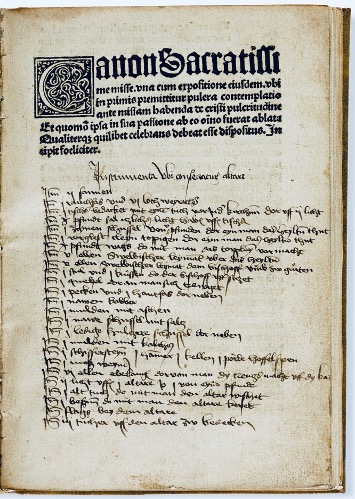
Chancery half-sheet Quarto: 18.5 x12.5 cm. Signatures: aa-dd6, 24 of 24 leaves. Editio princeps, text in gothic letter, including a set of large caps, large woodcut initial and display face on title page, long list in a contemporary hand beneath printed title; This copy is bound in antique parchment .
Balthasar de Porta’s Canon Missae, also contains the the proposal of the Exposition of the Eucharist before the celebration of mass . This commentary on the Mass, has verses taken from the Jesuida of Hieronymus de Vallibus, which are used in the appropriate context to illustrate or emphasize the author’s meaning. We know very few facts about the life of Balthasar de Porta , a Cistercian monk who served as Provisor at the order’s College (Saint Bernard) at Leipzig until about 1499. In the same years, he also published another work about Mass, the Expositio mysteriorum missae (Leipzig: Kacheloven, 1494) and a work on the heretical Bohemian Brethren, Conclusiones contra quorundam Bohemorum errores (Lepzig: Böttiger, about 1494), in which Balthasar refutes specific “errors” of the Hussite beliefs. Balthasar de Porta was Provisor of the Cistercian College of St. Bernhard in Leipzig (fl. 1487-1499).
Goff B39; H 2345*; GfT GfT: Gesellschaft für Typenkunde des XV. Jahrhunderts. Veröffentlichungen. 33 parts. Leipzig [etc], 1907-39. 521, 522; Pell 1753; BSB-Ink B-25; GW 3216; ISTC ib00039000. US copies: Huntington Library (2), Southern Methodist Univ, Yale University .
https://data.cerl.org/istc/ib00039000
5
Two Incunabula bound together. One Very Rare, printed at Vienne by Eberhard Frommolt.

Both rubricated at the same time and both signed by the Rubricator!

https://data.cerl.org/istc/_search?query=+ig00654800&from=0
https://data.cerl.org/istc/it00553000

f.1 VITAM BONAM ET EXITUM Beatum | Ego Frater Guilhermus sacre Theologie Profes | sor minimus parisius educat[um]. Sacroru[m] euangelio|rum ac epistolariu[m] de te[m]pore dieb[us] dominicus et sa[n] | ctis. Etiam super cômune Apostolo[rum] Martirum. confossorum. | virginum. Et pro defunctis Exposiciones in vnu[m] colligere v | olume mius expertis clericis.


f 180v: [Et ego reſuſci—||tabo eum in nouiſſimo die] quo ad coꝛpus vt ſimul gaudeat|| in coꝛpore et in anima.
Poſtilla ſuper epiſtolis et euangelijs dominicalibus feſt||uitatibus ac de ſanctis per anni ciꝛculum ſecūdum ſenſum||litteralem collecta feliciter Explicit.

[Vienne: Eberhard Frommolt. not before 1480] ( Date and assignment to printer by GW)
BOUND WITH
[Basel: Johann Amerbach, [ A copy at Frankfurt am Main has rubricator’s date 28 Sept. 1481]
Price $22,000
Chanclery Folio. 26.8 x 18 cm. signatures: [a–x⁸ y-z⁶]. 179 of 180 leaves 40 lines Lacking the initial blank. Three-to six-line capital spaces, with guide letters. Six-line opening text initial supplied in red, capital strokes. In this edition the comentaries are pinted within the text controled by brackets. Many initials supplied in red.

“More than one hundred editions of the Postilla super epistolas et evangelia by Guillermus Parisiensis were printed during the fifteenth century. Surely this esteemed compilation must be regarded as one of the earliest ‘best sellers’, for how else can one explain why the text was not only frequently reprinted but was reissued time and time again by the same printer. The introduction to the Postilla, his only published work, tells us that he was a Dominican and a professor of sacred theology at Paris. This compilation of the Postilla was written down in 1437 expressly for members of the clergy and for those desirous of understanding the excerpts from the Epistles and the Evangelists, more commonly called lessons, which are read at appropriate services throughout the church year. It obviously filled a most pressing need” (Goff, “The Postilla of Guillermus Parisiensis,” Gutenberg-Jahrbuch 1959, p. 73).
Thirteen titles are assigned to Frommolt. Of the present edition, only four copies are known with Only one in the US at Brown University which came from the Southwark Diocesan Archives, London.
GW 11926.; ISTC ig00654800. ;Pellechet 5641. ; Copinger 2861.
- World wide Holdings:
- France: Beaune BM, Besançon BM, Colmar BM
- United States Brown Univ. ONLY
- Number of holding institutions 4
- OF PRINTINGS BY FROMMOLT THERE ONLY 11 COPIES OF ANY OF HIS TITLES, REPRESENTING 6 TITLES AND ONLY 8 INSTITUTIONS.
https://data.cerl.org/istc/_search?query=+ig00654800u0026amp;from=0
BOUND WITH
Johannes de Turrecremata, (1388-1468) NICOLAUS DE BYARD(fl. c.1300).
Quaestiones Evangeliorum de tempore et de sanctis. & [Dictionarius pauperum:] Flos theologiae sive Summa de abstinentia. ; 2 parts in 1 volume.
Incipit materia aurea enucleata ex originalib[us] virtutu[m] et vitioru[m], Flos theologi[a]e nu[n]cupata, [secundu]m ordine[m] alphabeti pro sermonib[us] applicabilis tam de tempore q[uam] de sanctis totius anni.


[Basel: Johann Amerbach, [ A copy at Frankfurt am Main has rubricator’s date 28 Sept. 1481]
(Price for both Above)
Chanclery Folio. 26.8 x 18 cm. [350].f ; 110 28 310 48 58 A10/8-L10 M12 (Flos) π8, a10/8-v8 x6
ISTC it00553000; Goff T553 ; BMC III 747; GW M48236 ; HC 15714* ; Pell Ms 11270; Polain(B) 3869 ; IDL 4519 ; IBE 5680 ; IGI 9889 ; Sheppard 2414 ; Pr 7566 ; BSB T-568
Bound in later full calf over wooden boards.
https://data.cerl.org/istc/it00553000

- US Holdings
- Collection of the late Phyllis and John Gordan, New York NY (BMawrCL?)
- Columbia University,
- Cornell Univ.
- Free Library of Philadelphia,
- Library of Congress,
- Huntington Library
- Southern Methodist
- Stanford Univ. Library
- Univ. of Illinois Urbana-Champaign
- Washington Univ.
- Yale


6
Savonarola’s last two works !
440J. Savonarola, Girolamo, 1452-1498

Jncipit Exposicio v[e]l Meditacio fr[at]is Hieronimi sauonarole de Ferraria ordi[ni]s p[rae]dicatorus in psalmu[m] Jn te d[omi]ne speraui. qua[m] i[n] vltimis dieb[us] du[m] vite sue fine[m] prestolaretur edidit.

(Exposicio in psalmum XXXI In te domine speravi).
N.pl., n.d. (prob. the ed. Magdenburg, Moritz Brandis), after 1500, Price: SOLD
Quarto 20 x 15 cm. a4,b4. (8) lvs.

This copy is rubricated in red, Bound modern boards covered with an incunable leaf. The First leaf with the incipit has the outer edges remargined; a few tiny wormholes throughout (mostly in the blank margins).
Most likely third printed edition. (all editions are undated of this Savonarola’s last two works, first published 1498 Louvain?, 1499 Milan, 1500 Augsburg & or Magdeburg).

In 1497/8 The Dominican preacher Hieronymus Savonarola wrote these two text while in prison in Florence in 1498, charged with heresy, and having been found guilty was burned at the stake in that year. He was a Catholic and a critic of the luxurious lives of the rulers, the Medici family, of the Florentian people and the corruption in the Catholic Church. His sermons resulted in the downfall of the ruling Medici family. Pope Alexander VI excommunicated him.
“ Savonarola , after his first ” examination ” was for nearly amonth of quiet in the little prison , which, after all, was notless spacious or comfortable than his cell. This resting timenthe victim employed in a manner befitting his characterand life. He wrote two meditations , one on the Miserere(5 1st Psalm) and the other on the 31 st Psalm, in which hepoured out his whole heart in communion with God. Withthe right hand which had been spared to him in diabolicalmercy that he might be able to sign the false papers whichwere intended to cover him with ignominy, he still had itin his power to leave a record of that intercourse with hisheavenly Master in which his stricken soul found strengthand comfort. Between the miserable lies of the notary Ceccone,over which those Florentine nobles in the palace werewrangling ; and the stillness of the little prison hung highin air over their heads, where a great soul in noble trustyet sadness approached its Maker, what a difference!” [E. H. PEROWNE, D.D. 1900 ]

These works are meditations and conversations with God and Savonarola alone and stand out among four other great texts dealing with one similar situation and three other texts on the same psalms. Savonarola’s texts are unlike Boethius’ Consolation of philosophy, it is not an allegoric apocalyptic dialogue, rather it is a recorded scene of one man bonding to /God. Unlike Saint Augustine not commentary and explanations of these psalms, unlike Saint Aquinas who formalizes and instructs his reader how to understand these psalms, and also unlike Martin Luther who said of Psalm 51, “A knowledge of this psalm is necessary and useful in many ways. It contains instruction about the chief parts of our religion, about repentance, sin, grace, and justification, as well as about the worship we ought to render to God. These are divine and heavenly doctrines. Unless they are taught by the great Spirit, they cannot enter the heart of man.” Savonarola’s text are painfully personal and heart wrenching.
Psalms 51& 30 (Psalms 50 & 31 in Septuagint numbering)
51 “Miserere Mei Deus” Have mercy upon me, O God, according to thy loving kindness: according unto the multitude of thy tender mercies blot out my transgressions.
30 “In te, Domine, speravi non confounder in æternum” In Thee, O Lord, have I put my trust, let me never be put to confusion.

Under torture Savonarola confessed to having invented his prophecies and visions, then recanted, then confessed again. In his prison cell in the tower of the government palace he composed meditations on Psalms 51 and 31. On the morning of 23 May 1498, Savonarola and two other friars were led out into the main square where, before a tribunal of high clerics and government officials, they were condemned as heretics and schismatics, and sentenced to die forthwith. Stripped of their Dominican garments in ritual degradation, they mounted the scaffold in their thin white shirts. Each on a separate gallows, they were hanged, while fires were ignited below them to consume their bodies. To prevent devotees from searching for relics, their ashes were carted away and scattered in the Arno .
ISTC locates one U.S. copy. New Haven CT, Yale University, Beinecke. Worldwide number of holding institutions 20
Goff (suppl.); S-206a; BMC, II 601; GW M40482 ; Hain-Copinger; 14412; Reichling; 1384; Audin de Rians, E. Bib.,; 138; ISTC No.is00206500. https://data.cerl.org/istc/is00206500 United Kingdom British Library (IA.10973)
Cf. P. Scapecchi, Cat. Savonarola,; 87 (Catalogo delle edizioni di Girolamo Savonarola (secc. XV-XVI) possedute dalla Biblioteca nazionale centrale di Firenze)
John Patrick Donnelly S.J Girolamo Savonarola, Prison Meditations on Psalms 51 and 31 Tr., Ed. . (Milwaukee, Marquette University Press, 1994).
Martin Luther, Selected Psalms, in Luther’s Works, vols. 12-14 (St. Louis, MO: Concordia, 1974-1976), 12:305.
7
Henry Suso: Mystic to Women and Servent to Eternal Wisdom A rare and wonderful copy!


573J Henricus Suso. (1295-1366)
Horologium aeternae sapientiae.

573J Henricus Suso. (1295-1366)
Horologium aeternae sapientiae.
Cologne: Johann Landen, December 1500/1501. Price $15,000
Octavo, 13.4 x 10cm. Signatures A-Q8. In this copy there are lombard initials in red and blue, one with dog-head decoration, red capital strokes, paragraph marks, and underlining.
A Woodcut appears three times, on title, title verso, and verso of final leaf (margin of f. 2 slightly extended, occasional damp stains at gutter and edges, a few leaves in gathering O stained and one with short closed tear). Bound in modern vellum with manuscript antiphonal leaf reused as pastedowns.

No copies of this edition are recorded at auction by ABPC or RBH.
VD16 S 6103; ISTC is00876500; Goldschmidt p. 135. See Ford BPH 177 (first edition) and 178 (fourth edition). [APA citation. McMahon, A. (1910). Blessed Henry Suso. In The Catholic Encyclopedia. New York: Robert Appleton Company. Retrieved April 27, 2022 from New Advent: http://www.newadvent.org/cathen/07238c.htm%5D
https://data.cerl.org/istc/is00876500
Holdings: GermanyWuppertal StB & Russia Moscow, [Russian State Library] Rossijskaja Gosudarstvennaja Biblioteka (Berlin copy). Number of holding institutions 2.
Last Edit2016-07-13 12:00:00.00.

The German Mystics of the fourteenth century, Meister Eckhart, Johannes Tauler and Heinrich Suso, seemed to be constantly Willing the ability of Unwillingness. Perhaps Eckhart is the most profoundly speculatively blunt so much so that he was accused of heresy and brought up before the local Franciscan-led Inquisition, and tried as a heretic but died before a verdict. Tauler intern provides neo-platonic richness and logic to this position. Suso’s is to explore the territory through emotion. Suso’s first books , Büchlein der Wahrheit (Little Book of Truth) and Das Büchlein der ewigen Weisheit (The Little Book of Eternal Wisdom) were written in German and structured as instructions and explanations for Beginners as well as a defense and adaptation of Eckharts spiritual views.
Eckhart tells us : “Be willing to be a beginner every single morning”
Likewise Suso writes of himself in his Autobiography “The inward impulse, which he had received 8from God, urged him to turn away entirely from every thing which might be a hindrance to him. The tempter met this with the suggestion:—Bethink thee better. ” (First printed Cologne A.D. 1535.) Suso proceeds to expose the interior to the elements and deals with in good spirit. The Clock of Eternal Wisdom, ( which was most likely edited by Elsbeth Stagel) [https://en.wikipedia.org/wiki/Elsbeth_Stagel ] exhibits not only faith but trust in the unknown, Like Walter Hilton before him, and Thomas à Kempis after him, Suso dwells poetically and thoughtfully on the frustrations and disappointments as well as spiritualising ways of dealing with them by servitude to that which is beyond perception..
Suso Belongs in the Higherarchy of Great books
of internal spiritual quest along with
Boethius, Dante and à Kempis


VD16 S 6103; ISTC is00876500; Goldschmidt p. 135. See Ford BPH 177 (first edition) and 178 (fourth edition). [ McMahon, A. (1910). Blessed Henry Suso. In The Catholic Encyclopedia. New York: Robert Appleton Company. Retrieved April 27, 2022 from New Advent: http://www.newadvent.org/ cathen/07238c.htm%5D
https://data.cerl.org/istc/is00876500
Holdings: GermanyWuppertal StB & RussiaMoscow, [Russian State Library] Rossijskaja Gosudarstvennaja Biblioteka (Berlin copy). Number of holding institutions 2.
https://www.duo.uio.no/bitstream/handle/10852/49179/PhD-Flaeten.pdf?sequence=1
Horologium sapientiae is an intense work of religious fiction. It is written by a man of unique literary talent and religious fervor. The Horologium is the product of a religious culture that that was under pressure, a culture pervaded by eschatological anticipation and religious anxiety. However, the work is also an example of how this culture produced new and innovative forms of popular theol- ogy that provided relief to pious minds. This study will argue that Suso’s ap- proaches may be seen as a pioneering effort of late medieval ‘theology of piety.’ This concept, developed by German scholars, enables appreciative and accurate analysis of certain types of theological literature from the later medieval period that does not easily answer to categories such as ‘scholastic’ or ‘mystical’ or ‘monastic’ theology.
—————
1 I prefer the ‘hybrid’ and partly latinized form Heinrich Suso. Other much used forms are Heinrich Seuse, common in German scholarship, or the anglicized form Henry Suso.
2 See Künzle (1977), pp. 285-89.
3 See Künzle (1977), 285-6 with references; Breuer (1984); See also Werner J. Hoffman’s contribution in Blumrich / Kaiser (1994), pp. 202-54.
Most scholars think that the Horologium sapientiae was completed in 1333 or 1334.16 As mentioned, it is a considerably ‘expanded version’ of Suso’s Middle High German work, the “Little Book of Eternal Wisdom,” Buchlein der ewigen weisheit (Bdew).17 The Bdew was in its own right a popular and widely transmit- ted work, however not on the same scale as the Horologium. The two books have most parts in common: with the Horologium, Suso adopted (and expanded) most of the German version. They are based on the same fundamental idea and structur- ing principle: the spiritual beginner, the Servant (diener) in the Bdew or the Disci- ple (discipulus) in the Horologium, in dialogue with Eternal Wisdom, a female character that is presented as the “sum of everything that is good.” Suso draws on an ancient tradition of philosophical dialogues with Sapientia, the female ‘principle of wisdom’ as seen above all in the work of Boethius.18 For the protagonist, who is a figure of identification for the reader,19 the dialogue is a process of spir- itual edification and also a lover-beloved relationship in the fashion of bridal mysticism that was so popular since the time of Bernard of Clairvaux.
As a Dominican friar, he spent much of his professional life in the service of the cura monialium, the pastoral care for nuns. This meant some travelling to female Dominican convents in this area. Suso developed a close friendship with Elsbeth Stagel, a nun at the convent of Töss, for whom he was also confessor. Stagel is also known as one of the primary authors of the Töss Sister-Book, and was relatively well educated (for a woman in this period) and, like Suso, she appears to have been of a fervent religious personality; the relationship between Suso and Stagel was also a literary collaboration. Stagel was responsible for collecting the letters that would become Suso’s Briefbuchlein (Bfb), and she may also have contributed to parts of Suso’s Vita, where she also appears in person, as the “spiritual daughter” of the Servant (Suso). The pastoral care for nuns provided Suso with both the material and pur- pose for much of his literary production.
For a period during the 1340’s Suso was prior at the female convent of St. Katherinenthal / Diessenhofen. A main reason for this stay was that the Domini- cans of the Inselkloster in Constance were forced into exile from the city as a result of a papal interdict. This interdict was the culmination of a conflict between John XXII and the Emperor Lewis of Bavaria. It is widely agreed upon that it is this conflict that gave Suso the material for the dramatic vision of “the ram,” the tyrant leader who persecutes a small flock of devout friends of God, in chapter five of Book II of the Horologium.8
New Readings of Heinrich Suso’s Horologium sapientiae
Jon Øygarden Flæten. Dissertation submitted for the degree of philosophiae doctor (ph.d.) Faculty of Theology, University of Oslo, 2013.
—————
mined exactly. Exemplar 105; Vita 62.32-63.6; Exemplar 105. See also Bihlmeyer’s comments, (1907/61), pp. 72-3*; 62. For disregard of works as a tendency in late medieval hagiography, see Vauchez (2005), p. 533.
15 On Suso’s letters, see Bihlmeyer 117*-122*; Ruh (1996), pp. 469-71. The Bfb is “Pas- toralbriefe im Rahmen der cura monialium” (Ruh), a total of eleven letters that are reworked versions from ‘raw material’ in the Grosses Briefbuch, 27 letters collected by Elsbeth Stagel. The reworking of these letters and the editing of the Exemplar generally demonstrates Suso’s careful efforts of controlling the composition of his total oeuvre in a way that is quite unique in this period. See McGinn (2005), p. 199; see also Ruh (1996), pp. 421-2.
16 See Künzle (1977), pp. 19-27. See Summary of the arguments in Colledge (1994), pp. 10-15. McGinn (2005), p. 198, proposes a later time span for the writing of the book, 1334-37, for reasons that I cannot discern; Fenten (2007b) argues for 1333 as the year of completion.
17 For a comprehensive comparison of the Bdew and the Horologium in Künzle (1977), pp. 28-54. It was earlier believed by some that the Bdew was an abbreviated version that built on the Horologium. Künzle refuted this once and for all.
———-


Leave a Reply