

(•)
#1. History ,
A Restitution of Decayed Intelligence.

736J. Verstegan, Richard. (1550-1640)
Concerning the most noble, and renowned English Nation. By the study, and travell of R.V. Dedicated unto the Kings most excellent Majestie.
London: by Iohn Bill, Printer to the Kings most Excellent Maiestie, 1628
Price. $2,300

Quarto, 14 x 17 cm. Second edition (the first printed in England). –**4, A-Z4, Aa-Xx4 (Xx4, blank, lacking). There are Eleven engravings by Verstegan himself, (copies/re-cut for copies printed in England but very faithfully so) that appear in the text including the title vignette of the tower of Babel. The engravings illustrate various Saxon Gods who are the namesakes of our ‘days of the week’,( in the style of an emblem book) The arrival of the Saxons in Britain, and remains of ancient fish and fossils found inland. This edition also has woodcut initials, head and tailpieces.

This copy is bound in original sheep rebacked about 100 years ago.
Having one of my favorite titles of an early modern book, this book does not betray its promise. The contents list reveal the breath of subjects explored by Verstegan in order that unlike Joannes Goropius Becanus his opinion would not exceeded his proofs. The ten Chapters are expansive, consisting of observations historical, natural, linguistic, cultural and moral . Published first in Antwerp on the eve of ”The gun powder plot” and dedicated to James I , wonderful illustrated by Verstegan. The book defies categorisation touching upon many genres of books, Lexicon, Natural history (geology and paleontography) , Mythology (This includes the first English version of the story of the Pied Piper of Hamelin) and Historical national controversies, Catholic apologetics (and idolatrie of the old pagan Saxons.”).


Verstegan sets out by reminding us that
“We not only finde Englishmen (and those no Idiots neyther) that cannot directly tellfrom whench the Englishmen are descended, and chancing to speak of the Saxons, doerather seeme to understand them for a kind of forraine people . . . how ridiculous it mustseem unto the posterity of the Brittaines, for Englishmen to borrow honour from them,not needing to borrow it of any in the world.”

Graham Parry places this book in a historical context:
“The reputation of the Anglo-Saxons was further enhanced by an influential little book published in 1605, ‘A Restitution of Decayed Intelligence in Antiquities’ by Richard Verstegan. In the dedication to King James, Verstegan ignores the conventional flattering genealogy of the King from Brutus and Arthur, and plainly asserts that ‘your majestie is descended of the chiefest blood-royal of our ancient English-Saxon kings.’ (James would probably have flatly denied any such affiliations.) Verstegan offered a convncing theory of the Teutonic origin of the British people which he buttressed with sensible evidence from Tacitus and other Roman historians, supplemented with philological material astutely used. He also introduced evidence of cultural and religious similarities with the ancient Germanic tribes encountered by the Romans. Heacknowledged that his theory of Teutonic settlement lacked the glorious appeal of the far-fetched derivations from Troy or Greece or Scythia, but none the less he maintained there was a peculiar virtue in the Nordic line that was every bit as admirable as any Mediterranean inheritance. The repossession of Britain by the Saxons after the Roman occupation was a reinforcement of the oldTeutonic strength. Verstegan admired the hardiness and energy of what he called the English Saxons (whom we would term the Anglo-Saxons) in their military and political affairs, just as he admired the spiritual brightness shown by their eager reception of Christianity. Above all, the vigor of the race was characterized by the English language, which overcame the Latin of the Romans and resisted the French of the Normans. A terse, witty, and sinewy language, itexpressed the plain forthrightness of the English spirit.Although it showed the scars of its battles with Latin and French, it needed no meretricious ornaments from modern languages, andVerstegan was hostile to any new borrowings from Europe, or neologistic inventions, for ‘our tongue is most copious if we please to make our most use thereof.’” (Parry)


Jane P. Davidson explains Verstegan’s discussion of
“ the geology of Britain in his Restitution. He posited that Albion, as he calls England, was once part of the continent of Europe and connected to France as a peninsula. One of the reasons which he gave for this theory was the presence of what we would call fossils and what he recognized as the remains of animals which were not living in the areas in which they were found. I have retained Verstegan’s original spelling:
“A third reason is, that in digging about two fadome deepin the earth, though in some places more and in some lesse, innumerable shelles of sea life are found, and that commonly in all places of these plain and even grounds both in field and town and heerof to be thoroughly informed I have talked with such laboring men as usually digged welles and deep foundations of buildings and they all agree that they do commonly in all places find an innumerable quantitie of these shelles some whole and some broken and in many places the great bones of fishes whereof I have seen many and have had some even as they have bin digged out of the earth. For a more plain description of the manner and forme of these bones and shelles of fishes and to give the curious reader herin the more satisfaction I have thought good in the next ensuing page to set down some of them in picture.” (page103)
After this comment Verstegan placed his illustration ofvarious bones and shells, and a tongue stone, so that his readers might take his meaning, more plainly, as he put it. He went on to comment specifically about the tongue stone and to give further indication to his readers that he was something of an empirical scientist himself. His statement concerning tongue stones seems to indicate that Verstegan understood these to be fossils, if not fossil shark teeth:
“… potters woorking their clay, which is gotten in some espetial places, do fynd in it certain things which are as hard as stone and of the very forme and shape of the toungs of some sortes of fishes, each with the root unto it to make it the very markable and right proportion of such a kind of toung in all respects, some being more than two inches long and some lesse then one inche. And they that thus fynd them do not otherwise call them but the tongues of fishes, which beeing so, and turned into very hard stone, is a strange thing in nature, but the lesse strange because nature in her conversions of other sub-stances into stone is often seen to woork the lyk.”
ETYMOLOGIES and Lexicons:
Anthony a Wood, in Athenae Oxonienses (1691–92). emphasized Verstegen’s linguistic skills, calling him “a most admirable Critic in the Saxon and Gothic Languages.


Were-wulf.
This name remaineth stil known in the Teutonic

Were-wulf. This name remaineth stil known in the Teutonic, & is as much to say as man-wolf; the greeks expressing the very lyke, in Lycanthropos.
Ortelius not knowing what were signified, because in the Netherlandes it is now clean out of use, except just composed with wolf, doth mis-interprete it according to his fancie.
The Were-Wolves are certain sorcerers, who having annoynted their bodyes, with an oyntment which the make by the instinct of the devil; and putting on a certain inchanted girdel, do not only unto the view of others seemed as Wolves, but to their own thinking have both the shape and nature of wolves, so long as they were the said girdel. And they do dispose theselves as very wolves, in wurrying and killing, and most of humaine creatures.
Of such sundry have bin taken and executed in sundry partes of Germanie,and the Netherlands. One Peeter Stump for being a Were-wolf/ and having killed thirteen children, two women, and one man; was at Bedbur not far from Cullen in the yeare 1589, put unto a very terrible death. The flesh of divers partes of his body was pulled out with hot iron tongs, his armes thighes and legges broke on a wheel, & his body lastly burnt. He dyed with very great remorce, defyring that his body might not be spared from any torment, so his soule might be saved.
The Were-wolf (so called in Germanie) is in France, called Loupgarou.
Jane P. Davidson, A History of Paleontology Illustration. Bloomington: Indiana University Press 2008
Jane P. Davidson, “Historical Point of View: Fish Tales: Attributing the First Illustration of a Fossil Shark’s Tooth to Richard Verstegan (1605) and Nicolas Steno (1667)” in Proceedings of the Academy of Natural Sciences of Philadelphia vol. 150 (2000). https://www.jstor.org/stable/4065077?read-now=1&seq=14#page_scan_tab_contents
Graham Parry. The Trophies of Time: English Antiquarians of the Seventeenth Century. Oxford: Oxford University Press, 1995.
Rolf H. Bremmer, Jr. The anglo-saxon Pantheon according to Richard Verstegen 1605, Published in The recovery of Old-English. Kalamazoo Medieval Institute Publications 2000.

#2. Travel
631J
Sandys, George, 1578-1644.,
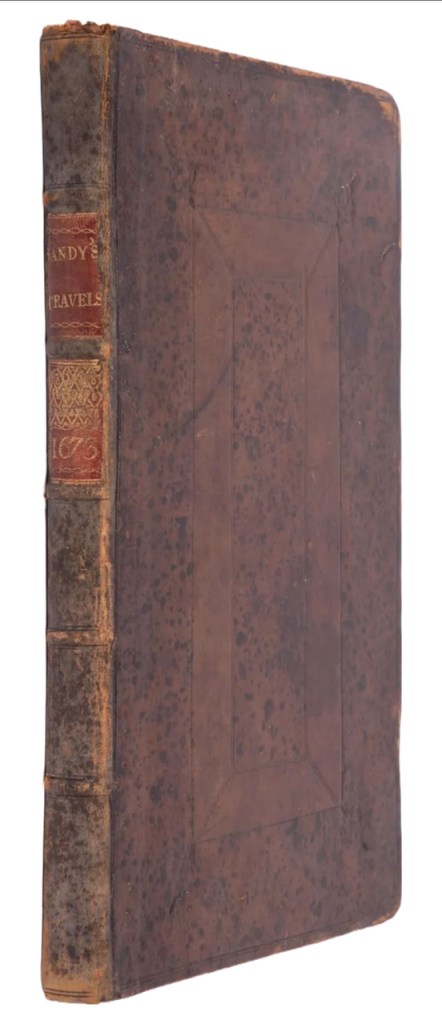
Sandys travels : containing an history of the original and present state of the Turkish Empire, their laws, government, policy, military force, courts of justice, and commerce, the Mahometan religion and ceremonies, a description of Constantinople, the Grand Signior’s seraglio, and his manner of living : also, of Greece, with the religion and customs of the Grecians : of Ægypt, the antiquity, hieroglyphicks, rites, customs, and discipline, and religion of the Ægyptians : a voyage on the River Nylvs : of Armenia, Grand Cairo, Rhodes, the Pyramides, Colossus, the former flourishing and present state of Alexandria : a description of the Holy-Land, of the Jews, and several sects of Christians living there : of Jerusalem, sepulchre of Christ, Temple of Solomon, and what else either of antiquity, or worth observation : lastly, Italy described, and the islands adjoining, as Cyprus, Crete, Malta, Sicilia, the Æolian Islands, of Rome, Venice, Naples, Syracusa, Mesena, Aetna, Scylla, and Charybdis, and other places of note : illustrated with fifty graven maps and figures.
London : printed for John Williams junior, at the Crown in Little-Britain, 1673. $2,900

Folio , 32 1/2 x 20 cm. . Seventh edition. Signatures: A3 B-X6 There is an extra engraved title page as frontis, double-page map of eastern Mediterranean to Caspian Sea, Arabia, Black Sea, fold-out panorama of part of Constantinople, and a total of 50 engravings including costumes, plans, views. This copy is bound in a beautifully perserved 17th century panel calf binding. With an old and expert rebacking.
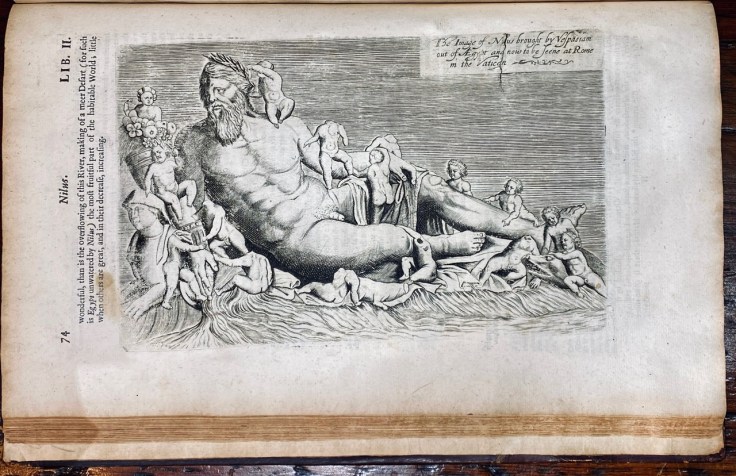
“In 1615 Sandys published an account of his travels, with the title ‘The Relation of a Journey begun an. Dom. 1610, in Four Books.’ The volume was dedicated to Prince Charles, under whose auspices all Sandys’s literary work saw the light. Sandys was an observant traveller. Izaak Walton noticed in his ‘Compleat Angler’ (pt. i. ch. i.) Sandys’s account of the pigeon-carrier service between Aleppo and Babylon. His visit to the holy sepulchre at Jerusalem inspired an outburst of fervent verse—‘A hymn to my Redeemer’—whence Milton derived hints for his ‘Ode on the Passion’ (stanza vii). The volume was adorned with maps and illustrations, and at once became popular. Editions, with engraved title-pages by Delaram, are dated 1621, 1627, 1637, 1652, and 1673.
An extract, ‘The Relation of Africa,’ i.e. Egypt, appeared in Purchas’s ‘Pilgrimes,’ 1625, pt. ii. Sandys’s accounts of both Africa and the Holy Land figure in John Harris’s ‘Navigantium et Itinerantium Bibliotheca,’ 1705 (vols. i. and ii.).(DNB).

He also took great interest in the earliest English colonization in America and in 1621 sailed to Virginia with his niece’s husband, Sir Francis Wyat, who had been appointed the new governor. Sandys took the position as colonial treasurer of the Virginia Company and when Virginia became a crown colony, he served as a member of the council. Illustrations include plans, views and architecture of Jerusalem and Bethlehem, Pompei’s pillar, the Sphinx and the Great Pyramid, the Virgin’s Sepulchre and the mysterious

Bastions of Christendom, and the Holy Land, are represented in great detail; regions where Islam is prevalent are sketched in with minimal detail. This is likewise the case for the perceived backwaters of Christendom. The North and East of Europe, spreading into Asia, remains comparatively sparse. Some of the perceived idiosyncrasies are simply matters of convention for the day. The moniker “Part of ____” might appear at first to be an insult to the Africans and the Arabians. This, however, is a common usage in contemporary maps of this era, demonstrating a lack of detail on un necessary locals.
ESTC R18550. WING S680.


(••)
#3)
895D. Fuler, Thomas (1608-1661)
The Church History of Britain; From the Birth of Jesus Christ, Untill the Year M. DC. XLVIII. Endevoured by Thomas Fuller.
London: for John Williams, 1655. $2,200
Folio 32 x 21.7 cm. Signatures: a4, A-Y4, Aa-Nn4, Oo2, P-Qq4, Rr2, Rr-Zz4, [Aa]-[Ii]4, Ccc4, [Ddd]-[Zzz]4, [aaa]-[ggg]4, [hhh]2: ¶¶4, Aaa6, Bbb-Zz4, [Aaa]-[Ggg]4, Aaaa-Zzzz4,[ Aaaa]-[Gggg]4, [Hhhh]2 , aaaaa4, Aaaaa-Xxxxx4, Yyyyy2, 6A-6C4, ¶-¶¶4, ¶¶¶2. First Edition Illustrated with three full-paged engraved plates:”The Seales of the Armes of all the Mitred Abbeys of England” The other two are separate views of Litchfield Cathedral; and a folding map of Cambridge. This copy is lacking the double-paged engraved plate: the arms of “the Knights Joined with the Monkes of Ely by William the Conqueror”; This copy is bound in full light modern calf by the Studio 4 bindery 1986.
“It is regrettable that so fine a writer as Fuller should so often be dismissed as merely ‘quaint.’ Coleridge— who, with Lamb, revived his reputation —ranked him with Shakespeare, Milton, Defoe, and Hogarth as one of the ‘uniques’ among the ‘mighty host of our great men,’ and although that ranking may be open to objection, it does suggest the stature of Pepys’ ‘great Tom Fuller.’ […] Fuller’s chief concern was the completion of two major works that had been long deferred — the promised Church History (1655) and The Worthies (1662) […] Into these two massive undertakings he poured enough antiquarian zeal, piety, patriotism, erudition, and witty common sense to supply a dozen lesser men. As his first, anonymous biographer observed in 1661, Fuller’s later life was ‘a kind of errantry,’ with the object of his quest the history of his native land. Wherever he went, jogging through the English countryside, ‘he spent frequently most of his time in views and researches of their antiquities and church monuments, insinuating himself into the acquaintance (which frequently ended in a lasting friendship) of the learnedst and gravest persons residing in the place, thereby to inform himself fully of those things thought worthy the commendation of his labors.’ He himself records that he wrote the first three books of the Church History (from the birth of Christ to the later fourteenth century) before 1649 and the other nine (which end with Charles’ execution) after ‘monarchy was turned into a state.’ Despite ‘much difficulty’ in completing this gigantic labor, the twelve books, each provided with a lavish dedication, appeared in 1655.” (Baker)
Wing F-2416. Gibson, Thomas More #304.
#4)
Witchcraft/Exorcism
Elizabethan Exorcisms

752J Darrell, John 1562- 1602
A detection of that sinnful, shamful, lying, and ridiculous discours, of Samuel Harshnet. entituled: A discouerie of the fravvdulent practises of Iohn Darrell wherein is manifestly and apparantly shewed in the eyes of the world. not only the vnlikelihoode, but the flate impossibilitie of the pretended counterfayting of William Somers, Thomas Darling, Kath. Wright, and Mary Couper, togeather with the other 7. in Lancashire, and the supposed teaching of them by the saide Iohn Darrell.
[England?]: Imprinted [by the English secret press?], 1600. $6,000
[Imprint conjectured by STC.]
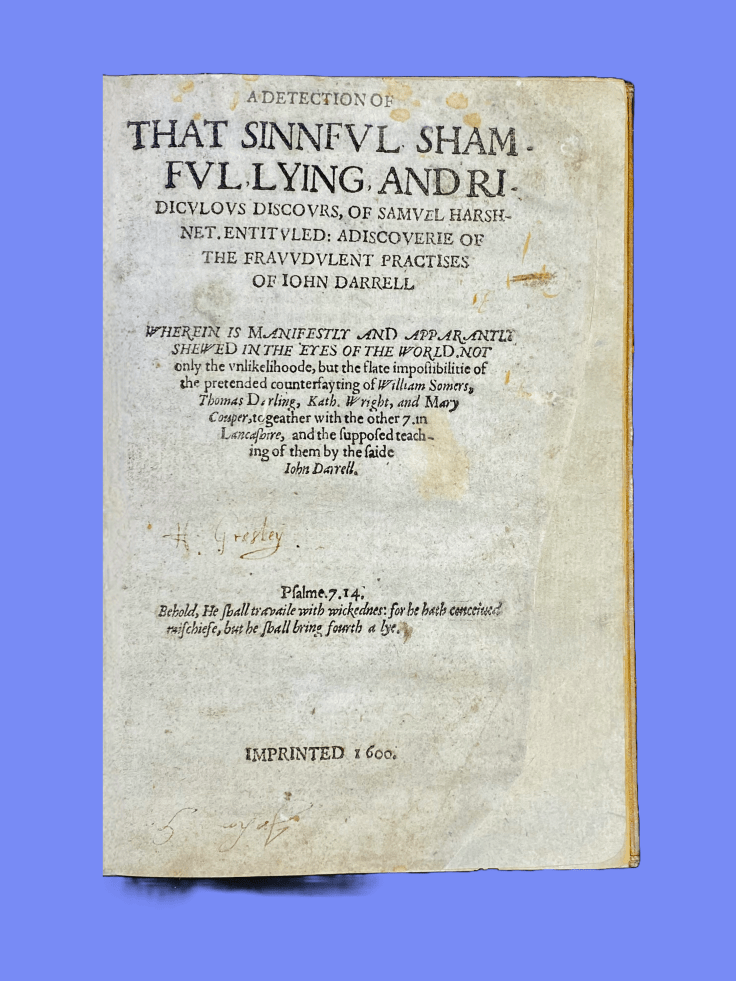
Octavo 18 x 12.5 cm. Signatures: π1, A2 B2,A3,B4, C-Y2, Aa-Zz2, Aaa-Ggg2. (lacking 4 un-numbered pages table of contents). Title and first leaves extended; otherwise, a very good copy. Text is predominantly clean. First edition. Binding: Full recent calf with blind tooled rulings. Spine in six compartments of raised bands with gilt title.
Darrell (1562-1602) was an Anglican clergyman noted for his Puritan views and his practice as an exorcist, which led to imprisonment. As one of England’s most famous exorcists. In 1586 he was called to help by Isabel Foljambe and he exorcised a girl in Derbyshire, and published an account of his work. In 1596–1597 he conducted further exorcisms, mainly at St Mary’s Church, Nottingham, where he was appointed curate by Robert Aldridge, but also in Lancashire, where with others he exorcised demons from seven members of the household of Nicholas Starkey in Tyldesley on 17 and 18 March 1597 and in Staffordshire. Many were skeptical about these cases, especially when Darrell claimed he knew of 13 witches in the town. “After some controversy regarding the exorcism of William Somers, Darrell was summoned to London and imprisoned for over a year. ‘After being imprisoned for more than a year, Darrell and More were found guilty of fraud by the commissioners for ecclesiastical causes, in late May 1599. The two ministers were deprived of their livings and returned to prison to await sentencing. An acrimonious controversy ensued which lasted for four years and provoked more than a dozen books. Darrell’s opponents, led by Richard Bancroft, the bishop of London, and his chaplain Samuel Harsnett, were well placed to sponsor sermons and printed attacks on Darrell and to suppress works defending him. But Darrell clearly enjoyed well-organized support since works championing him poured from foreign and clandestine presses. Although Darrell was quietly released in the summer of 1599, he went underground and by the end of 1602 had published five works on his own behalf. His career as an exorcist, however, was finished’ (DNB).

His career was highly controversial at the time; one of his first exorcism clients admitted fakery was involved, and his continued practice drew criticism from prominent members of society. This work is part of a pamphlet war that raged between Darrell and one of his chief accusers, Samuel Harshnett, who would become the Archbishop of York. In 1599 Darrell was questioned at Lambeth Palace, pronounced an imposter, defrocked, and given a year in jail. The remainder of his life was passed in obscurity, with copies of his book being burned, making this a very rare volume., Because of the intense public interest and the fierce arguments in Nottingham, John Whitgift, Archbishop of Canterbury, ordered an investigation. As a result, Darrell was accused of fraudulent exorcism. The prosecutor was Samuel Harsnett, who was to end his career as Archbishop of York. Harsnett’s views about Darrell were published in A Declaration of Egregious Popish Impostures in 1603.
Shakespeare read it, and King Lear contains the names of devils, like Flibbertigibbet and Smulkin, taken from Darrell’s book. Darrell himself maintained that there was no fraud in his activities. What he wanted to prove was that Puritans were as capable as Roman Catholics in the matter of dispossessing evil spirits.

Darrell was deprived of holy orders and sent to prison but released in 1599.
Provenance: Ex Libris Isabel Somerset Reigate Priory Lady Henry Somerset (nee Lady Isabella Caroline Somers-Cocks; 1851-1921) was a British philanthropist, temperance leader and campaigner for women’s rights.
STC (2nd ed.), 6283; ESTC (RLIN); S109292
cf: Marion Gibson, Possession, Puritanism and Print: Darrell, Harsnett, Shakespeare and the Elizabethan Exorcism Controversy, London: Pickering and Chatto, 2006, ISBN 9781851965397
Brendan C. Walsh, The English Exorcist: John Darrell and the Shaping of Early Modern English Protestant Demonology, New York; NY: Routledge, 2021

Copies – N.America Folger, Harvard, Huntington Newberry, Trinity , Yale.
(•••)
#5). A philosophical treatise writ in America
637J. Franck, Richard. (1624-1680?)
A philosophical treatise of the original and production of things writ in America in a time of solitudes by R. Franck.
London : Printed by John Gain, and are to be sold by S. Tidmarsh at the King’s Head in Cornhill: and S. Smith at the Prince’s Arms in St. Paul’s Church-Yard, 1687. (But arguments have been made—most lucidly by Worthington Ford that it might be Boston. or Cambridge) Price $3,700

Octavo,16 ½ x 10 ½ cm. Signatures: A-M8 N2. Only edition. This copy is bound in modern quarter calf
by none other than Benjamin Harris, who, having been recently liberated from gaol, may have “borrowed” John Gain’s identity as a safe, obscure, respectable unbrella under which to resume publishing. Ford, writing in The Boston Book Market 1679-1700, examines the history of the publication of The New England Primer, and not incidentally considers Franck’s book:
“Who was this “Master John Gaine” who thus holds the first claim to the title New England Primer? He must have been a member of the Stationers’ Company, for he is styled “master,” and presumably was a bookseller but without a known place of business. His name does not appear in the Term Catalogues, and it occurs in the Stationers’ Registers so infrequently as to suggest an unenterprising publisher. […] In 1687 he issued R. Franck’s Phylosophical Treatise of the originall and Produccon of things. Writ in America in a Time of Solitude. On the titlepage of that work [Gain] is a printer. With this second venture pertaining to America [Gain] disappears. […] In 1683 Benjamin Harris had been out of prison a year or more, and his situation would lead him to print over his own name as an advertisement of his reentry into the field. […] Later, when safe in New England, it may be imagined that Harris may have seen the possibilities attached to such a title, and deliberately made Gaine’s still-born proposition his own—an early instance of a pirate publisher on American soil.”
Franck, was a captain in Cromwell’s army during the Battle of Dunbar and other Scots campaigns, lived for a few years in America in the 1680s, during which time he composed his Philosophical Treatise, a strange, euphuistic meditation on God, Mosaic Creation, and the wonders of nature—especially fish and fishing. Franck’s book is now regarded as the first work of philosophy written in North America, though it is a confusing, unfocused text complicated by grossly ornamental language—”the vaporings of a disordered mind,” Charles E. Goodspeed said in his 1943 monograph on Franck. Goodspeed regards Franck as an enigma, and though he researched him deeply, Goodspeed was unable to pinpoint the exact years Franck was in the Colonies, or even where he lived. The most compelling passage relating to America occurs on p. 75, where the Franck asserts:
“The Americans can tell you that Trees grew naturally where the Native Indians never had a being; and were it not for Europes agriculture, and industry; her florid Fields, and flourishing Pasture, would soon feel the fatal stroke of disorder; so become Forrests, and barren Desarts, fit only for bestial and savage inhabitants.”
On p. 34 Franck implies that he actually battled with Native Americans.
And on page 112, Franck, an avocational angler (who is better known for his piscatory Northern Memoirs, published at London in 1694), refers to a fish called the American snite, a term on which the OED is silent.
The imprint of A Philosophical Treatise is London: John Gain, 1687, but arguments have been made—most lucidly by Worthington Ford—that the book might have been printed in Boston, by none other than Benjamin Harris, who, having been recently liberated from gaol, may have “borrowed” John Gain’s identity as a safe, obscure, respectable unbrella under which to resume publishing.
During the late 1680s colonial printers often closely mirrored London imprints, and visual evidence suggests that A Philosophical Treatise could indeed be a Boston printing, especially the layout of the title page. But more rigorous typographic examination must be performed to support this assertion. Richard Franck, for his part, probably returned to England in the early 1690s, but at some point may have journeyed back to America. Cotton Mather, in his diaries, remarks:
“There is an old Man in the Town, who was a Souldier in the Army of my admirable Cromwel, and actually present in the Battel of Dunbar; he is now come to eighty-eight; an honest Man, and in great Penury. I must releeve him, and look after him.”
Wing F2065; ESTC R20723; Sabin 25467; Alden-Landis 687/65; Barrett, Wendell, ed., Cotton Mather, the Puritan Priest, New York: Dodd; Mead, 1891, p. 244; Ford, Worthington Chauncey, The Boston Book Market, 1679-1700, Boston: Club of Odd Volumes, 1917, pp. 29-33;
Goodspeed, Charles E., “Richard Franck,” Bookmen’s Holiday: Notes and Studies Written and Gathered in Tribute to Harry Miller Lydenberg, New York: NYPL, pp. 151-187.


Leave a Reply